






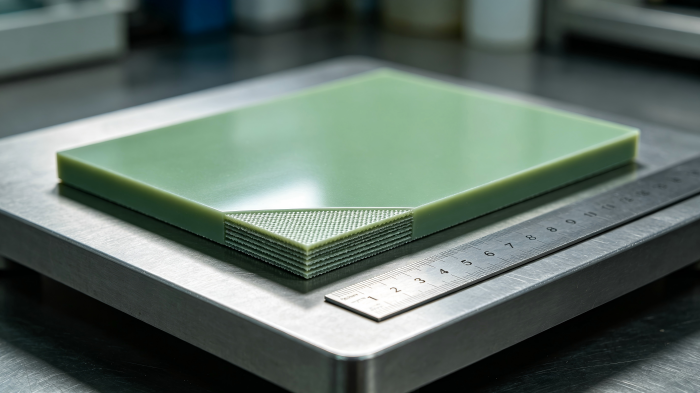
O G10 é um compósito laminado termoendurecível de alto desempenho que utiliza tecido de fibra de vidro como reforço e resina epóxi como matriz de ligação. Oferece uma relação resistência/peso excecional, um isolamento elétrico notável, baixa absorção de humidade e resistência química estável, pelo que constitui um material de engenharia fundamental para os setores do isolamento industrial, ferramentas de precisão, aeroespacial e marítimo. Para ajudar os engenheiros e fabricantes a tirar o máximo partido deste material, a equipa técnica da PartsMastery elaborou este guia sistemático, que abrange tudo, desde as especificações padrão e o desempenho essencial até aos processos de maquinagem, à seleção de engenharia e à manutenção a longo prazo.
1. Definição e especificações normativas
Várias normas internacionais regulam rigorosamente a consistência do desempenho e a fiabilidade da qualidade do G10, constituindo a base de referência para a seleção de materiais em aplicações de elevada fiabilidade.
1.1 Referência NEMA G-10 e FR-4
A Associação Nacional de Fabricantes Elétricos dos EUA (NEMA) define os padrões de referência para esta categoria de materiais. A classe G-10 descreve laminados de fibra de vidro com resina epóxi não retardadores de chamas, enquanto a classe FR-4 se refere à sua versão retardadora de chamas. As principais propriedades obrigatórias ao abrigo desta norma incluem uma rigidez dielétrica de 19–50 kV/mm, uma resistência à tração mínima de 310 MPa e uma resistência mínima à flexão e à compressão de 450 MPa cada.
1.2 Especificação Militar MIL-I-24768/2
Passando dos requisitos comerciais para os de nível militar, a especificação militar MIL-I-24768/2 destina-se a aplicações nos setores da defesa e aeroespacial. Esta norma norte-americana (Tipo GEE) impõe regras rigorosas em matéria de rastreabilidade de lotes, ensaios de qualificação e consistência de desempenho. Exige uma absorção de água ≤ 0,1%, um intervalo de temperatura de funcionamento contínuo entre −60 °C e +140 °C e limites de inflamabilidade claramente definidos.
1.3 Norma Internacional IEC 60893
Para garantir a compatibilidade com o mercado global, a Comissão Eletrotécnica Internacional publica a norma IEC 60893, que abrange laminados industriais à base de resinas termoendurecíveis, incluindo as classes G10 e FR-4. Os seus principais indicadores de controlo incluem a permissividade relativa ≤ 5,4, o fator de dissipação ≤ 0,035 e o índice térmico ≥ 130 °C, o que garante a adequação universal para aplicações de isolamento elétrico em todo o mundo.
2. Parâmetros-chave de desempenho
Para além das normas formais, os engenheiros avaliam o G10 principalmente com base nos seus principais indicadores de desempenho. Este material apresenta um desempenho equilibrado nas dimensões elétrica, mecânica, térmica e química, o que o torna adaptável a diversos cenários de engenharia.
| Categoria do imóvel | Intervalo de valores típico | Importância da Engenharia |
|---|---|---|
| Elétrica | Resistência dielétrica: 19–50 kV/mm Resistividade volumétrica: 10¹²–10¹⁴ Ω·cm |
Isolamento fiável em condições de alta tensão; degradação mínima do desempenho em ambientes húmidos |
| Mecânica | Resistência à tração: 250–350 MPa Resistência à flexão: 300–500 MPa Resistência à compressão: 400–500 MPa Densidade: 1,8–1,95 g/cm³ |
Elevada resistência específica comparável à das ligas de metais leves; adequado para estruturas portantes e ferramentas de precisão |
| Térmico | Temperatura de transição vítrea (Tg): 130–180 °C Temperatura de funcionamento contínuo: 120–140 °C Condutividade térmica: ~0,3 W/m·K |
Desempenho estável a temperaturas moderadas; não recomendado para situações que exijam elevada dissipação de calor |
| Química / Ambiente | Absorção de água: 0,05–0,31 TP3T Resistente a óleos, ácidos fracos e solventes comuns |
Excelente estabilidade dimensional em ambientes húmidos e ligeiramente corrosivos |
| Inflamabilidade | Norma G10: UL94 HB Classe FR-4: UL94 V-0 |
O G10 padrão não é ignífugo; o FR-4 é necessário para aplicações em que a segurança contra incêndios é fundamental |
3. Formulários de fornecimento e especificações de apresentação
Para além das características de desempenho, os formatos de fornecimento disponíveis e as opções de aparência determinam diretamente a forma como o G10 se integra em fluxos de trabalho de produção específicos. Está disponível em perfis industriais normalizados com opções de aparência personalizáveis, abrangendo tanto aplicações industriais como de consumo.
3.1 Principais formatos de fornecimento
Mais concretamente, os fabricantes fornecem o G10 em três formatos principais:
- Lençóis: A forma mais comum, com espessuras que variam entre 0,2 mm e 50 mm; também estão disponíveis chapas ultra-grossas personalizadas com mais de 100 mm. As dimensões padrão incluem 1020×1220 mm e 1220×2440 mm.
- Varas: Diâmetro de 6 mm a 200 mm, comprimentos padrão de 1000 mm e 2000 mm. São frequentemente utilizados como pinos isolantes, pinos de posicionamento e buchas resistentes ao desgaste.
- Tubos: Diâmetro interior de 10–500 mm, espessura da parede de 1–20 mm, comprimento de 1–2 m. São ideais para mangas de isolamento de motores e revestimentos resistentes à corrosão.
3.2 Controlo da aparência e das tolerâncias
Em termos de características visuais e dimensionais, o G10 padrão apresenta uma cor verde-jade natural, enquanto as variantes em preto, cáqui e cinzento são amplamente utilizadas em contextos industriais. É possível produzir folhas laminadas decorativas com padrões riscados ou ondulados através da sobreposição de tecidos de fibra de vidro coloridos, com mais de 20 opções de cores personalizadas, incluindo variantes que brilham no escuro.
No que diz respeito à precisão dimensional, as chapas finas apresentam normalmente uma tolerância de espessura de ±0,10 mm, enquanto as chapas grossas apresentam uma tolerância de ±0,30 mm. A planicidade mantém-se em ≤ 0,5 mm/m, e os fornecedores oferecem acabamentos de superfície foscos, mate e brilhantes.
4. Processos de maquinagem e técnicas de otimização
Apesar das suas inúmeras vantagens em termos de desempenho, o G10 apresenta desafios únicos de maquinagem, uma vez que o seu reforço de fibra de vidro de elevada dureza provoca um forte desgaste abrasivo durante o corte. Por este motivo, a seleção adequada das ferramentas e o ajuste dos parâmetros são fundamentais para garantir a precisão dimensional e prolongar a vida útil das ferramentas.
4.1 Métodos de maquinagem convencionais
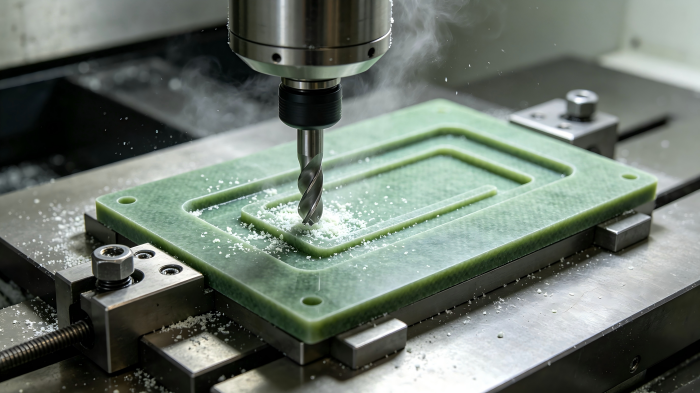
Fresagem CNC
Os fabricantes utilizam amplamente a fresagem CNC para a realização de ranhuras, cavidades e fresagem de contornos em chapas de G10. Recomendamos fresas de ponta revestidas a carboneto ou diamante, com uma velocidade de corte de 50–150 m/min, profundidade de 0,2–0,5 mm por passagem e velocidade de avanço de 0,05–0,20 mm/rev. As equipas devem utilizar arrefecimento por névoa ou arrefecimento por injeção para reduzir o desgaste da ferramenta e controlar a emissão de pó de fibra de vidro.
Torneamento CNC
O torneamento CNC aplica-se a peças rotativas fabricadas a partir de barras e tubos G10. As operações exigem velocidades elevadas do fuso, entre 2000 e 4000 rpm, e cortes superficiais para minimizar a lasca nas arestas. Os fabricantes preferem pastilhas de metal duro com revestimento de diamante, que proporcionam uma vida útil 5 a 10 vezes superior à das ferramentas de aço rápido, com uma velocidade de avanço de 0,03 a 0,08 mm/rev.
Perfuração CNC
O principal desafio na perfuração de G10 consiste em evitar o arrancamento das fibras e a delaminação na saída do furo. Os operadores devem utilizar brocas helicoidais de metal duro com ponta dividida a 135°, a uma velocidade de corte de 30–60 m/min. A perfuração por toques, com uma profundidade por toque ≤ 2× o diâmetro, reduz a acumulação de calor e melhora a qualidade do furo. No caso de furos roscados, as inserções roscadas metálicas apresentam um desempenho muito superior ao da rosca direta.
Corte com serra
As equipas de produção utilizam o corte com serra para o corte inicial das chapas e para cortes retos. As operações requerem lâminas de serra circulares de metal duro de dentes finos, com 8 a 12 dentes por polegada, e uma velocidade de corte de 600 a 1000 m/min. Os operadores devem controlar a velocidade de avanço para evitar a queima da resina e o lascamento das arestas, sendo obrigatório um sistema de extração de poeira para garantir a segurança no local de trabalho.
Corte por jato de água
O corte por jato de água é a solução ideal para chapas grossas com mais de 10 mm e contornos complexos. O sistema funciona a uma pressão ultra-alta de 3000–4000 bar, permitindo alcançar uma precisão dimensional de ±0,10 mm sem zona afetada pelo calor. Em comparação com o corte a laser, elimina a queima das arestas e reduz a delaminação, pelo que é frequentemente utilizado em projetos aeroespaciais e de isolamento de alta tensão.
4.2 Dicas para a otimização da qualidade da maquinagem
Para além dos métodos de maquinagem específicos, existem algumas estratégias de otimização universais que irão melhorar de forma consistente a qualidade das peças e reduzir os custos de produção:
- Seleção de ferramentas: Utilize ferramentas de metal duro para a produção em pequenas quantidades; opte por ferramentas com revestimento de diamante para a maquinagem de precisão em grandes quantidades, uma vez que estas prolongam a vida útil da ferramenta em 5 a 10 vezes.
- Estratégia de corte: Opte por vários cortes superficiais em vez de um único corte profundo, para reduzir a acumulação de calor e evitar a degradação da resina. A velocidade recomendada do fuso varia entre 6000 e 12 000 rpm, com uma velocidade de avanço de 0,02 a 0,08 mm/rev.
- Acabamento das arestas: Todas as arestas usinadas devem ser chanfradas e desbastadas para evitar descargas corona em aplicações elétricas e a concentração de tensões em peças estruturais.
- Reforço do fio: As inserções roscadas em aço inoxidável, latão ou alumínio aumentam a vida útil da rosca em 3 a 5 vezes e melhoram a fiabilidade em montagens repetidas.
5. Tecnologia de colagem e acabamento de superfícies
Após a conclusão da maquinação, os fabricantes têm frequentemente de unir componentes em G10 a outras peças. Sendo um compósito termoendurecível de baixa energia superficial, o G10 não forma ligações fortes com adesivos convencionais sem um pré-tratamento adequado; por isso, são essenciais adesivos específicos e uma preparação adequada da superfície para garantir uma ligação estrutural fiável.
5.1 Escolha do adesivo
- Adesivos epóxi: São mais adequados para juntas estruturais, com resistência ao cisalhamento por sobreposição que se situa normalmente entre 18 e 25 MPa. Constituem a escolha preferida para componentes industriais que suportam cargas.
- Adesivos acrílicos: Curam mais rapidamente e oferecem boa resistência ao impacto, com uma resistência ao cisalhamento mais baixa, de 12–18 MPa. São ideais para montagens rápidas não estruturais.
- Adesivos de cianoacrilato: Destinam-se apenas a reparações temporárias e ligações para trabalhos leves. Não as recomendamos para estruturas portantes, devido à sua fraca durabilidade a longo prazo.
5.2 Pré-tratamento da superfície para colagem
Um tratamento adequado da superfície pode aumentar a resistência de aderência em 30–50%. Mais especificamente, os métodos recomendados incluem a rugosidade mecânica através de lixagem ou jateamento com alumina de malha 80–120 para aumentar a área de contacto, o tratamento por plasma ou chama para aumentar a energia superficial e melhorar a molhabilidade da resina, e a limpeza final com álcool isopropílico ou acetona para remover contaminantes como óleo e poeira antes da colagem.
5.3 Processos de acabamento de superfícies
- Polimento: Cria uma superfície lisa e brilhante com Ra < 0,8 μm, adequada para componentes decorativos e ergonómicos.
- Escovagem / jato de areia: Proporciona um acabamento mate texturado com melhor aderência, pelo que os fabricantes costumam utilizá-lo em cabos de facas e pegas de ferramentas.
- Laminação decorativa: As camadas multicoloridas de fibra de vidro produzem padrões listrados únicos após a usinagem, combinando desempenho funcional com valor estético.
6. Processo de fabrico de laminação
Todas as propriedades inerentes ao G10 têm origem no seu processo de fabrico por laminação controlada. O fluxo de trabalho de produção segue cinco etapas principais que determinam diretamente o desempenho final do material:
- Impregnação com resina epóxi: Os fabricantes impregnam tecido de fibra de vidro de qualidade elétrica com resina epóxi difuncional ou trifuncional, com um teor final de fibra de vidro de 55–65 wt%, de modo a equilibrar a resistência e o isolamento.
- Preparação do pré-impregnado: O tecido impregnado é submetido a uma secagem parcial para formar um estado de pré-impregnado semi-curado, com o teor de resina controlado entre 35 e 45%.
- Empilhamento por camadas: Os técnicos empilham as camadas de pré-impregnado em orientações unidirecionais, cruzadas (0°/90°) ou multieixos, de acordo com os requisitos de desempenho.
- Cura por prensagem a quente: O processo de consolidação é realizado a uma pressão ≥ 6,9 MPa (1000 psi) e a uma temperatura de 160–180 °C, para reticular a matriz epóxi.
- Pós-cura: Os trabalhadores reaquecem o laminado a 150–170 °C durante várias horas para aumentar a densidade de reticulação, a temperatura de deflexão térmica e a rigidez dielétrica.
7. Vantagens, limitações e comparação de materiais
Para escolher o material adequado para um determinado projeto, os engenheiros devem ponderar os pontos fortes do G10 face às suas limitações inerentes e compará-lo com materiais alternativos comuns.
7.1 Principais vantagens
- Elevada relação resistência/peso: Oferece uma resistência comparável à das ligas de metais leves, com uma densidade muito inferior, o que contribui para o desenvolvimento de designs leves nos setores aeroespacial e de ferramentas de precisão.
- Isolamento elétrico de alta qualidade: Oferece uma ampla gama de rigidez dielétrica e uma resistividade volumétrica ultra-elevada para aplicações de alta tensão.
- Excelente estabilidade dimensional: A absorção de água extremamente baixa evita o inchaço e a deformação dimensional em ambientes húmidos.
- Boa resistência química: É resistente à maioria dos óleos, lubrificantes e ácidos ou álcalis fracos, pelo que funciona de forma fiável em aplicações químicas e marítimas.
- Versatilidade estética: A laminação multicolorida personalizada satisfaz tanto os requisitos de desempenho industrial como os requisitos visuais do mercado de consumo.
7.2 Limitações inerentes
- Não reciclável: A sua estrutura termoendurecível significa que não pode ser refundido nem remodelado após a cura, pelo que as opções de reciclagem no fim da vida útil continuam a ser limitadas.
- degradação por radiação UV: A exposição prolongada aos raios UV provoca amarelecimento, desagregação e perda da rigidez dielétrica 20–30%. Por este motivo, a utilização no exterior requer um revestimento protetor.
- Baixa condutividade térmica: A fraca dissipação de calor limita a sua utilização em aplicações de gestão térmica.
- Fragilidade ao impacto: Uma dureza elevada implica uma baixa tenacidade, pelo que cargas repentinas de alto impacto podem provocar fissuras ou lascas.
- Risco associado ao pó de usinagem: O pó de fibra de vidro resultante da maquinagem irrita as vias respiratórias e a pele, pelo que as operações exigem a utilização de sistemas de extração de pó e de equipamento de proteção individual.
7.3 Comparação com materiais semelhantes
| Material | Características principais | Aplicações típicas |
|---|---|---|
| G10 (referência) | Desempenho equilibrado: elevada resistência, isolamento, resistência à humidade e boa relação custo-benefício | Acessórios mecânicos, painéis isolantes, cabos de ferramentas |
| FR-4 | Propriedades mecânicas semelhantes às do G10, com retardância de chamas UL94 V-0 | Circuitos impressos para eletrónica, equipamento elétrico para a defesa |
| Micarta / laminado fenólico | Custo mais baixo, desempenho mecânico/elétrico inferior, maior absorção de humidade | Cabo de faca económico, peças básicas de isolamento |
| Compósito de fibra de carbono | Maior relação resistência/peso, mais leve, mas condutor de eletricidade e caro | Estruturas aeroespaciais, artigos desportivos de alta gama |
| Plásticos técnicos (PEEK, PA, etc.) | Fácil de moldar, custo moderado, mas com menor isolamento e resistência à humidade | Peças mecânicas gerais, caixas de equipamentos |
8. Pontos-chave das especificações para a seleção de soluções de engenharia
Ao adquirir materiais G10, as equipas de engenharia devem concentrar-se em três áreas-chave das especificações, de modo a equilibrar o desempenho, a conformidade e os custos.
8.1 Seleção do tamanho e da espessura
Em primeiro lugar, selecione uma espessura entre 0,2 mm e 50 mm, consoante os requisitos da aplicação. Os tamanhos padrão das chapas minimizam o desperdício de corte, enquanto as chapas personalizadas podem otimizar ainda mais a utilização do material. As equipas devem confirmar a tolerância de espessura de acordo com os requisitos de precisão, optando por tolerâncias mais restritas em cenários que exijam alta precisão.
8.2 Certificação e conformidade
Em seguida, verifique os requisitos de conformidade para o mercado-alvo e a aplicação:
– Segurança contra incêndios: é obrigatório o uso de material de tipo FR-4 com certificação UL94 V-0 em ambientes com risco elevado de incêndio
– Conformidade ambiental: é exigida a conformidade com as normas RoHS e REACH para os mercados de exportação globais
– Aplicações de alta exigência: Os projetos aeroespaciais e de defesa exigem classes que cumpram a norma MIL-I-24768/2 ou especificações militares equivalentes
8.3 Fatores que influenciam os custos
Por fim, tenha em conta os fatores que afetam o custo total:
– Espessura: As chapas com mais de 20 mm implicam custos significativamente mais elevados devido ao maior consumo de resina e aos ciclos de cura mais longos
– Retardância de chamas: as variedades FR-4 e isentas de halogéneos custam 10–25% mais do que o G10 padrão
– Aspecto personalizado: os laminados decorativos, as cores especiais e as variantes que brilham no escuro aumentam o preço unitário em 10–30%
– Tolerância de maquinagem: As tolerâncias dimensionais restritas aumentam a complexidade do processamento e os custos de produção
9. Operação e manutenção para prolongar a vida útil
O manuseamento e a manutenção adequados prolongam significativamente a vida útil dos componentes G10, especialmente quando estas peças funcionam em ambientes exteriores adversos ou húmidos.
9.1 Requisitos relativos ao ambiente de armazenamento
Armazene os materiais G10 num ambiente seco, com humidade relativa inferior a 60% e temperatura controlada entre 15 e 25 °C. Mantenha-os afastados da luz solar direta e de fontes intensas de radiação UV, uma vez que a exposição prolongada aos raios UV provoca uma perda de rigidez dielétrica de 20–30%, a par do amarelecimento e da formação de pó na superfície.
9.2 Vedação das bordas para resistência à humidade
Embora o G10 tenha uma baixa absorção de água, a exposição prolongada à humidade pode, ainda assim, causar instabilidade dimensional e uma redução do isolamento. A aplicação de selante epóxi ou de um revestimento de poliuretano nas arestas expostas reduz a penetração de humidade em 50–70%, o que é fundamental para aplicações marítimas e ao ar livre.
9.3 Testes periódicos de desempenho elétrico
Para aplicações de isolamento de alta tensão, verifique a resistência de isolamento e a rigidez dielétrica a cada 10–12 meses. Mantenha a resistência de isolamento acima de 10¹² Ω·cm para detetar atempadamente qualquer degradação do desempenho e evitar avarias no equipamento.
9.4 Proteção contra os raios UV no exterior
Os componentes G10 utilizados no exterior devem ser revestidos com poliuretano ou fluoropolímero resistente aos raios UV. Os dados recolhidos no terreno demonstram que esta fina barreira pode duplicar a vida útil no exterior, passando de cerca de 5 anos para quase 10 anos, ao retardar o envelhecimento da superfície e a degradação do desempenho.
10. Áreas de aplicação típicas
Graças ao seu perfil de desempenho equilibrado, o G10 é utilizado numa vasta gama de setores e casos de utilização. As áreas de aplicação mais comuns incluem:
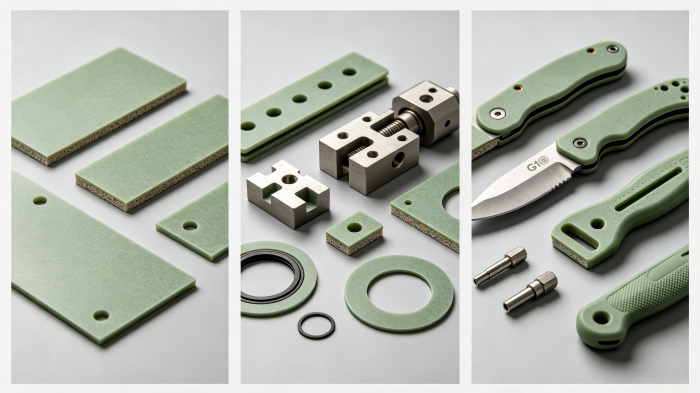
- Eletrónica e eletricidade: substratos de PCB, divisórias isolantes de alta tensão, juntas para transformadores, componentes isolantes para quadros elétricos
- Ferramentas industriais: Gabaritos de precisão, dispositivos de ensaio, calços para máquinas, engrenagens resistentes ao desgaste, anilhas de vedação
- Aeroespacial e defesa: Painéis interiores de aeronaves, ferramentas não condutoras, conjuntos de isolamento para radares
- Marítimo e químico: Suportes para bombas, painéis de isolamento marítimo, acessórios para instalações químicas
- Produtos de consumo: Cabos de facas, punhos de armas de fogo, cabos de ferramentas para atividades ao ar livre, componentes de artigos desportivos
- Impressão 3D e ferramentas para eletrónica: Superfícies de base aquecida para impressoras 3D, soldadura por onda e suportes de refluxo
11. Perguntas frequentes
P1: Qual é o material equivalente ao G10?
O FR-4 é o equivalente mais próximo do G10, com propriedades mecânicas e elétricas praticamente idênticas. A principal diferença reside no facto de o FR-4 incorporar um sistema retardador de chamas para cumprir a classificação UL94 V-0. Os dois materiais são intercambiáveis em situações em que a segurança contra incêndios não é crítica; em contrapartida, o FR-4 é obrigatório em aplicações relacionadas com a segurança contra incêndios.
P2: O G10 é de plástico ou de metal?
O G10 não é nem plástico puro nem metal — é um compósito termofixo de epóxi reforçado com fibra de vidro. É mais leve que o alumínio, mas mais resistente do que a maioria dos plásticos de engenharia. Ao contrário dos metais, não é condutor de eletricidade e é resistente à corrosão, pelo que se destaca como material para componentes de isolamento.
P3: O G10 pode ser utilizado no exterior?
Sim, mas apenas com um tratamento de proteção. A sua baixa absorção de água e resistência química permitem-lhe suportar bem a chuva e a corrosão ligeira. No entanto, a exposição prolongada aos raios UV provoca uma degradação gradual do desempenho. A aplicação de um revestimento resistente aos raios UV é a solução padrão, uma vez que duplica efetivamente a vida útil em ambiente exterior.
P4: O G10 é adequado para contacto com alimentos?
O G10 não possui certificação de segurança para contacto com alimentos. A matriz de epóxi pode libertar pequenas moléculas a altas temperaturas ou em ambientes ácidos, pelo que não recomendamos o contacto direto com alimentos. Para equipamento de processamento alimentar, materiais aprovados pela FDA, como o PEEK ou o HDPE, são opções mais seguras e adequadas.
P5: Qual é a diferença entre as placas G10 e as placas normais de fibra de vidro?
O G10 é um tipo específico de chapa de fibra de vidro epóxi que cumpre as normas da NEMA, com desempenho rigorosamente controlado e consistência de qualidade. Em comparação, as chapas de fibra de vidro comuns constituem uma categoria abrangente. Estas utilizam frequentemente resina de poliéster com menor resistência, maior absorção de água e sem normas de desempenho unificadas, pelo que só se adequam a aplicações de gama baixa e não críticas.
Conclusão
O laminado de fibra de vidro epóxi G10 é um compósito de engenharia altamente equilibrado, com um desempenho excecional em termos de isolamento elétrico, suporte de cargas estruturais e resistência ambiental, o que o torna um dos materiais fundamentais na produção industrial moderna. Na PartsMastery, acreditamos que a seleção do tipo adequado, de acordo com os requisitos específicos da aplicação, combinada com processos de maquinagem e práticas de manutenção normalizados, maximizará o desempenho e a relação custo-benefício do G10 ao longo de todo o seu ciclo de vida.