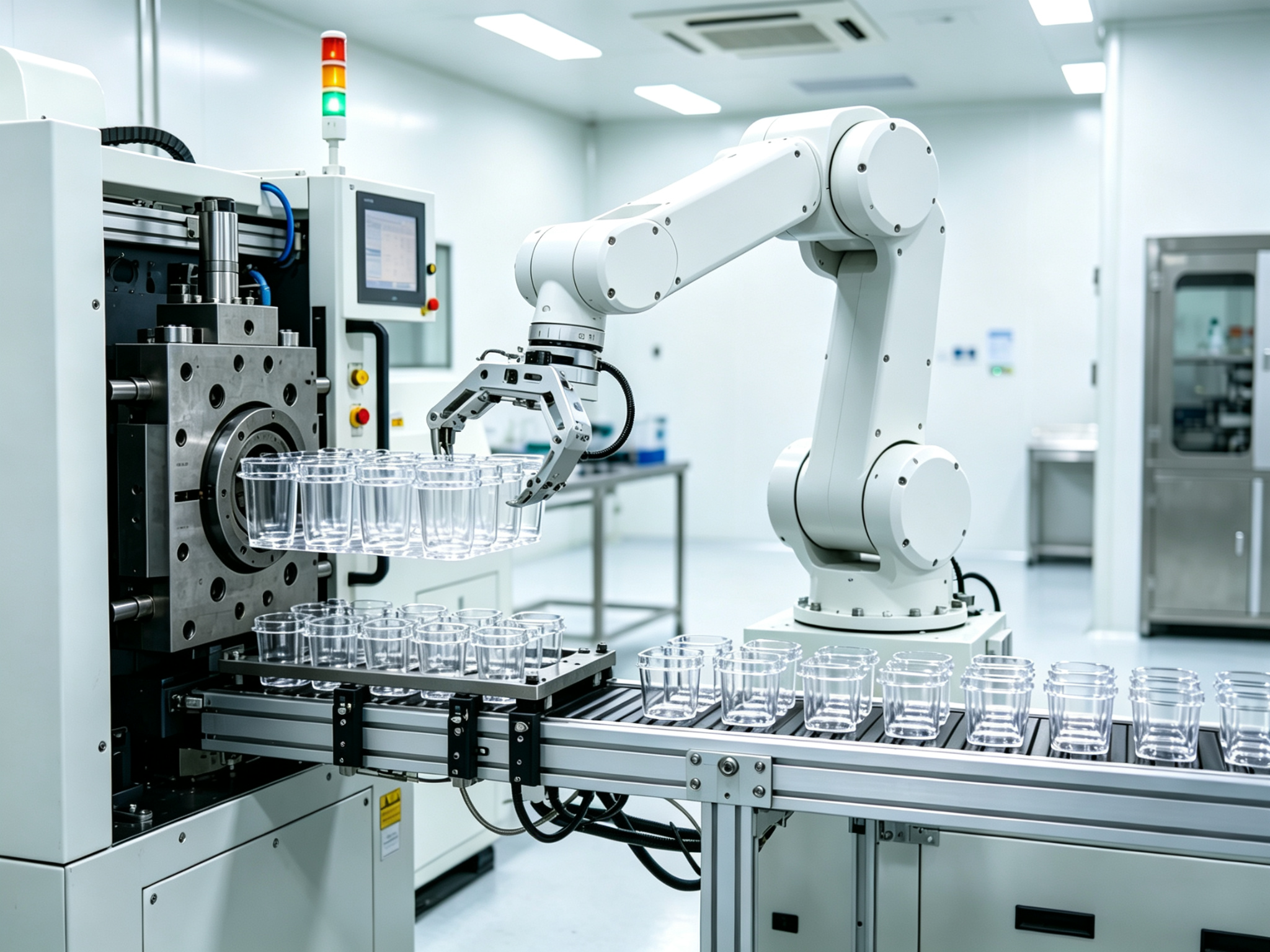
The cleanliness of a molded part depends entirely on the environment where it is produced. On a standard shop floor, dust, fibers, oil mist, and moisture can settle on parts during molding, handling, and packaging. For medical implants, pharmaceutical packaging, semiconductor components, and optical elements, a single micron-sized particle can cause patient infection, electrical short circuits, or optical failure.
Cleanroom injection molding moves the entire production flow into a controlled, ISO-classified environment. Through multi-layer protection including HEPA filtration, positive pressure, gowning procedures, sealed resin transfer, and automated part removal, manufacturers minimize contamination risk. However, a cleanroom is not simply a “cleaner shop floor.” It means higher construction costs, operating costs, and documentation requirements. The right choice depends on the part’s contamination risk level and regulatory requirements, not blindly pursuing the highest cleanliness grade.
1. What Is Cleanroom Injection Molding
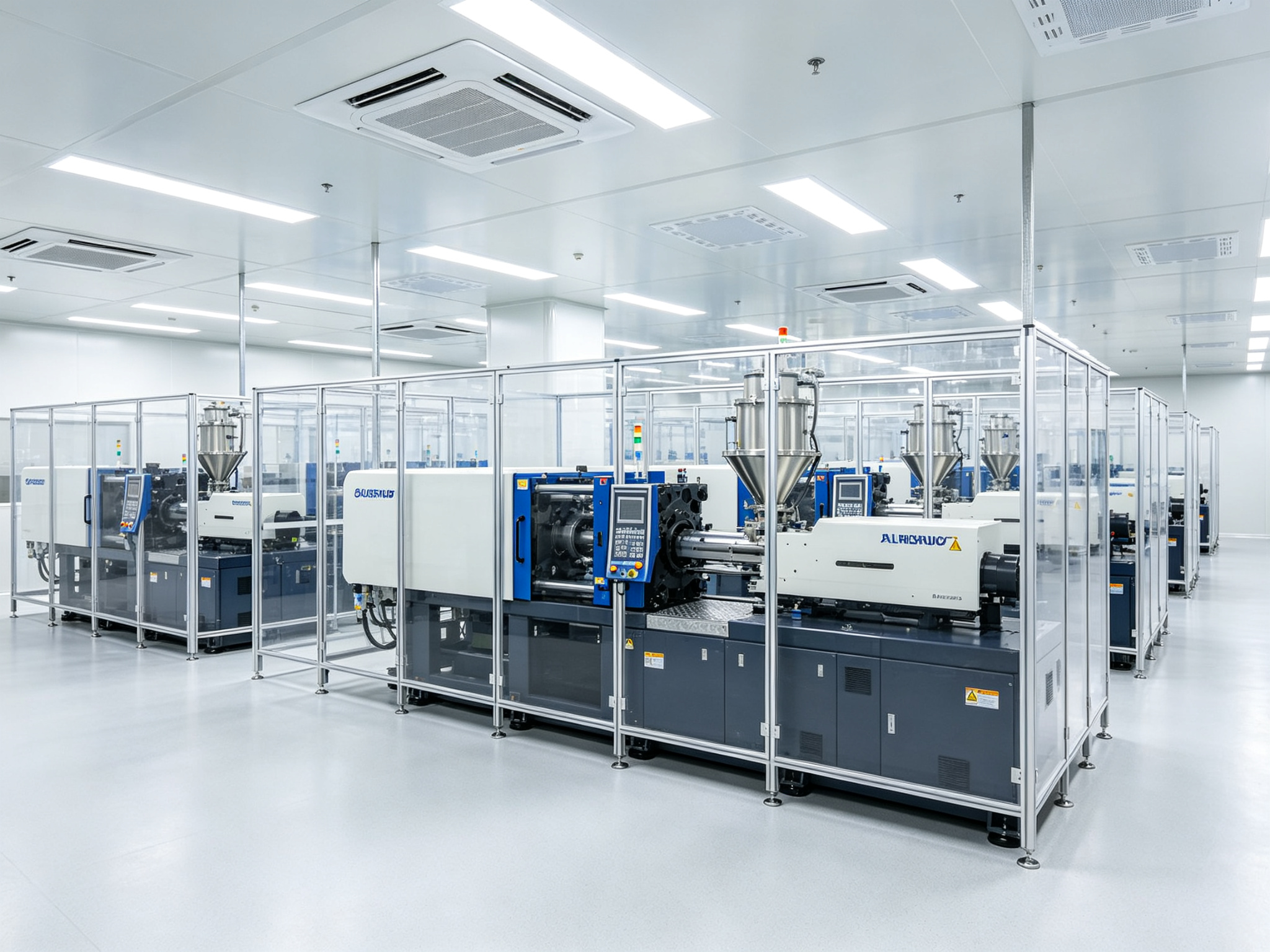
Cleanroom injection molding refers to standard injection molding that manufacturers perform in a controlled environment classified under ISO 14644-1. This environment strictly regulates airborne particle concentrations, air pressure differentials, temperature, humidity, and personnel access. The molding machine, mold, automation equipment, inspection stations, and packaging operations all sit inside the controlled space, or connect to it through pass-through chambers.
From a process principle standpoint, cleanroom molding is identical to standard molding. Operators dry, melt, inject, pack, cool, and eject resin to form the final part. What truly changes is the system surrounding the press. HEPA-filtered clean air, positive pressure gradients that keep unfiltered air out, gowning and airlock entry, sealed resin delivery pipelines, automated part removal robots, and workers complete sealed packaging before parts leave the controlled zone. Every layer of protection aims to stop contaminants from reaching the part in the gap between demolding and sealing.
Manufacturers should particularly emphasize that “cleanroom” is not a feature configuration of the injection molding machine. Instead, it represents a set of controlled conditions and operating procedures. The injection press is merely one element within it. Contamination during molding rarely comes from the resin itself. Personnel, air, tooling, and manual handling generate most of it. Therefore, the core value of a cleanroom lies in systematically eliminating these contamination sources, not merely replacing a piece of equipment.
2. ISO Cleanliness Classification and Selection Principles
2.1 ISO 14644-1 Classification Levels
The ISO 14644-1 standard classifies cleanrooms by the maximum allowable number of particles per cubic meter of air. Lower class numbers indicate cleaner air. The vast majority of injection molding production runs in ISO Class 7 or ISO Class 8 environments, while manufacturers reserve ISO Class 5 for critical assembly and packaging operations. The following table shows particle limits and typical applications for each class.
ISO Class
Particles ≥0.5µm per m³
Particles ≥5.0µm per m³
Typical Molding Application
ISO 5
3,520
29
Critical assembly and sterile packaging
ISO 6
35,200
293
High-sensitivity device manufacturing
ISO 7
352,000
2,930
Standard cleanroom injection molding
ISO 8
3,520,000
29,300
General molding and packaging
The values in the table represent maximum allowable limits, not actual measured values. Class selection is a risk-based decision, not a marketing label. ISO Class 7 meets the requirements of the vast majority of medical injection molded parts. ISO Class 8 suits many housings and subassemblies, especially those that undergo downstream cleaning or sterilization. Selecting a class before clarifying the contamination risk, sterilization route, and regulatory context usually means paying for a cleaner room than the part actually needs.
2.2 Matching Class to Product Flow
The appropriate class depends on the downstream processing flow after part demolding. If the part will undergo sterilization and handling in a controlled environment afterward, the molding step can tolerate higher airborne particle concentrations. Conversely, if workers immediately seal the part in sterile packaging after demolding, the process requires a higher cleanliness class. Matching the class to the downstream flow is the most effective way to avoid over-investment.
Furthermore, cleanroom certification is a snapshot result, not a permanent attribute. It reflects the room state under specified operating conditions on the certification day. Therefore, when selecting a supplier, you should ask how often the cleanroom undergoes recertification, and whether the certification covers the actual molding area or merely an adjacent showcase space. Each step up in cleanliness class significantly increases operating costs. Filtration energy, air change rates, gowning time, and monitoring costs all rise with class. ISO Class 7 requires far more air changes per hour than ISO Class 8.
3. Core Differences Between Cleanroom and Standard Molding
Moving injection molding into a cleanroom changes production methods across four dimensions: equipment, environment, personnel, and tooling. The following analysis examines these differences and their impact on part quality.
3.1 Equipment and Automation
Cleanrooms universally employ all-electric or enclosed servo-driven injection molding machines because they produce less oil mist and fewer leaks than hydraulic machines. Designers create machine surfaces as smooth, easy-to-clean planes that avoid dust-trapping corners. Automated pick-and-place robots and conveyors replace manual handling. Closed material systems deliver dried resin directly from sealed containers to the press, with no exposure to ambient air at any point.
3.2 Environmental Controls
A cleanroom maintains temperature and humidity within strict ranges, typically 20–24°C and 40–60% relative humidity. Stable temperature ensures consistent material viscosity and mold cooling, thereby protecting dimensional repeatability. Controlled humidity reduces static buildup, which in turn lowers the risk of particles adhering to part and equipment surfaces. Compressed air used for valves and part handling must be oil-free, multi-stage filtered, and dried to prevent moisture from entering the system.
3.3 Personnel and Material Handling
Operators enter the cleanroom through airlocks and strictly follow gowning procedures, including cleanroom suits, hairnets, beard covers, gloves, and shoe covers. Resin enters through sealed, controlled transfer channels. Workers demold parts in the controlled zone, immediately bag them, and then move them out through pass-through chambers. Every manual contact point is a contamination source, so designers create the process flow to eliminate these contact points as much as possible.
3.4 Mold and Tooling Design
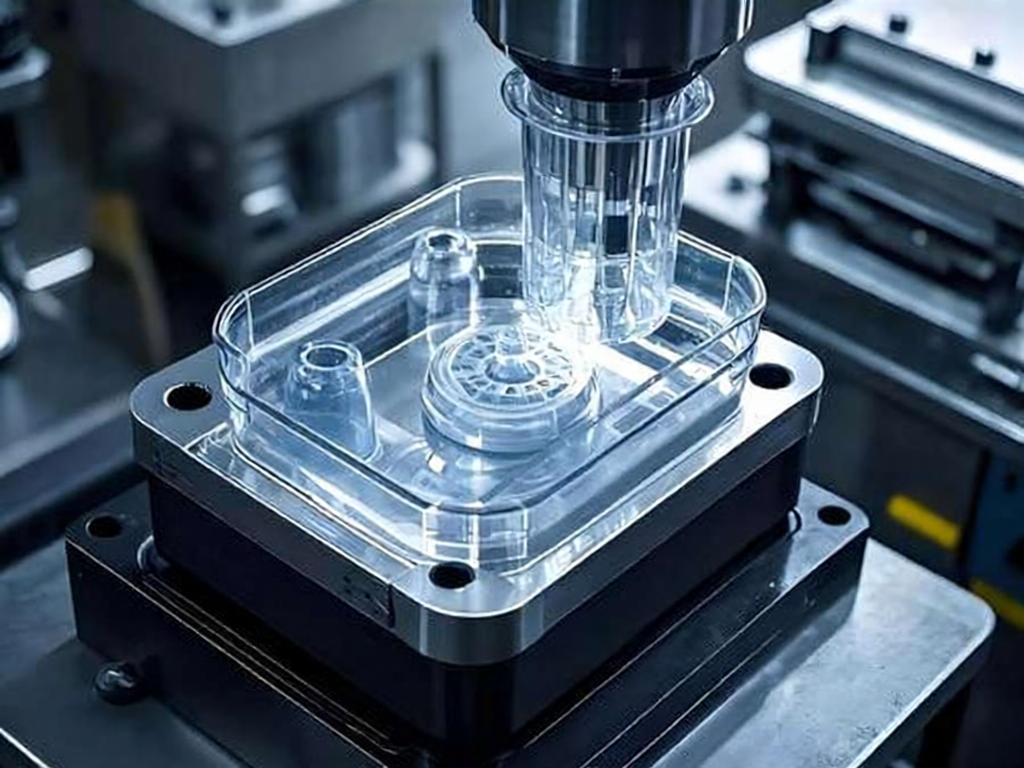
Mold design supports cleanliness before production even begins. Polished cavities reduce particle traps and facilitate cleaning. Engineers position vent locations to prevent burn marks that shed material. Gate and ejector system designs ensure clean part release without additional manual handling. Mold release agents and regrind, commonly used on standard shop floors, face strict control or complete prohibition in cleanrooms because they increase contamination and batch variability risks.
None of these changes affect the physical principles of injection molding. What they change is the pathways through which contaminants can enter. This is why the same part molded in a cleanroom and on a standard floor may have identical geometry but vastly different cleanliness levels and audit outcomes.
4. The Real Trade-offs in Cost and Lead Time
Cleanroom molding costs more, and the premium comes primarily from operations rather than construction investment alone. Understanding the cost structure helps with effective comparison during quotation.
4.1 Sources of the Premium
The additional costs of cleanroom injection molding come from four main areas. First is facility and filtration systems. HVAC design, HEPA filters, positive pressure control, and high air change rates dominate capital expenditure. Second is personnel cost. Gowning procedures, restricted access, and specialized training increase labor overhead and reduce operator flexibility. Third is process overhead. Validated process parameters, environmental monitoring, batch records, and batch release documentation add time both before and during production. Fourth is changeover cost. Re-cleaning, re-qualification, and gowning cycles make changeovers slower than on a standard floor.
The practical effect is higher per-part cost and longer total lead time, because validation and documentation work runs in parallel with production. The core molding cycle may be similar to a standard floor, but the surrounding process is slower and less flexible.
4.2 Comparing Quotes and Lead Times
When evaluating quotes, you should separate environmental costs from molding costs. If a supplier bundles cleanroom overhead into the per-part price, the premium becomes difficult to compare. Therefore, request that the cleanroom class, monitoring plan, and validation scope appear separately in the quotation, then compare like for like. Lead times also require comparison. Certified programs add validation and release steps that standard floors do not have, so a cheaper quote with a long validation cycle may cost more at the project level.
4.3 When the Premium Is Justified
Whether the premium is justified depends on one core question: would contamination of this part cause a safety, regulatory, or functional failure? If the answer is yes, then cleanroom molding is a cost of doing business, not an optional upgrade. If the answer is no, then the funds are better invested elsewhere, and a controlled white room or disciplined shop floor may deliver the required cleanliness without ISO certification overhead. For example, a diagnostic housing that undergoes cleaning and inspection after molding does not need the same class as a syringe that workers seal sterile immediately after demolding.
5. When Cleanroom Molding Is Required
5.1 Regulatory-Mandated Scenarios
When contamination directly affects product safety, regulatory compliance, or function, cleanroom injection molding becomes a necessary choice. The most typical trigger is medical devices and diagnostic products, including syringes, IV connectors, catheter components, drug delivery parts, and diagnostic housings. In these products, particles or bioburden can put patients at risk. Pharmaceutical packaging is another typical scenario, where caps, vials, and packaging components must not compromise drug purity. Additionally, sterile-adjacent products that manufacturers sterilize and use in controlled clinical or laboratory environments also require cleanroom environments.
Regulatory standards often make the decision for you. ISO 13485 medical device quality management systems, GMP requirements, and FDA expectations commonly require documented contamination control for medical and pharmaceutical programs. If the product falls under these categories, cleanroom molding is not optional. For medical parts, the control target includes not only particles but also bioburden, meaning microorganisms that survive the molding and packaging process. Cleanroom molding limits the initial bioburden level on parts, making downstream sterilization and validation more predictable and reducing the risk of batches failing release testing.
5.2 Yield-Driven Scenarios
Electronics and semiconductors represent the primary yield-driven scenarios. In connectors, sensor housings, and optical holders, dust can cause short circuits, optical defects, or field failures. Semiconductor and optical programs choose cleanroom molding for a different reason than medical programs. A particle on a connector contact or optical surface can cause intermittent failure or inspection rejection, so cleanliness is a yield driver rather than a compliance checkbox. For these parts, failure analysis typically determines the class rather than regulatory requirements.
5.3 When Standard Molding Is Enough
The reverse case is equally important. Cosmetic parts, industrial components, and products without regulatory requirements typically do not need a certified cleanroom. A disciplined production floor, or a white room with controlled housekeeping, disciplined purging, and reduced airborne contamination, often delivers the required surface finish and consistency without particle count certification. Over-specifying the environment is a real cost risk, especially when a higher ISO class is chosen “just to be safe” without supporting risk analysis.
6. How to Specify and Verify Cleanroom Molding
If teams determine that cleanroom molding is necessary, the specification document will determine both cost and audit outcome. A vague line such as “cleanroom molding required” leaves the supplier free to choose the cheapest interpretation.
6.1 What to Include in the RFQ
In the request for quotation (RFQ), the following items should appear clearly. First is the ISO class for the molding step, and separately for any assembly or packaging operations. Second is applicable standards, including ISO 14644-1 classification certification and the applicable quality management standard (such as ISO 13485 for medical). Third is validation scope, including IQ/OQ/PQ expectations and change control triggers. Fourth is the environmental monitoring plan, specifying what teams measure, where they measure it, and how often. Fifth is packaging and sterilization notes, including how workers seal parts and which sterilization method the resin must survive. Sixth is documentation requirements, including recent class test data, batch traceability, and device history records.
If sterilization occurs downstream, confirm that the injection molding material can tolerate the intended sterilization method, because ethylene oxide (EtO), gamma radiation, and steam sterilization each have different effects on material and packaging choices.
6.2 Verifying Supplier Claims
Verification matters as much as specification. Request the supplier’s current, valid ISO 14644-1 classification certificate and recent monitoring data, rather than relying on brochure claims. Confirm that the certificate covers the actual molding area, not merely a showcase room. Check that gowning, material handling, and packaging procedures match the class, because a certified room run with sloppy procedures still fails to protect the part.
Ask what teams measure and how often: particle counts during shifts, after changeovers, and after gowning events. Confirm that monitoring covers the molding zone rather than only a corridor, and check how the team handles deviations. A monitoring plan without a documented response procedure is merely paperwork, not actual contamination control.
PartsMastery provides a full range of injection molding services from prototype molds to production tooling. The factory holds ISO 9001, IATF 16949, and ISO 13485 certifications, with dimensional tolerances down to ±0.05 mm. The company operates cleanroom injection molding facilities compliant with ISO Class 7 and ISO Class 8 standards, equipped with all-electric injection molding machines, HEPA high-efficiency filtration systems, and automated part removal robots. These capabilities meet the strict cleanliness requirements of the medical, pharmaceutical, electronics, and semiconductor industries.
In cleanroom operations, PartsMastery has established a comprehensive environmental monitoring system that tracks particle counts, temperature, humidity, and pressure differentials in real time. Operators strictly follow gowning and airlock procedures. Materials enter through sealed channels, and workers complete demolding, inspection, and sealed packaging within the controlled zone. All production batches carry complete traceability records and batch release documentation, ensuring compliance with ISO 13485 and GMP requirements.
Additionally, the PartsMastery engineering team provides free DFM (Design for Manufacturing) reviews. These reviews help customers optimize part geometry, mold venting, and gate locations during the design phase, reducing contamination risk at the source. Whether for single-piece prototype validation or million-unit mass production, PartsMastery delivers stable and reliable cleanroom injection molding solutions.
8. Summary
Cleanroom injection molding combines the standard injection molding process with a controlled environment, and the difference manifests in three dimensions: cost, documentation, and risk control. Cleanliness class selection should rest on the results of risk assessment. Most injection molded parts require only ISO Class 7 or ISO Class 8, while teams reserve ISO Class 5 for critical assembly operations. Before freezing the design, teams can validate assembly relationships through 3D-printed prototypes before committing to cleanroom tooling.
A cleanroom is not the cleaner the better. It works well only when it matches the product’s contamination risk and downstream flow. For medical and pharmaceutical products, regulatory requirements make cleanrooms an inevitable choice. For electronic and optical products, yield drivers make cleanrooms an economic choice. For general industrial parts, a disciplined shop floor is often sufficient. Correct selection ensures product safety and quality while avoiding unnecessary cost investment.
Frequently Asked Questions
Do I need ISO Class 7 or ISO Class 8 for my molded parts?
Start from product risk, not a default choice. ISO Class 7 suits higher-risk devices. ISO Class 8 fits many housings and subassemblies, especially when parts undergo downstream cleaning or sterilization. Tie the class to the sterilization and packaging path, and confirm it during the DFM phase.
What if I need cleaner parts but cannot justify a certified cleanroom?
A white room or controlled production environment can reduce contamination and improve cosmetic consistency without ISO certification overhead. If the product has no regulatory mandate, this approach typically meets the requirement at a fraction of the cost.
What should a cleanroom molding RFQ actually specify?
Specify the ISO class and the documentation you expect, then ask the supplier to confirm both in writing. A vague “cleanroom required” leaves room for the cheapest interpretation, and the gap surfaces at audit, not at quote.
Does cleanroom molding change mold design or material selection?
It should. Polished mold surfaces, robust venting, and easy-to-clean geometries reduce particle sources, while closed resin handling and medical-grade materials support cleanliness. For electronics, ESD-safe materials prevent static buildup. Confirm draft angles and vent placement during DFM, when changes in CAD are cheapest to make.






 Cleanroom injection molding refers to standard injection molding that manufacturers perform in a controlled environment classified under ISO 14644-1. This environment strictly regulates airborne particle concentrations, air pressure differentials, temperature, humidity, and personnel access. The molding machine, mold, automation equipment, inspection stations, and packaging operations all sit inside the controlled space, or connect to it through pass-through chambers.
From a process principle standpoint, cleanroom molding is identical to standard molding. Operators dry, melt, inject, pack, cool, and eject resin to form the final part. What truly changes is the system surrounding the press. HEPA-filtered clean air, positive pressure gradients that keep unfiltered air out, gowning and airlock entry, sealed resin delivery pipelines, automated part removal robots, and workers complete sealed packaging before parts leave the controlled zone. Every layer of protection aims to stop contaminants from reaching the part in the gap between demolding and sealing.
Manufacturers should particularly emphasize that “cleanroom” is not a feature configuration of the injection molding machine. Instead, it represents a set of controlled conditions and operating procedures. The injection press is merely one element within it. Contamination during molding rarely comes from the resin itself. Personnel, air, tooling, and manual handling generate most of it. Therefore, the core value of a cleanroom lies in systematically eliminating these contamination sources, not merely replacing a piece of equipment.
Cleanroom injection molding refers to standard injection molding that manufacturers perform in a controlled environment classified under ISO 14644-1. This environment strictly regulates airborne particle concentrations, air pressure differentials, temperature, humidity, and personnel access. The molding machine, mold, automation equipment, inspection stations, and packaging operations all sit inside the controlled space, or connect to it through pass-through chambers.
From a process principle standpoint, cleanroom molding is identical to standard molding. Operators dry, melt, inject, pack, cool, and eject resin to form the final part. What truly changes is the system surrounding the press. HEPA-filtered clean air, positive pressure gradients that keep unfiltered air out, gowning and airlock entry, sealed resin delivery pipelines, automated part removal robots, and workers complete sealed packaging before parts leave the controlled zone. Every layer of protection aims to stop contaminants from reaching the part in the gap between demolding and sealing.
Manufacturers should particularly emphasize that “cleanroom” is not a feature configuration of the injection molding machine. Instead, it represents a set of controlled conditions and operating procedures. The injection press is merely one element within it. Contamination during molding rarely comes from the resin itself. Personnel, air, tooling, and manual handling generate most of it. Therefore, the core value of a cleanroom lies in systematically eliminating these contamination sources, not merely replacing a piece of equipment.