







Mold Manufacturing
Target Keyword: Mold manufacturing

Mold Manufacturing: The Hidden Engine of High-Quality Production
In the world of mass production, few processes are as decisive—and as easily overlooked—as mold manufacturing. Every plastic part, every metal casting, and many composite components begin their life inside a carefully designed cavity. That cavity, the mold, determines not only the shape of the final product but also its structural integrity, surface finish, dimensional consistency, and production cost. Without precision mold manufacturing, modern industries ranging from automotive and medical devices to consumer electronics and packaging would simply grind to a halt. At PartsMastery, we have built our reputation on delivering molds that balance complexity, durability, and cycle efficiency.
What Is Mold Manufacturing?
Mold manufacturing is the specialized discipline of designing and producing tooling that shapes molten or pliable materials into finished parts under pressure. Unlike general machining, which creates individual components, mold manufacturing creates a reusable negative form capable of producing thousands or even millions of identical positives. The most common types include injection molds for thermoplastics, compression molds for thermosets, transfer molds for electronic encapsulation, and die-casting molds for non-ferrous metals.
Each mold type imposes unique demands on the manufacturer. An injection mold must withstand repeated high-pressure injections of molten polymer at temperatures exceeding 200°C, followed by rapid cooling. A die-casting mold faces thermal shock from liquid aluminum or zinc. A blow mold must maintain uniform wall thickness while air pressure expands the material. A professional mold manufacturer understands these differences and tailors every aspect of the mold—steel grade, cooling layout, ejection system, and surface treatment—to the specific application.
Why Quality Mold Manufacturing Directly Impacts Your Bottom Line
Many product companies treat molds as a necessary but secondary expense. This is a costly misunderstanding. A poorly manufactured mold will not only produce defective parts from the first shot but will also degrade rapidly, leading to unplanned downtime, rejected batches, and emergency repairs. Each hour a production line waits for mold maintenance translates directly into lost revenue and missed delivery deadlines.
Conversely, a well-executed mold from an experienced mold manufacturing partner delivers multiple financial benefits. First, it reduces scrap rates from double-digit percentages to near zero. Second, it extends tool life, often achieving one million or more cycles before requiring major refurbishment. Third, it shortens cycle times through optimized cooling and venting, allowing you to produce more parts per hour without additional capital investment. Finally, it ensures that parts from cycle 100,000 are identical to those from cycle one—a critical requirement for regulated industries like medical devices and aerospace.
The Mold Manufacturing Process: From Concept to Steel
High-end mold manufacturing follows a rigorous, multi-step workflow that combines advanced software, precision machining, and human craftsmanship.
Step 1: Part Analysis and Mold Design
Everything begins with the finished part geometry, typically provided as a 3D CAD model. The mold manufacturer analyzes the part for draft angles, wall thickness uniformity, undercuts, and anticipated shrinkage rates. Using specialized mold flow simulation software, the engineer predicts how the molten material will fill the cavity, where air traps might form, and how cooling will proceed. This simulation step is non-negotiable for complex geometries; skipping it almost guarantees defects.
Step 2: Steel Selection and Preparation
Mold manufacturing demands specific tool steels that balance hardness, toughness, wear resistance, and thermal conductivity. Common choices include P20 for general-purpose injection molds, H13 for high-temperature die-casting, and stainless grades for medical or food-contact applications. The selected steel undergoes pre-hardening or annealing before machining to ensure dimensional stability.
Step 3: CNC Machining and EDM
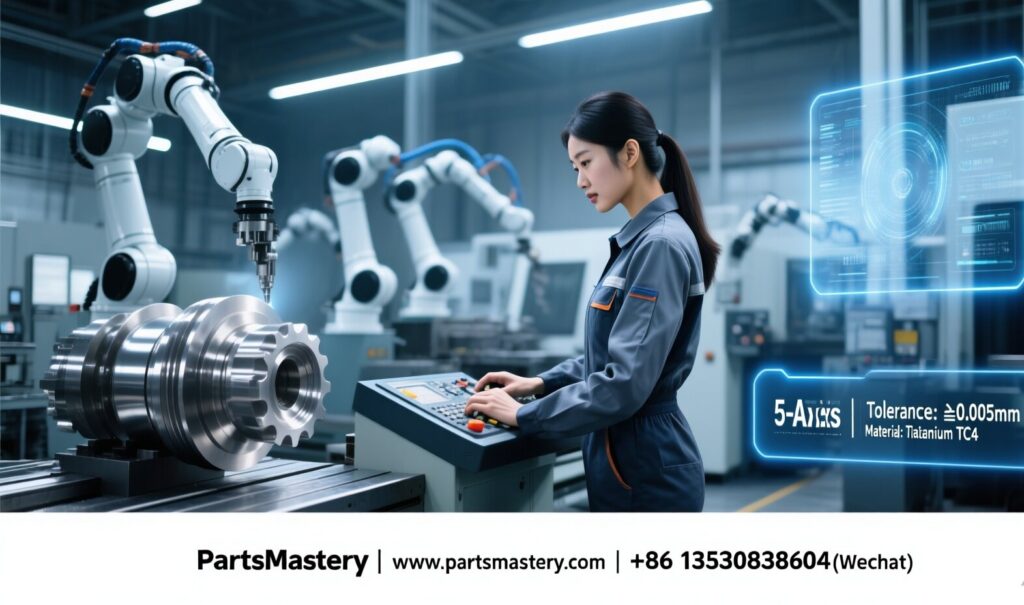
Roughing operations remove the bulk of steel using three- or five-axis CNC mills. For fine details—sharp internal corners, narrow ribs, or textured surfaces—the mold manufacturer switches to electrical discharge machining (EDM). Sinker EDM burns complex cavities using shaped electrodes, while wire EDM cuts through hardened steel with microscopic precision.
Step 4: Hand Finishing and Polishing
No machine can produce a truly mirror finish on complex mold surfaces. Skilled mold makers hand-polish critical areas to surface finishes below Ra 0.2 µm, ensuring easy part ejection and flawless cosmetic surfaces. They also lap shut-off surfaces to prevent flash (thin excess material leaking from the mold parting line).
Step 5: Heat Treatment and Coating
After rough machining, the mold undergoes vacuum heat treatment to achieve target hardness—typically 48-52 HRC for injection molds, or 50-55 HRC for die-casting. Some molds receive PVD coatings such as TiN or CrN to reduce friction and resist chemical attack from aggressive polymers.
Step 6: Fitting, Testing, and First Article Inspection
The completed mold is assembled into its frame, fitted with ejector pins, cooling lines, and sprue bushings. The mold manufacturer then runs test shots on an actual injection or casting machine, measuring the resulting parts against the original CAD model. Only when every critical dimension falls within tolerance—and the parts show no sink, warp, or burn marks—is the mold certified for production.
Materials and Tolerances: The Difference Between Good and Great
Professional mold manufacturing is measured in microns. A high-quality mold holds cavity dimensions to ±0.01 mm or better, with ejector pin clearances measured in thousandths of a millimeter. Cooling channels are positioned within 1-2 mm of the cavity surface, and their flow paths are designed to eliminate hot spots that cause uneven shrinkage.
Material selection is equally critical. For high-volume production exceeding 500,000 cycles, the mold manufacturer will specify premium steels such as Bohler M390 or Uddeholm Stavax, which maintain their polish and corrosion resistance over decades. For prototype or low-volume runs (under 10,000 parts), aluminum molds offer faster machining and lower upfront cost, though they wear out quickly with abrasive materials.
Common Mold Defects and How Expert Manufacturing Prevents Them
Even small errors in mold manufacturing lead to characteristic defects. Sink marks appear when the mold’s cooling is insufficient near thick sections. Flash occurs when clamping force cannot overcome injection pressure due to worn or mismatched shut-off surfaces. Short shots result from inadequate venting or restrictive gates. Ejector pin marks become visible when pins are misaligned or surface finishes are too rough.
An experienced mold manufacturer anticipates these problems during the design phase. They add conformal cooling channels that follow the part contour, design robust venting paths, and specify gate locations that minimize visible witness marks. They also build in serviceability—making it easy to replace worn ejector pins or polish corroded cavity surfaces without disassembling the entire mold.
Industries That Depend on Precision Mold Manufacturing
The reach of professional mold manufacturing extends across nearly every manufacturing sector. In automotive, molds produce dashboard components, light housings, interior trim clips, and under-hood connectors. In medical technology, molds create syringe barrels, IV connector hubs, surgical instrument handles, and diagnostic cartridge bodies—all requiring biocompatible materials and cleanroom-compatible finishes. Consumer electronics rely on micro-molding for phone camera bezels, SIM trays, and internal structural frames. Even household goods like bottle caps, food containers, and toothbrush handles emerge from high-cavity molds that produce dozens of parts per second.
The Future of Mold Manufacturing: Simulation, Automation, and Smart Molds
Mold manufacturing continues to evolve. Cloud-based mold flow simulation now allows collaborative design across continents. Automated electrode production and robotic polishing reduce lead times. Perhaps most exciting is the rise of “smart molds” equipped with cavity pressure sensors and thermal cameras that feed real-time data back to the injection machine, enabling closed-loop quality control. PartsMastery actively integrates these technologies where they deliver clear ROI for our clients, but we never lose respect for the fundamentals: correct steel, accurate machining, and meticulous testing.
Choosing Your Mold Manufacturing Partner
When evaluating a mold manufacturer, request sample parts from previous projects and inspect them under magnification. Ask about their simulation capabilities—do they run mold flow analysis for every new design? Review their maintenance recommendations; a responsible manufacturer will provide a documented schedule for cleaning, lubrication, and wear-part replacement. Finally, discuss post-delivery support: can they repair, modify, or duplicate the mold years later?
結論
Mold manufacturing is not a commodity service—it is a core competency that separates market leaders from also-rans. A precision mold from a trusted partner reduces waste, accelerates production, and ensures your product looks and functions exactly as intended, part after part. Whether you are launching a new medical device, scaling up an automotive component, or simply tired of inconsistent quality from your current supplier, investing in superior mold manufacturing pays for itself many times over.
For technical discussions, quotes, or mold design consultations, contact PartsMastery today.
パーツマスター
Phone / WeChat: +86 13530838604