




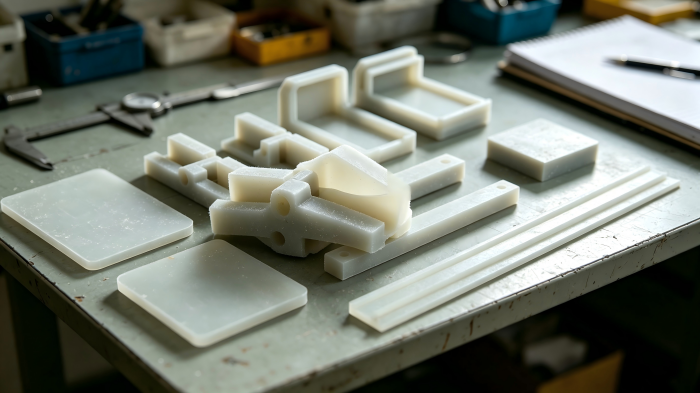
El polipropileno (PP) es uno de los termoplásticos más utilizados en el moldeo por inyección tradicional. Se valora especialmente por su inigualable resistencia a la fatiga, que le permite soportar millones de ciclos de flexión, y por su gran tolerancia a los productos químicos industriales agresivos.
Para los equipos de ingeniería de hardware y de producto, el PP impreso en 3D permite la validación directa en el banco de pruebas de piezas funcionales. Estas abarcan desde bisagras flexibles hasta depósitos de fluidos para la automoción.
Sin embargo, la estructura molecular semicristalina del material provoca una contracción térmica significativa al enfriarse. Esta contracción suele provocar una deformación considerable cuando se imprime en impresoras de sobremesa básicas.
En PartsMastery, ofrecemos procesos de fusión en lecho de polvo ajustados con precisión y diseñados específicamente para el PP. Gracias a ello, los equipos de ingeniería pueden evitar los prototipos deformados y trabajar con piezas totalmente funcionales, sin tensiones y listas para su prueba inmediata.
Índice
- Matriz comparativa de procesos de impresión 3D con PP
- Ciencia de los materiales: por qué el PP plantea dificultades a la hora de imprimir en 3D
- Análisis en profundidad de la tecnología: SLS/MJF, FDM y SLA para PP
- Directrices de diseño para la fabricación mediante impresión 3D con PP
- Producción directa en fábrica para piezas trazables y rentables
- Puntos clave
- Preguntas frecuentes
Matriz comparativa de procesos de impresión 3D con PP
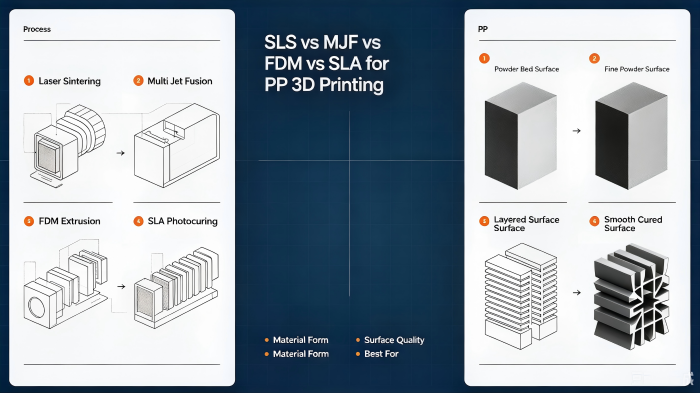
Utiliza esta matriz de referencia para seleccionar el proceso de fabricación más adecuado a tus requisitos mecánicos. De este modo, podrás reducir en varias semanas el costoso proceso de prueba y error con los materiales en el ciclo de desarrollo de tu producto.
| Tecnología aditiva | Formato de los datos brutos | Ventaja principal para PP | Limitación clave | Casos de uso recomendados |
|---|---|---|---|---|
| SLS / MJF | Polvo de PP virgen | Resistencia isotrópica superior; no se necesitan estructuras de soporte | Porosidad superficial leve | Bisagras flexibles, depósitos de productos químicos, colectores de fluidos |
| FDM | Filamento de PP | Bajo coste de material, compatible con impresoras de sobremesa | Alto riesgo de deformación, escasa adherencia a la base, resistencia anisotrópica | Plantillas básicas, soportes de montaje para cargas ligeras |
| SLA | Resina fotopolimérica similar al PP | Acabado de superficie de alta calidad, alta resolución para detalles precisos | No es PP termoplástico auténtico; resistencia reducida al calor y a los productos químicos | Maquetas de productos cosméticos, conjuntos de encaje a presión de alta precisión |
Ciencia de los materiales: por qué el PP plantea dificultades a la hora de imprimir en 3D
La estructura semicristalina del polipropileno es la causa principal de la mayoría de las dificultades que plantea la impresión 3D.
A medida que el PP fundido se enfría y se solidifica, sus largas cadenas poliméricas se reorganizan formando estructuras cristalinas compactas y altamente ordenadas. Esta reorganización provoca una contracción volumétrica significativa en toda la pieza.
Concretamente, en las impresoras FDM de sobremesa estándar que utilizan filamento de PP básico, esta contracción desigual genera una intensa tensión interna. Esta tensión puede hacer que la pieza se desprenda por completo de la placa de impresión en mitad del proceso de impresión.
En definitiva, esto da lugar a piezas con distorsiones geométricas que no son aptas para las pruebas funcionales ni para la validación del diseño.
Análisis en profundidad de la tecnología: SLS/MJF, FDM y SLA para PP
Fusión en lecho de polvo (SLS y MJF): el referente industrial para el PP
Afortunadamente, los procesos de sinterización selectiva por láser (SLS) y fusión por chorro múltiple (MJF) eliminan por completo los problemas de adhesión a la base y de deformación que suelen producirse en la impresión por extrusión.
Estos sistemas industriales de lecho de polvo son la solución más fiable para la fabricación aditiva de PP. Durante el ciclo de sinterización a alta temperatura, el polvo suelto no sinterizado que rodea la pieza actúa como soporte estructural natural.
Este entorno térmico estrictamente controlado evita que se produzcan contracciones desiguales. Además, permite obtener bisagras flexibles con propiedades mecánicas isotrópicas y uniformes.
La cámara de impresión se mantiene a una temperatura constante ligeramente inferior al punto de fusión del PP. Esto permite que la estructura semicristalina se forme de manera uniforme en toda la pieza.
Por ejemplo, los equipos de lanzamiento de nuevos productos (NPI) del sector de la automoción utilizan los sistemas SLS industriales de PartsMastery para fabricar depósitos de fluidos funcionales. Estas piezas se montan directamente en dinamómetros de motor en funcionamiento sin que se produzcan fugas.
Impresión 3D FDM: limitaciones y soluciones alternativas para el filamento de PP
Aunque la tecnología FDM ofrece una gran accesibilidad y unos bajos costes de material, la impresión con filamento de PP plantea importantes dificultades técnicas.
El polipropileno tiene una energía superficial extremadamente baja. Por este motivo, el PP fundido se adhiere mal a las superficies de impresión habituales, como el vidrio, las láminas de PEI o las placas texturizadas.
En la práctica, para que la impresión en PP mediante FDM tenga éxito, es necesario disponer de una cámara de impresión totalmente cerrada y con calefacción activa. Esto ralentiza la velocidad de enfriamiento y reduce la tensión derivada de la contracción.
Además, los operadores deben aplicar láminas adhesivas específicas para PP o cinta de embalaje de PP sin recubrimiento sobre la superficie de impresión. Este paso es necesario para conseguir una adhesión mínima de la primera capa.
Incluso con una configuración optimizada, las piezas de PP impresas mediante FDM siguen presentando una unión entre capas en el eje Z intrínsecamente débil. Como consecuencia, no son fiables para aplicaciones de bisagras flexibles sometidas a ciclos elevados y a tensiones repetidas.
Impresión 3D SLA: resinas similares al PP para la validación de la forma y el ajuste
Algunos diseños requieren una calidad de superficie propia del moldeo por inyección, como es el caso de las carcasas cosméticas encajables. En estos casos, el PP impreso con tinta en polvo puede resultar insuficiente debido a su acabado mate y ligeramente poroso.
En cambio, las máquinas SLA industriales con resinas fotopoliméricas similares al PP ofrecen una alternativa de alta precisión. Proporcionan una suavidad superficial excepcional y tolerancias dimensionales muy ajustadas.
Estas resinas de ingeniería se asemejan mucho al polipropileno en cuanto a flexibilidad y dureza Shore. Sin embargo, se trata de materiales termoendurecibles fotopolimerizables, y no de PP termoplástico propiamente dicho.
Como consecuencia, su rendimiento se deteriora rápidamente cuando se exponen a productos químicos agresivos o a temperaturas elevadas, a las que el PP auténtico resiste sin problemas.
En general, las resinas SLA similares al PP son las más adecuadas para la validación de la forma, el ajuste y la estética en entornos de laboratorio controlados.
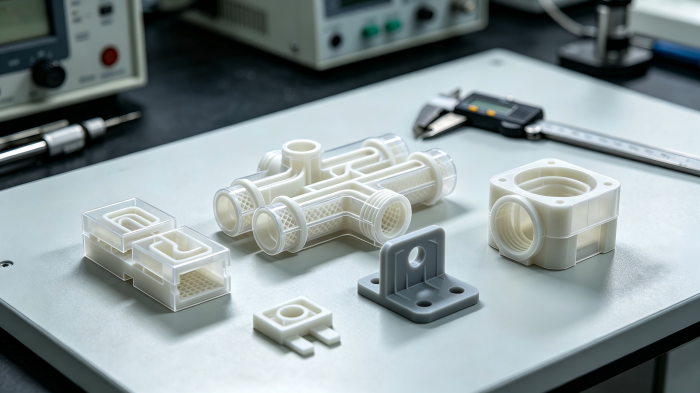
Consejo de experto: Si no estás seguro de si tu proyecto requiere la resistencia química del PP SLS auténtico o el acabado liso de la resina tipo PP SLA, podemos ayudarte. Solo tienes que solicitar hoy mismo la caja de muestras de materiales gratuita de PartsMastery. De este modo, podrás probar y flexionar en persona nuestras muestras de bisagras vivas impresas para tomar decisiones con confianza y con un riesgo mínimo para tu montaje.
Directrices de diseño para la fabricación mediante impresión 3D con PP
Diseño de bisagras flexibles de larga duración
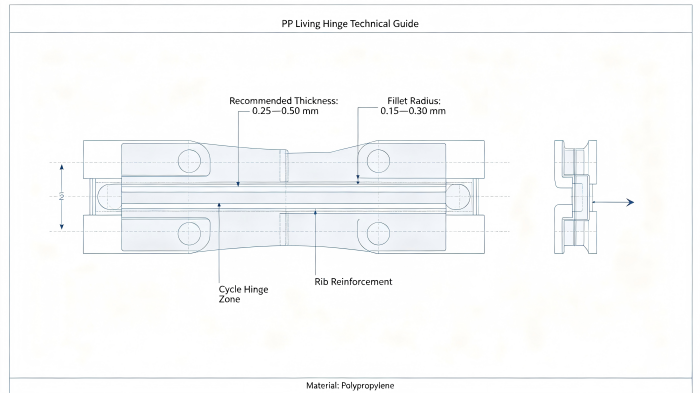
Las bisagras flexibles impresas en PP están diseñadas para flexionarse repetidamente sin que se rompan las cadenas poliméricas.
En concreto, para lograr un equilibrio entre la flexibilidad y la resistencia a la tracción, mantén el grosor de la bisagra entre 0,3 mm y 0,5 mm.
En los procesos de fusión en lecho de polvo, orienta siempre la bisagra de forma perpendicular al eje Z de la cámara de fabricación.
Esta alineación exacta maximiza la vida útil a la fatiga por flexión. Además, evita la delaminación entre capas durante el primer ciclo de flexión, que es crítico.
Cómo minimizar la deformación en piezas de geometría voluminosa
Las secciones transversales gruesas y macizas se enfrían mucho más lentamente que las paredes delgadas. Esto provoca desequilibrios térmicos que generan una elevada tensión interna.
Con el tiempo, esta tensión provoca la deformación de las piezas y una desviación dimensional respecto a las especificaciones CAD originales.
Para mitigar este riesgo, vacía las secciones sólidas voluminosas y mantén un espesor de pared uniforme. También debes aplicar filetes generosos en todas las esquinas internas.
Distribuir la tensión de enfriamiento de manera uniforme por toda la pieza garantiza unos resultados homogéneos. De este modo, los colectores, soportes y carcasas impresos se ajustarán exactamente a las dimensiones de tu diseño.
Producción directa en fábrica para piezas trazables y rentables
El abastecimiento de piezas impresas en 3D a través de mercados digitales de terceros puede comprometer la trazabilidad de la fabricación.
Cuando los datos CAD se transmiten entre las instalaciones de varios subcontratistas, se rompe el circuito de retroalimentación directa. Esta desconexión entre los ingenieros de diseño y los operarios de producción aumenta el riesgo de errores dimensionales y problemas de calidad.
Por el contrario, PartsMastery opera como proveedor directo de fabricación de primer nivel con un control integral de la producción.
Nuestras instalaciones centralizadas, con una superficie de 20 000 m², gestionan todas las fases de producción siguiendo estrictos protocolos internos de calidad. Esto abarca desde la inspección de la materia prima en polvo a su llegada hasta el mecanizado de precisión posterior.
Además, eliminamos los gastos generales de los intermediarios para ofrecer precios transparentes y competitivos. Esto se traduce en un ahorro presupuestario de hasta 30% para su equipo de compras.
Puntos clave
Para validar las bisagras flexibles y las carcasas estancas a los fluidos se requiere material de PP auténtico con un comportamiento predecible y sin deformaciones.
Las líneas SLS y MJF de PartsMastery, con suministro directo desde fábrica, abordan los retos que plantea la contracción térmica desde el origen. Ofrecen componentes con precisión dimensional y sin tensiones, diseñados para pruebas funcionales.
Sube hoy mismo tus archivos CAD a nuestra plataforma de impresión 3D para obtener un presupuesto instantáneo de DFM. A continuación, recibirás tus piezas de PP terminadas en tan solo 3-5 días laborables.
Preguntas frecuentes
¿Por qué resulta difícil imprimir con filamento de PP en impresoras FDM de sobremesa estándar?
En primer lugar, al ser un termoplástico semicristalino, el polipropileno se contrae considerablemente al solidificarse. En segundo lugar, su energía superficial extremadamente baja impide que se adhiera correctamente a superficies de impresión que no sean de PP.
La combinación de estos dos factores provoca una deformación térmica grave. Sin una cámara de impresión calefactada y sin herramientas específicas para la adhesión del PP, resulta muy difícil conseguir una impresión FDM de PP de alta calidad y uniforme.
¿Se pueden utilizar las piezas de PP impresas en 3D para aplicaciones alimentarias o médicas?
La resina de polipropileno auténtica es químicamente inerte y, por naturaleza, segura para el uso general. Sin embargo, el proceso de impresión 3D capa por capa genera una porosidad superficial a escala microscópica.
Estos poros minúsculos pueden retener bacterias y contaminantes. En el caso de las piezas que entran en contacto directo con alimentos o que requieren una esterilización de grado médico, es necesario aplicar un tratamiento posterior de alisado al vapor. Este paso sella completamente la superficie para cumplir con las normas reglamentarias.
¿En qué casos resulta más económico el moldeo por inyección que la impresión 3D con PP?
Para series de producción de entre 1 y 500 unidades, la impresión industrial mediante SLS o MJF con polvo de PP puro resulta más rentable. Esto se debe a que evita el elevado coste inicial que supone el mecanizado de un molde de inyección de acero.
Una vez que el volumen supera las 1.000 unidades, la ecuación cambia. Pasar al moldeo por inyección tradicional reduce entonces considerablemente los costes por pieza y se convierte en la estrategia más económica a largo plazo.