



Engineering plastic components are widely used in electronic enclosures, automotive structural parts, medical devices, automation fixtures, and industrial insulation assemblies. Hole features are the most critical assembly structures in plastic parts, and the machining quality of mounting holes, dowel pin holes, tapped holes, and slotted profiles directly determines assembly accuracy, structural strength, and long-term equipment stability.
CNC drilling and CNC milling are the two primary processes for creating holes in plastic components, and they differ fundamentally in cutting principle, hole shape compatibility, dimensional accuracy, and production efficiency. Because plastics have unique characteristics such as low thermal conductivity, elastic springback, and susceptibility to thermal deformation, process selection should never rely solely on hole diameter. Teams must also consider material properties, tolerance requirements, structural form, and production volume.
At PartsMastery, we specialize in precision CNC machining of engineering plastics. We provide full-spectrum hole machining services including drilling, milling, boring, and reaming for all types of polymer materials. We support the full project lifecycle from prototype trials to volume production, and we guarantee consistent hole positioning accuracy and assembly reliability.
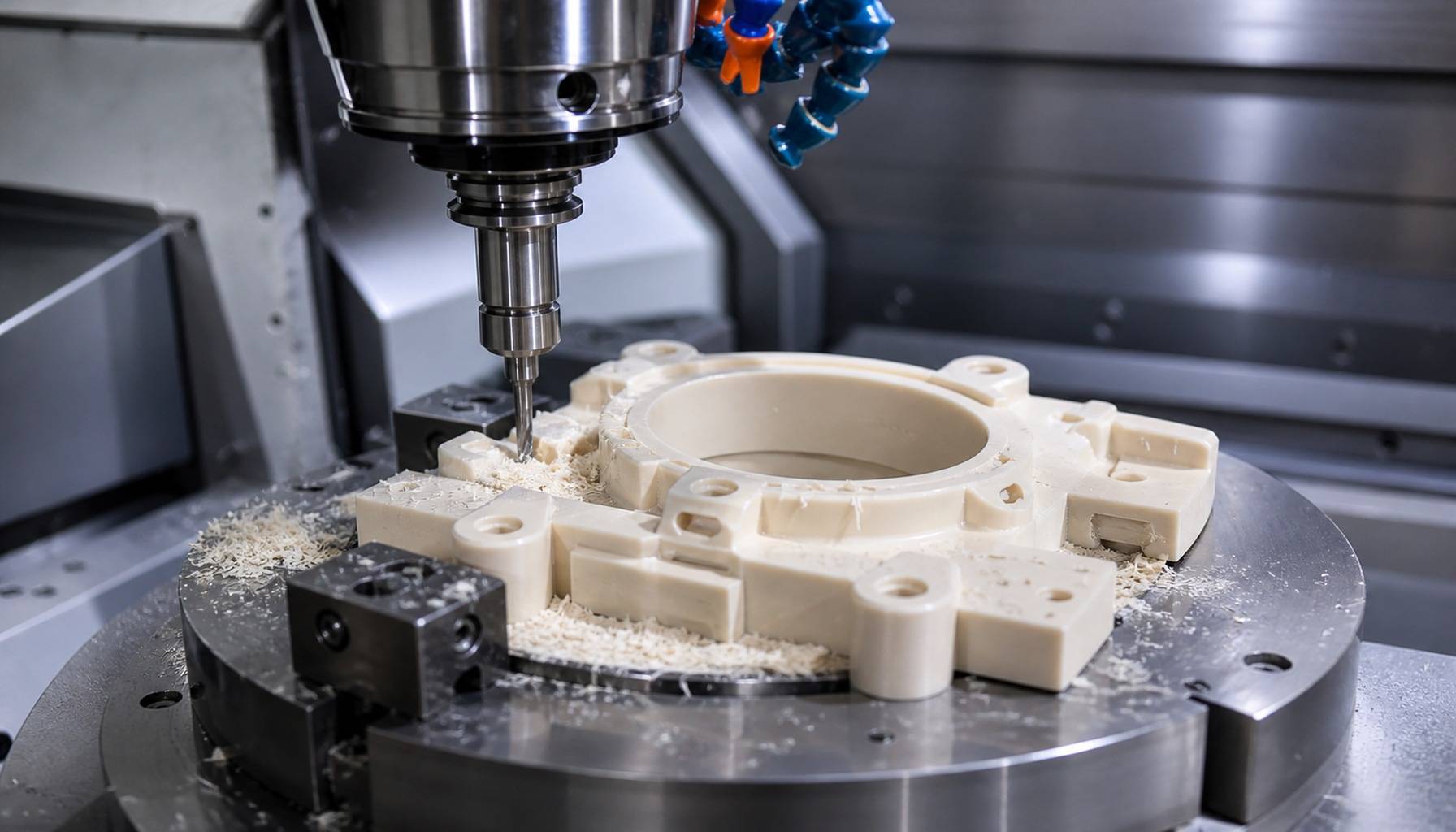
1. Core Process Principles and Fundamental Differences
Drilling and milling differ most obviously in tool motion and material removal logic, and each is suited to different types of hole features.
1.1 CNC Drilling: Axial Feed for Standard Round Holes
CNC drilling uses twist drills or application-specific plastic drill bits. The spindle rotates the tool while it feeds vertically along the hole axis, removing material through cutting action at the drill point and edge to form a clean, round hole.
Drilling follows a simple tool path that only requires coordinate positioning and depth control. Programming is straightforward, making it the preferred method for standard round holes. However, limited by tool geometry, it can only produce fixed-diameter through holes, blind holes, and counterbores — it cannot accommodate irregular profiles or non-standard hole sizes.
1.2 CNC Milling: Planar Interpolation for Flexible Contour Machining
CNC milling uses rotating tools such as end mills to remove material along a predefined contour through circular interpolation, helical interpolation, or layered cutting paths in the X/Y plane.
The greatest strength of milling is its extreme flexibility. It is not limited by tool diameter, so it can produce round holes of any size, long slots, square openings, irregular profile holes, and stepped bores. It also supports a roughing + finishing layered strategy to tightly control hole tolerance and wall quality. The tradeoff is longer tool travel per hole, so cycle times are usually higher than drilling for equivalent hole sizes.
2. Side-by-Side Comparison Across Four Key Dimensions
We can compare the two processes clearly across hole shape flexibility, accuracy control, machining efficiency, and overall cost:
| Comparison Dimension | CNC Drilling | CNC Milling |
|---|---|---|
| Hole Shape Flexibility | Only supports standard round through/blind holes; hole diameter defined by tool size | Supports round holes, slots, irregular shapes, and stepped bores; diameter adjustable via program |
| Accuracy & Surface Quality | Strongly affected by drill runout and chip evacuation; deep holes prone to axis drift; hole walls susceptible to thermal scuffing | Layered rough/finish milling compensates for tool wear; highly controllable diameter; better wall finish and roundness |
| Machining Efficiency | Short tool path and fast cycle time per hole; extremely efficient for batches of identical holes | Longer cutting path per hole than drilling; more efficient for multi-size irregular holes by reducing tool changes |
| Tooling & Overall Cost | Low-cost dedicated drills; one tool per size; ideal for standardized volume production | Universal end mills cover multiple diameters, reducing tool inventory; longer cycle time, more cost-effective for low-volume custom jobs |
Importantly, milling is not always more accurate. Final machining accuracy depends equally on machine rigidity, tool runout, fixturing stability, and material deformation. For standard round holes with moderate tolerances, drilling usually delivers fully acceptable results, and there is no need to switch to milling purely for perceived accuracy gains.
3. Hole Machining Compatibility by Engineering Plastic Material
Different plastics have vastly different cutting behaviors, and the same process can produce very different results from one material to another. Teams must match tooling and parameters to material properties.
3.1 Polyoxymethylene (POM)
POM offers excellent dimensional stability and machinability. It forms clean chips and resists built-up edge, making it one of the most drill-friendly engineering plastics. For POM, sharp standard twist drills with controlled feed rates and good chip evacuation produce consistent hole diameters and clean wall surfaces. For high-precision fitting holes, teams can add a reaming operation after drilling to further improve accuracy.
3.2 Nylon (PA)
Nylon is tough and hygroscopic, so it exhibits noticeable dimensional springback after machining and swells with moisture absorption, making tight diameter control more challenging. Drilling often produces exit burrs, so milling is the better choice for high-precision holes, as finishing stock can compensate for material springback. Before machining, teams should confirm material moisture content to avoid confusing hygroscopic dimensional shift with machining error.
3.3 ABS and Polycarbonate (PC)
ABS has low thermal conductivity, so cutting heat can easily cause material softening, tool adhesion, and hole edge burrs. For drilling, use high-helix plastic-specific drills and forced compressed air cooling to clear chips and control temperature.
PC offers high impact resistance but is prone to stress cracking. When drilling, add a backing support plate at the hole exit to prevent breakout. For holes near part edges, prefer milling with layered cutting to reduce cutting forces and lower cracking risk.
3.4 High-Performance Engineering Plastics such as PEEK
PEEK combines high strength and high temperature resistance, making it a difficult-to-machine engineering plastic. Drilling leads to rapid tool wear and unstable hole diameter, so high-precision holes are best produced by milling, which controls cutting heat and tool wear through layered passes. Before full production, run trial cuts to verify hole consistency and surface quality.
4. Practical Process Selection Guide
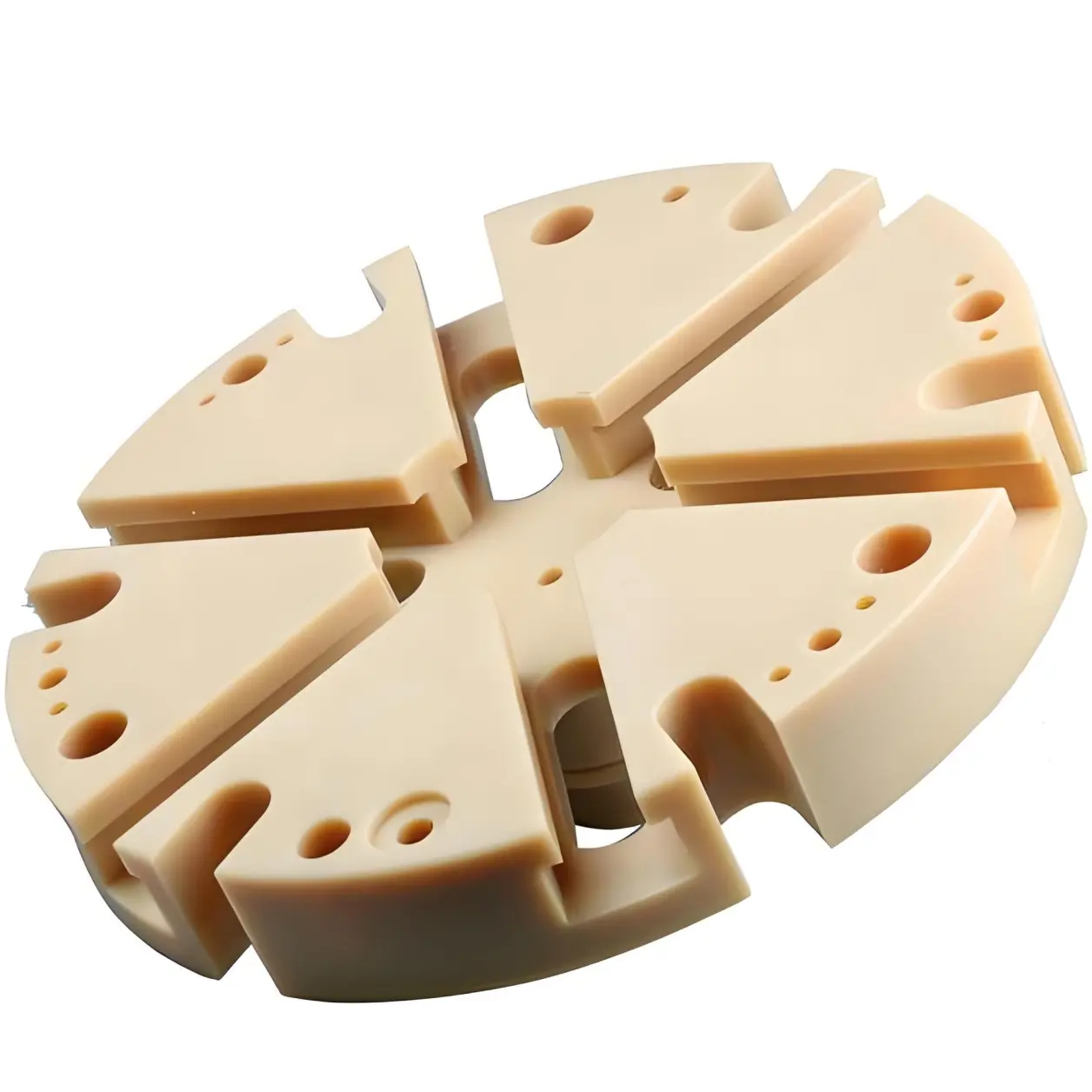
Based on hole shape, tolerance, volume, and material characteristics, follow these guidelines to choose the right process quickly.
4.1 Scenarios Where Drilling Is Preferred
- Standard round mounting holes, dowel holes, and tap drill holes with fixed diameters
- High-volume production with uniform hole sizes, where maximum throughput is the priority
- Shallow holes with a depth-to-diameter ratio below 3:1 and moderate tolerance requirements
- General-purpose hole machining in easy-to-cut materials such as POM and ABS
4.2 Scenarios Where Milling Is Preferred
- Non-standard hole features such as long slots, irregular openings, stepped bores, and large-diameter round holes
- Precision fitting holes with tight diameter tolerances, high roundness requirements, and superior wall finish
- Low-volume custom parts with multiple hole sizes, where minimizing tool changes improves efficiency
- Holes in thin-wall parts or near part edges, where reduced cutting forces help prevent deformation and cracking
4.3 Combined Drill-and-Mill Process
For large-diameter deep holes, a combined process — drilling for roughing followed by milling for finishing — delivers the best balance of speed and accuracy. The drill removes most of the material quickly, and the end mill finishes the final diameter and wall quality. This hybrid approach is a cost-effective solution for large plastic holes.
5. Key Quality Control Practices for Plastic Hole Machining
The unique properties of plastics mean hole machining cannot simply copy metal machining parameters. Teams should focus on four core control areas.
5.1 Chip Evacuation and Temperature Control
Plastics conduct heat poorly, so trapped chips can build up heat and cause melting, tool adhesion, and wall scuffing. Use compressed air cooling during machining to clear chips effectively. For deep holes, use peck drilling cycles with periodic retraction to avoid chip clogging. Never run excessively high spindle speeds, as overheating can cause permanent hole deformation.
5.2 Fixturing and Deformation Control
Thin-wall plastic parts can elastically deform under clamping force, and springback after release causes out-of-round holes. Use multi-point flexible fixturing to distribute clamping force evenly. Follow a symmetrical cutting sequence for hole patterns to avoid uneven stress buildup and part warpage.
5.3 Burr and Edge Quality Control
Exit burrs are a common defect in plastic drilling. Reduce burr formation by using sharp tools, optimizing feed rates, and adding backing support at the hole exit. For parts with high cosmetic or assembly requirements, include a dedicated deburring and chamfering operation after machining.
5.4 Dimensional Inspection Standards
Plastics exhibit elastic recovery and thermal expansion/contraction, so dimensional measurements should be taken only after parts have stabilized to room temperature. For precision fitting holes, verify fit against actual mating components instead of relying solely on instrument readings.
Conclusion
All things considered, neither CNC drilling nor milling is universally superior — they serve two different needs. Drilling excels at speed and low cost for standard round holes, while milling offers greater flexibility and controllable accuracy for non-standard and precision holes.
In practice, teams should select the process based on hole shape, tolerance grade, production volume, and material properties. When needed, a combined drill-and-mill approach can balance efficiency and accuracy. With extensive experience in engineering plastic machining, PartsMastery tailors optimal hole machining solutions to each part’s requirements, ensuring dimensional stability and reliable assembly performance.