





Electrical Discharge Machining (EDM) stands as one of the most valuable non-contact advanced manufacturing processes in precision production. It removes material through controlled pulsed spark erosion, and this unique working principle lets it bypass the core limitations of traditional cutting processes — namely, constraints on material hardness and structural complexity. As a result, it serves as a core manufacturing solution for high-hardness alloys, complex cavities, and thin-walled micro-structured parts.
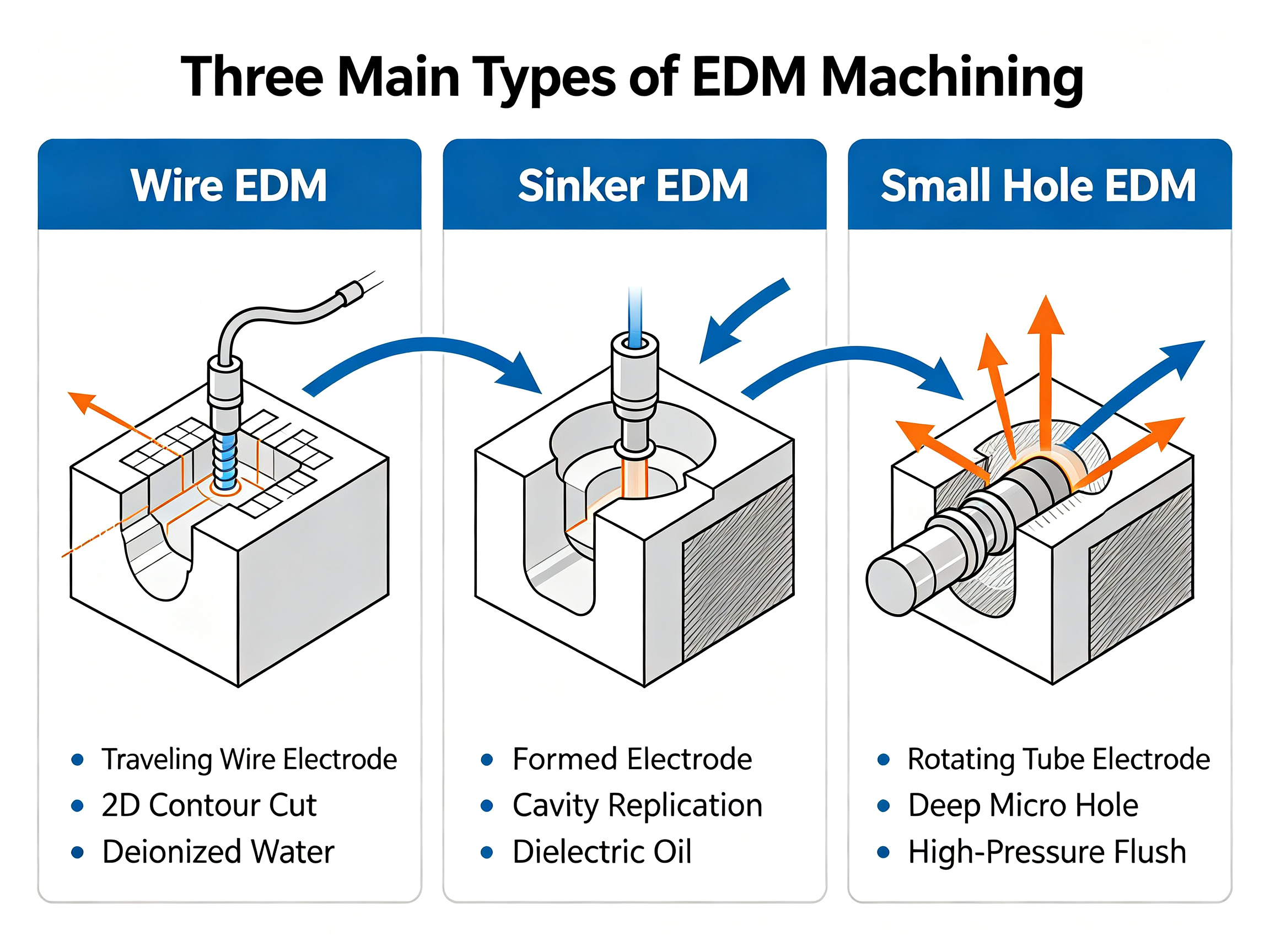
Today, three main EDM variants dominate industrial applications: wire EDM, sinker EDM, and small hole EDM. All three rely on spark erosion to remove conductive material, but they differ sharply in electrode design, machining capability, and ideal use cases. In this guide, we break down the core working principles of EDM, explore the unique strengths and limits of each core process, cover advanced specialty EDM methods, and share practical selection guidance tied to material properties and industry needs. In short, we deliver a complete decision framework for anyone planning precision manufacturing workflows.
1. Basic Principles and Core Value of EDM
1.1 How EDM Works
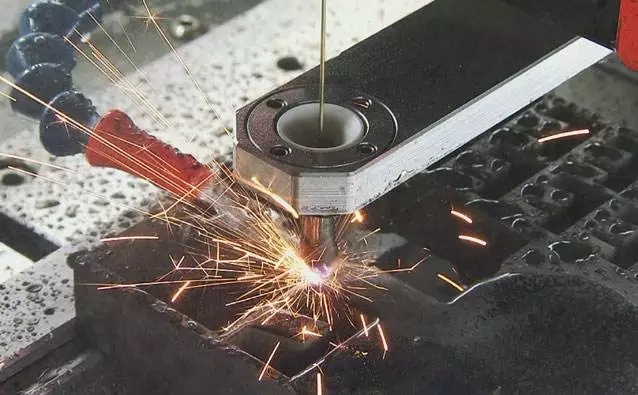
At its core, EDM works by generating controlled pulsed electrical discharges between a tool electrode and a workpiece electrode, with both electrodes immersed in a dielectric fluid. As pulsed voltage builds across the two electrodes and the gap shrinks to the breakdown threshold, a high-temperature plasma channel forms instantly. Local temperatures reach 8,000 to 12,000°C, which melts and vaporizes tiny volumes of workpiece material.
Immediately after each discharge pulse, the dielectric fluid restores insulation and flushes away molten debris before the next cycle starts. This cycle repeats thousands of times per second, steadily eroding material to form the target geometry along the programmed tool path. Importantly, the tool never touches the workpiece physically during the entire process, so no macroscopic cutting forces act on the part.
1.2 Unique Advantages in Precision Manufacturing
- Hardness-independent machinability: First, the process handles all conductive materials stably regardless of hardness, even grades above HRC 70. This completely eliminates the severe tool wear that plagues traditional cutting methods.
- Near-zero machining stress: Second, because no mechanical cutting forces act on the part, thin-walled, cantilevered, and micro-sized fragile parts see minimal deformation and retain excellent dimensional stability.
- Complex geometry capability: Furthermore, it creates sharp internal corners, deep narrow slots, closed internal cavities, and high-aspect-ratio micro holes — features traditional cutting tools simply cannot reach.
- High batch consistency: Finally, fully parameter-controlled operation delivers exceptional dimensional repeatability in mass production, making it ideal for high-precision serial parts.
2. Three Mainstream EDM Processes Explained
Broadly speaking, the three mainstream EDM processes cover the vast majority of industrial use cases, and engineers optimize each one for specific part geometries and accuracy targets.
2.1 Wire EDM
Process Principle
Wire EDM uses a continuously traveling thin metal wire as its tool electrode — most often brass or zinc-coated wire with a diameter between 0.10 and 0.25 mm. Specifically, the wire follows a numerically programmed 2D contour path and generates thousands of discharges per second against the workpiece to steadily erode material and deliver precision contour cutting. For cooling and debris flushing, the system uses deionized water as the dielectric fluid.
Key Process Characteristics
| Process Parameter | Typical Value Range |
|---|---|
| Dimensional tolerance | ±0.005 mm |
| Best surface roughness | Ra 0.4 μm |
| Wire diameter | 0.10–0.25 mm |
| Cutting efficiency | 80–180 mm²/min |
On the plus side, this process excels at through-cutting complex 2D contours, narrow slots, and thin-walled structures while maintaining outstanding batch stability. That said, it has clear limitations: it cannot machine closed 3D cavities, it leaves a minimum internal corner radius set by wire diameter and spark gap, and it raises consumable costs for long production runs due to wire wear and replacement.
Typical Applications
In practice, manufacturers use it for punches and dies for stamping tools, precision punch pins, die inserts, aerospace profiled structural parts, medical device precision components, and precision cutting of hard alloy profiles.
2.2 Sinker EDM (Ram EDM / Conventional EDM)
Process Principle
Sinker EDM relies on a custom-formed electrode shaped to complement the target cavity; manufacturers typically make these electrodes from copper, graphite, or copper-tungsten alloy. During operation, the electrode sits submerged in dielectric oil and feeds axially into the workpiece. It removes material layer by layer via pulsed discharges across its end and side faces, and in doing so, it accurately replicates the electrode’s 3D shape into the workpiece to form closed cavities or blind hole structures.
Key Process Characteristics
| Process Parameter | Typical Value Range |
|---|---|
| Dimensional tolerance | ±0.01 mm |
| Surface roughness range | Ra 0.4–1.2 μm (below Ra 0.2 μm with powder-mixed EDM) |
| Deep cavity capability | Depths of 50 mm and above, supporting high-aspect-ratio blind cavities |
| Common electrode materials | Pure copper, graphite, copper-tungsten alloy |
For now, it stands as the only EDM process that efficiently creates complex closed 3D cavities, blind holes, and fine internal textures. However, it comes with notable drawbacks: electrode design and manufacturing add extra lead time and upfront cost, and overall machining efficiency drops noticeably for large-volume cavities.
Typical Applications
Most often, manufacturers apply it to injection mold cavities, die-casting dies, forging dies, precision tooling fixtures, complex internal cavity parts, and optical mirror molds.
2.3 Small Hole EDM (Micro Hole EDM)
Process Principle
Small hole EDM uses a high-speed rotating hollow tubular electrode, and high-pressure dielectric fluid flows continuously through the electrode bore to handle cooling and debris removal at the same time. Specifically, pulsed discharges between the electrode face and the workpiece erode material layer by layer. This design enables deep micro-hole drilling with almost no axial cutting force and extremely high aspect ratios.
Key Process Characteristics
| Process Parameter | Typical Value Range |
|---|---|
| Hole diameter range | φ0.1–3 mm |
| Dimensional tolerance | ±0.02 mm |
| Best surface roughness | Ra 0.8 μm |
| Maximum aspect ratio | ≥ 20:1 |
This process creates high-precision deep micro holes in hard materials completely without the risk of drill breakage or hole wall tearing. Additionally, it produces burr-free hole walls and excellent inlet/outlet quality. Of course, it has tradeoffs: it runs slower than conventional mechanical drilling, so it works only for precision micro-hole applications.
Typical Applications
In real production, manufacturers use it for cooling holes in turbine blades, mold vent holes, fuel injector orifices, medical device micro holes, precision nozzles, and chemical fiber spinnerets.
3. Advanced Specialty EDM Processes
Beyond the three core methods, engineers have developed three advanced EDM variants for projects with special accuracy, surface quality, or environmental requirements. These specialty processes expand the boundaries of standard EDM performance.
3.1 Powder-Mixed EDM
In this process, operators uniformly disperse fine conductive powders — such as graphite or silicon — into the dielectric fluid. These powders spread single-pulse discharge energy more evenly and create softer, more uniformly distributed discharge points. As a result, the process drastically reduces surface roughness to achieve mirror finishes below Ra 0.2 μm, while also cutting electrode wear and improving surface uniformity.
Today, industry widely adopts this method for optical molds, high-gloss injection cavities, and medical cavity components. In these applications, it greatly reduces or even eliminates the need for manual polishing operations.
3.2 Dry EDM
Dry EDM replaces traditional liquid dielectric with compressed gas such as air or nitrogen, and this design completely eliminates oil contamination and waste fluid disposal costs. Compared with oil-based EDM, it creates a thinner heat-affected zone, a shallower surface recast layer, fewer thermal cracks, and less surface oxidation. For this reason, it works perfectly for electronic micro-components, semiconductor tooling, thin-walled precision parts, and other applications sensitive to thermal damage and contamination. That said, its main drawback is a lower material removal rate than wet EDM.
3.3 Micro-EDM
Micro-EDM is a specialty process built exclusively for micron-scale structures. It uses electrodes as small as 0.02 mm in diameter to create ultra-fine holes, micro slots, MEMS structures, and other tiny features. In terms of precision, it holds dimensional tolerances down to ±0.005 mm and supports aspect ratios up to 40:1. Today, manufacturers rely heavily on micro-EDM for medical device micro-structures, semiconductor precision tooling, high-end connectors, and aerospace micro sensors.
4. Materials Suitable for EDM
First and foremost, EDM requires the workpiece material to conduct electricity; material hardness has almost no impact on how well the process works. Broadly speaking, common compatible materials fall into four main categories:
| Material Category | Typical Grades | Key Machining Benefits | Typical Applications |
|---|---|---|---|
| Tool steel & hard metal | H13, D2, SKD11, tungsten carbide | Hardness-independent machining, high precision | Injection molds, stamping dies, carbide tools |
| Superalloys & titanium | Ti-6Al-4V, Inconel series | No cutting stress, low thermal deformation | Turbine components, aero-engine parts, medical implants |
| Non-ferrous metals | Pure copper, brass, 6061/7075 aluminum | Controllable electrode wear, dimensional stability | Mold inserts, precision electronic structures, conductive components |
| Stainless & specialty steels | 304/316 stainless, SUS420 | No work hardening, minimal thin-wall deformation | Medical devices, precision industrial parts, fluid components |
Important note: Standard EDM processes cannot machine non-conductive materials such as ceramics, plastics, and rubber.
5. Advantages, Limitations and Selection Logic
5.1 Core Advantages of EDM
- Broad material compatibility: First, the process handles all conductive materials regardless of hardness or toughness, making it the go-to solution for high-hardness, high-wear materials.
- No macroscopic cutting forces: Second, its non-contact nature ensures higher machining accuracy for thin-walled, slender, and easily deformed parts.
- Superior complex geometry capability: Furthermore, it creates sharp internal corners, deep narrow slots, closed cavities, and high-aspect-ratio micro holes — features completely beyond the reach of traditional tools.
- High precision and consistency: Finally, it delivers micron-level dimensional accuracy, stable surface quality, and excellent repeatability across full batch runs.
5.2 Inherent Limitations of EDM
- Low material removal rate: First, it runs much slower than CNC milling, and large-stock removal significantly extends overall production lead time.
- Ultra-thin recast layer: Second, instantaneous discharge temperatures create a micron-scale recast layer on the workpiece surface. Ultra-high-demand applications may require post-polishing to remove this layer.
- Conductive materials only: Furthermore, the process cannot machine non-conductive materials directly.
- Higher ancillary costs: Finally, consumables such as formed electrodes, wire, and dielectric fluid raise production costs. For complex cavity projects, electrode design and manufacturing account for an even larger share of total expense.
5.3 Scenarios Where EDM Is the Better Choice
So when should you choose EDM over traditional cutting? Generally, it delivers better technical and economic value when any of the following conditions apply:
- First, workpiece hardness exceeds HRC 50, which causes excessive tool wear and prohibitive machining costs with traditional methods;
- Second, parts contain thin walls, cantilevers, or other deformable structures that cannot withstand mechanical cutting forces;
- Third, internal features such as deep narrow slots, sharp internal corners, or closed cavities are completely inaccessible to cutting tools;
- Fourth, you need high-aspect-ratio micro holes or micro slots that conventional drilling or milling cannot produce with required precision;
- Finally, you produce high-precision serial parts with extremely strict requirements for dimensional consistency and batch stability.
6. Key Industry Applications
6.1 Aerospace
The aerospace industry relies heavily on EDM for cooling film holes in superalloy turbine blades, profiled titanium alloy structural parts, and precision aero-engine tooling. For example, small hole EDM reliably creates dozens of high-precision cooling holes per turbine blade, meeting strict requirements for high aspect ratio and burr-free edges. Meanwhile, manufacturers use wire EDM for precision blanking and profiled part machining of superalloy profiles.
6.2 Medical Devices
Medical device manufacturers apply EDM to orthopedic implant molds, surgical instrument precision parts, stent fabrication tooling, and micro medical components. In particular, micro-EDM delivers high-precision machining of micron-scale medical structures. Its stress-free operation also ensures dimensional stability of thin-walled and micro parts, which helps meet the strict reliability standards of the medical industry.
6.3 Tool & Die Manufacturing
Tool and die manufacturing still represents one of the largest industry segments for EDM. For instance, wire EDM creates punch and die components for stamping and progressive dies. Sinker EDM handles finish machining of injection and die-casting mold cavities, and it works especially well for deep cavities, sharp corners, and textures that milling cannot produce. Finally, small hole EDM forms precision vent holes and cooling circuits inside molds.
6.4 Automotive Precision Manufacturing
Automotive production teams use EDM for automotive precision tooling, fuel injection system orifices, transmission system precision hardened parts, and more. Specifically, wire EDM preserves contour accuracy of hardened parts, while small hole EDM creates high-precision micro orifices in fuel injectors to optimize fuel atomization performance.
6.5 Electronics & Micro-Manufacturing
Electronics manufacturers widely use micro-EDM and wire EDM for semiconductor tooling, precision connectors, micro conductive components, and fine slot machining. As electronic devices continue to shrink in size, the micro-structure machining capability of EDM plays an increasingly critical role in product development.
7. Common Process Q&A
Q1: What are the main types of EDM machines?
Three main machine categories dominate the industry: wire EDM machines, sinker EDM machines, and small hole EDM machines. For specialized requirements, manufacturers also offer advanced systems such as powder-mixed EDM, dry EDM, and micro-EDM. Each of these targets a specific goal: high surface quality, clean machining, and micro-structure fabrication respectively.
Q2: What is the core difference between wire EDM and sinker EDM?
The core difference lies in electrode form and machining objective. On one hand, wire EDM uses a continuously traveling metal wire for 2D contour cutting, blanking, and slot machining in a through-cutting mode. On the other hand, sinker EDM uses a custom 3D formed electrode to create closed cavities, blind holes, and 3D curved surfaces, replicating complex internal geometries inside the workpiece.
Q3: What advantages does small hole EDM have over conventional drilling?
Small hole EDM generates no axial cutting force, so it eliminates all risk of drill breakage or hole wall tearing. Additionally, it handles ultra-hard materials up to HRC 70 with aspect ratios of 20:1 and higher. It also creates burr-free hole walls and consistent inlet/outlet quality, which makes it ideal for high-precision, high-hardness, high-aspect-ratio micro-hole applications.
Q4: Can EDM process non-metallic materials?
Standard EDM relies on pulsed electrical discharge, so it only works with conductive materials. It cannot machine non-conductive materials such as ceramics, plastics, and rubber directly. Some specialty processes can handle certain non-metals after surface modification, but manufacturers have not yet adopted them for large-scale industrial use.
Q5: Is EDM better than CNC milling?
Neither process is absolutely superior; instead, the two work as complementary solutions. CNC milling delivers high efficiency and low cost for bulk stock removal, external contours, and simple cavities. By contrast, EDM excels at precision machining of hard materials, complex internal cavities, micro features, and thin-walled parts. In practice, most projects use a combined “milling for roughing + EDM for finishing” strategy to balance efficiency and precision.
Conclusion
All in all, EDM remains an irreplaceable advanced manufacturing technology in the precision manufacturing ecosystem. Each of the three mainstream processes has clear application boundaries: wire EDM excels at precision contour cutting, sinker EDM focuses on complex cavity fabrication, and small hole EDM specializes in high-aspect-ratio micro-hole production. Choosing the right EDM process effectively solves machining pain points for difficult-to-machine materials and complex structures, and it directly improves part accuracy and consistency.
PartsMastery provides a full range of precision EDM and CNC machining services, covering wire cutting, sinker EDM, small hole EDM, and supporting machining processes for custom metal components. Our engineering team develops optimized process solutions tailored to each part’s material properties, geometric complexity, and tolerance requirements. We carefully balance machining efficiency and precision to deliver reliable, high-quality precision manufacturing solutions for customers across all industries.