



In precision CNC manufacturing, surface finishing is often treated as a final cosmetic step — a misconception that ranks among the top causes of assembly failures, tolerance drift, and premature component wear. The choice between coating and painting is not a semantic debate; it defines whether a part will meet functional performance, dimensional accuracy, and service life requirements in real operating conditions.
This guide breaks down the core engineering differences between industrial coatings and paint systems, explains how coating thickness impacts CNC part tolerances, and provides a structured framework for selecting the right surface finish for your application.
1. Why Surface Finish Decisions Cause Manufacturing Failures
Most surface finishing failures stem from flawed design assumptions, not defective coating materials. Engineering teams that treat surface layers as geometrically negligible will encounter four predictable failure modes:
- Dimensional deviation: Coating buildup on internal walls shrinks bore diameters and tightens clearances, often turning a designed clearance fit into an interference fit.
- Thread interference: Film accumulation inside threaded holes reduces effective pitch diameter, increasing assembly torque or preventing fastener engagement entirely.
- Adhesion delamination: Residual cutting fluids, uneven oxide layers, and inconsistent surface energy prevent proper bonding, even with high-performance coating formulations.
- Tolerance stack-up: Cumulative coating thickness across multiple mating surfaces causes misalignment and assembly stress that remains invisible until final integration.
These issues are not coating defects — they are process planning oversights. Reliable surface performance requires finish specifications to be defined during early component design, not added at the end of production.
2. Core Distinction: Industrial Coating vs Paint Systems
In industrial engineering, the line between coating and painting is defined by design intent, not application method. One is built for performance, the other for appearance.
2.1 Industrial Coating Systems
Coatings are engineered surface treatments that modify substrate performance under defined operating conditions. Engineering teams specify them to control:
- Corrosion resistance in aggressive service environments
- Wear performance under repeated mechanical contact
- Chemical compatibility with industrial fluids and cleaners
- Surface hardness and friction behavior
- Electrical insulation or controlled conductivity
Common industrial coating processes include powder coating, anodizing, electroplating, and conversion coating. Each process delivers predictable film thickness and repeatable performance characteristics across production batches.
2.2 Industrial Paint Systems
Paint systems are appearance-focused treatments optimized for visual consistency. Their primary functions include:
- Precise color matching and brand identity alignment
- Gloss level control from full matte to high-gloss
- Uniform aesthetic across large and complex assemblies
- Basic environmental protection for indoor components
While modern industrial paints offer controlled film build, they generally lack the engineered mechanical and chemical performance of dedicated coating systems for precision and heavy-duty applications.
2.3 High-Level Comparison
| Surface Treatment | Primary Design Purpose | Typical Film Thickness | Primary Industrial Use Case |
|---|---|---|---|
| Wet Paint | Appearance, color, and aesthetic control | 20 – 40 µm | Consumer products, decorative panels, large structures |
| Industrial Coating | Surface protection and performance enhancement | 5 – 120 µm (process-dependent) | CNC machined parts, machinery, outdoor components |
3. How Coating Thickness Impacts CNC Part Tolerances
For precision machined parts, coating thickness is an engineering variable, not a cosmetic detail. It directly alters bore geometry, shaft fits, thread engagement, sealing interfaces, and bearing alignment surfaces.
3.1 Typical Film Thickness by Process
| Finishing Process | Typical Film Thickness Range |
|---|---|
| Wet paint | 20 – 40 µm |
| Powder coating | 60 – 120 µm |
| Type II anodizing | 5 – 25 µm |
| Hard anodizing | 25 – 75 µm |
| Zinc electroplating | 5 – 15 µm |
3.2 Dimensional Amplification in Internal Features
Coating deposits on every exposed surface, so internal geometries see a doubled dimensional impact. For a cylindrical bore, the effective inner diameter shrinks by twice the single-side coating thickness:
ΔD = 2t
where t = single-side coating thickness
For tight bearing and clearance fits, even a relatively thin coating can shift assembly behavior entirely. This effect is the leading cause of coating-related assembly failure in CNC components.
3.3 Anodizing: A Unique Conversion Coating Case
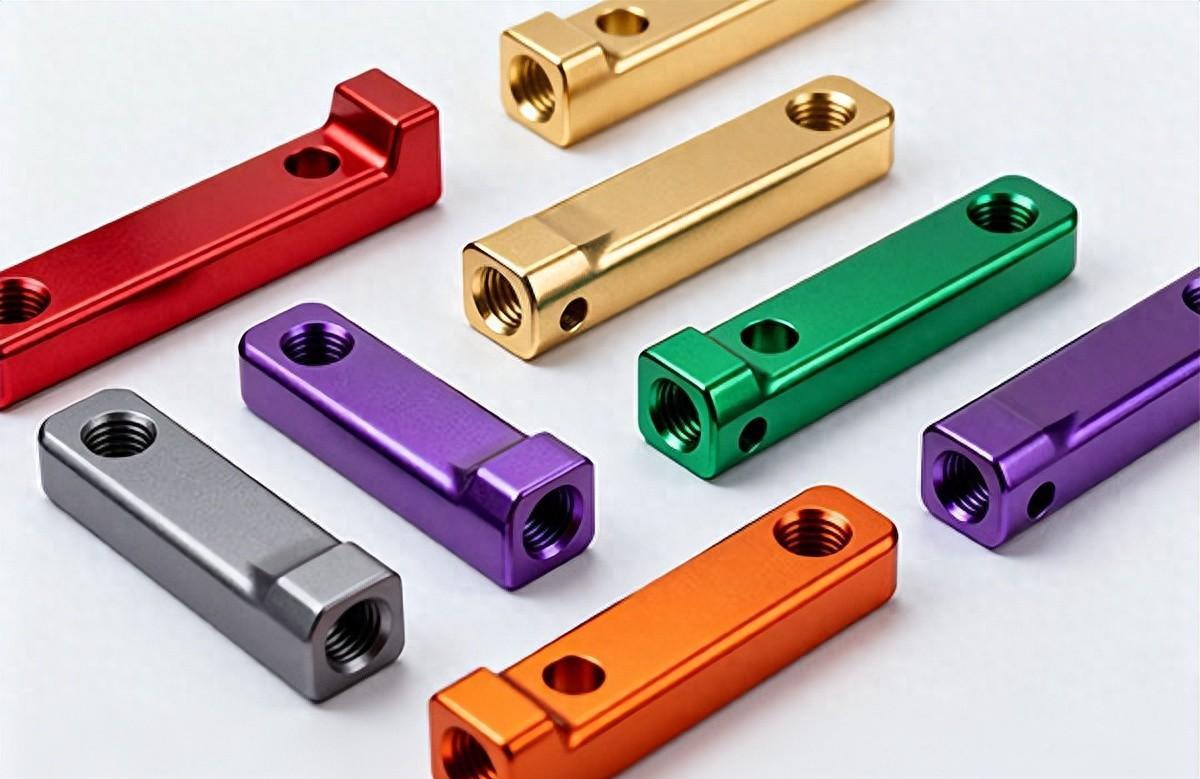
Unlike paint and powder coating, anodizing is a conversion coating rather than an added surface layer. During the electrochemical process, the outer layer of the aluminum substrate transforms into aluminum oxide.
This creates partial outward dimensional growth combined with partial consumption of the base material. The dimensional change is highly predictable and repeatable across batches, which makes anodizing the preferred coating method for precision CNC aluminum parts where dimensional stability is critical.
4. Powder Coating vs Wet Paint: Industrial Performance Comparison
Powder coating and wet paint represent the two most common organic surface treatments. Their performance gaps become most apparent under mechanical stress and environmental exposure.
4.1 Durability and Environmental Resistance
Powder coating forms a fully cross-linked polymer network after thermal curing. This structure delivers superior impact resistance, abrasion performance, and long-term outdoor durability compared to traditional wet paint. It also provides better corrosion protection and higher resistance to chipping and flaking.
Wet paint systems produce thinner films with lower mechanical strength. Their advantages include easier spot repair, lower processing temperatures, better suitability for very large structures, and greater flexibility for custom color matching.
4.2 Film Distribution and Edge Behavior
Electrostatic attraction causes powder coating to build thicker layers on sharp corners and edges. This edge buildup can create dimensional issues on mating interfaces and sealing surfaces, and it also raises the risk of uneven curing in recessed geometries.
Wet paint distributes more uniformly across edges and recesses, but it cannot match the mechanical robustness of powder coating in thick-film configurations.
4.3 Rework Capability and Production Flexibility
Once fully cured, powder coating is effectively irreversible. Defects require full stripping and complete reprocessing.
Wet paint supports localized touch-ups and in-process corrections. This makes it more forgiving for prototype development and low-volume iteration cycles.
5. Anodizing vs Powder Coating for Aluminum CNC Components
For aluminum CNC parts, the choice between anodizing and powder coating boils down to a core tradeoff: dimensional precision versus aesthetic flexibility.
5.1 Fundamental Process Difference
Anodizing transforms the substrate surface into an integral oxide layer through electrochemical reaction. The coating becomes part of the base material and cannot delaminate from it.
Powder coating deposits a separate polymer film on top of the substrate. It adheres through mechanical and chemical bonding but remains a distinct layer.
5.2 Dimensional Stability and Repeatability
Anodizing delivers low thickness variation and highly predictable dimensional change, with excellent batch-to-batch repeatability.
Powder coating introduces higher dimensional uncertainty. Results depend heavily on masking accuracy, and edge thickness variation is inherent to the electrostatic application process. It is generally not recommended for tight-tolerance mating features.
5.3 Mechanical and Wear Performance
Hard anodizing produces a much harder surface than any polymer coating. It is the standard choice for sliding components, wear surfaces, and mechanical guide structures that see repeated contact.
Standard powder coating systems are generally unsuitable for high-friction or precision wear interfaces.
5.4 Aesthetic and Color Flexibility
Powder coating supports an almost unlimited range of colors, gloss levels, and surface textures.
Anodizing produces a metallic, substrate-integrated appearance with a more limited color palette. It preserves the natural metallic feel of aluminum better than polymer coatings.
6. A Practical Framework for Surface Finish Selection
In real manufacturing environments, surface finish selection follows a hierarchy of constraints, starting with the most non-negotiable requirements:
- Service environment first: Corrosive, chemical, or high-wear conditions narrow down which coating systems are even feasible.
- Dimensional sensitivity second: Precision bores, mating surfaces, and threaded features determine whether a coating’s thickness can be accommodated in the design.
- Masking feasibility: Complex geometry can make masking prohibitively expensive or inconsistent across batches, requiring design changes instead of process compensation.
- Production volume: Prototype work favors flexible, reworkable processes; high-volume production demands stable, repeatable finishing with low labor input.
7. Common Coating Defects in Production
- Adhesion failure: Caused by incomplete surface preparation or residual contamination prior to coating application.
- Edge thickness variation: Typical of powder coating, driven by electrostatic concentration at sharp geometric features.
- Blistering: Caused by trapped moisture or volatile outgassing beneath the coating film during curing.
- Orange peel texture: Uneven surface finish resulting from unstable spray parameters or uncontrolled curing conditions.
8. Material-Specific Surface Finishing Strategies
Aluminum Components
Anodizing is the default industrial solution for CNC aluminum parts, thanks to its substrate integration and predictable dimensional behavior. Teams use powder coating only when color or texture requirements exceed what anodizing can deliver.
Steel and Carbon Steel Components
Steel requires external corrosion protection due to inherent oxidation susceptibility. Powder coating and zinc-based coating systems are the most common choices, selected based on exposure severity and cosmetic requirements.
Stainless Steel Components
Stainless steel relies primarily on passivation for corrosion resistance. Coatings are applied mostly for aesthetic or branding purposes, not for baseline protection.
Plastic and Polymer Components
Coating options are limited by thermal sensitivity and low surface energy. Low-temperature paint systems and surface activation treatments are typically required to achieve acceptable adhesion.
9. PartsMastery Coating and Surface Finishing Services
PartsMastery provides integrated coating and surface finishing as part of complete CNC manufacturing services. Our engineering teams review all coating specifications during the manufacturability analysis phase, before machining begins.
Our standard finishing capabilities include:
- Type II and hard anodizing for aluminum components
- Powder coating for steel frames, enclosures, and fabricated assemblies
- Electroless nickel plating for wear-resistant precision interfaces
- Black oxide for low-reflection steel and tooling components
- Wet paint systems for large fabricated structures
For tolerance-sensitive parts, we perform dedicated coating thickness impact reviews and implement masking strategies for critical features such as threaded holes, bearing seats, electrical contact surfaces, and precision mating interfaces.
We support both prototype and production volumes, with process controls designed to deliver consistent color, thickness, and performance across serial production batches.
10. Conclusion
The debate between coating and painting is not a question of terminology — it is a question of design intent. In precision CNC manufacturing, surface finishing is an engineering decision that impacts dimensional accuracy, assembly reliability, and long-term component performance.
A finish that works well cosmetically can fail mechanically if thickness, masking requirements, curing behavior, and material compatibility are not engineered into the design from the start. For precision components, surface finish selection belongs in the engineering specification, not in a post-production cosmetic review.
At PartsMastery, we integrate coating strategy into early-stage process planning to prevent fit issues, dimensional drift, and assembly failures across both prototype and production projects.
Frequently Asked Questions
Q: Does coating affect CNC machining tolerances?
Yes. Even thin coatings create measurable dimensional changes, especially on internal features, threads, and mating surfaces. Tight-tolerance designs must account for coating thickness or use targeted masking.
Q: Why does powder coating cause assembly fit problems?
Powder coating deposits material on every exposed surface, which reduces internal dimensions. Without design compensation or masking, the buildup can turn a designed clearance fit into an interference fit.
Q: Is anodizing better than paint for aluminum CNC parts?
For functional components, yes. Anodizing delivers superior wear resistance, corrosion protection, and dimensional stability compared to paint. Paint is preferred only when specific cosmetic requirements cannot be met with anodizing.
Q: Can a coating be applied without changing part dimensions?
No surface treatment has zero dimensional impact. However, anodizing and precisely controlled thin-film coatings have minimal and highly predictable dimensional effects, especially when paired with proper masking of critical features.
Q: What is the best coating for CNC machined aluminum parts?
For most industrial applications, Type II anodizing is the preferred choice. It balances corrosion resistance, surface hardness, and dimensional stability. Hard anodizing is specified for high-wear applications, and powder coating is used when custom color is required.
Q: Does powder coating affect threaded holes?
Yes. Powder buildup inside threaded holes reduces clearance and increases assembly torque. Critical threaded features are typically masked before coating, or re-tapped after curing to restore proper thread dimensions.