





Industrial robots, collaborative robots, AGVs and automation equipment keep evolving.
They shift toward lightweight design, fast response and high precision.
As a result, aluminum alloys have become the core material for robotic parts.
They deliver a high strength-to-weight ratio, strong corrosion resistance and excellent machinability.
Robotic parts work under constant reciprocating motion and high-speed positioning.
They must stay rigid without adding extra motion load.
Precision CNC machining is the core process to meet this need.
At PartsMastery, we deliver end-to-end custom CNC machining solutions.
Our services range from prototype development to full-scale mass production.
We work with common alloy grades including 6061, 6063 and 7075.
Specifically, our processes tightly control dimensional tolerance and hole position accuracy.
We also manage surface roughness and structural consistency.
This approach meets diverse machining needs across the robotics industry.
Common Aluminum Alloys for Robotic Applications
Different robotic components have unique performance requirements.
These include load capacity, weight, weather resistance and machinability.
For this reason, alloy grades must match actual working conditions and installation environments.
Below are the most common aluminum alloys we use for robotics applications:
| Alloy Grade | Key Performance Characteristics | Typical Robotic Applications | Machining Compatibility |
|---|---|---|---|
| 6061-T6 | Balanced strength, excellent corrosion resistance, outstanding machinability | Robotic arm brackets, motor mounting bases, connecting flanges | Highly versatile for milling, drilling and tapping operations |
| 6063-T5 | Exceptional lightweight properties, excellent formability | Equipment frames, protective structures, support profiles | Ideal for profile machining and simple structural milling |
| 7075-T6 | Ultra-high strength, high specific stiffness, excellent fatigue resistance | High-load moving components, robotic arm joints, end effectors | Requires optimized tooling and cutting parameters to control deformation |
| 6082-T6 | High strength, excellent corrosion resistance, superior structural stability | Heavy-duty machine bases, large robotic support frames | Suitable for precision milling and thick-plate structural machining |
| 5052-H32 | Superior corrosion resistance, excellent ductility | Thin-wall protective covers, housing structures, lightweight panels | Compatible with thin sheet stamping and CNC milling hybrid processes |
The right material choice maximizes weight reduction.
It also preserves full structural strength.
As a result, it boosts response speed and efficiency in robotic motion systems.
Core Machining Processes & Technical Advantages
Aluminum alloys offer excellent cutting performance for high-speed CNC work.
This enables efficient production of complex shapes and precision features.
Robotic parts often include weight-saving cavities, mounting holes and alignment slots.
They may also have reinforcing ribs and irregular curved surfaces.
To handle these features, PartsMastery uses targeted process strategies:
- CNC Milling: Finishes cavity, slot, hole and curved surface work in a single setup.
We select 3-axis, 4-axis or 5-axis tools based on part complexity.
This approach minimizes errors from repeated fixturing. - CNC Turning: Creates shafts, sleeves and flanged rotational parts.
It delivers precise control over diameters, end faces, grooves and concentricity. - Mill-Turn Combined Machining: Combines turning and milling in one setup.
It completes all machining features in a single run.
This method works especially well for complex, high-precision rotational parts.
Robotic machining often comes with common challenges.
These include thin walls, deep cavities and complex curved surfaces.
To address these issues, we use optimized tool paths and layered cutting.
We also apply proper workholding techniques.
This keeps deformation low and ensures dimensional stability.
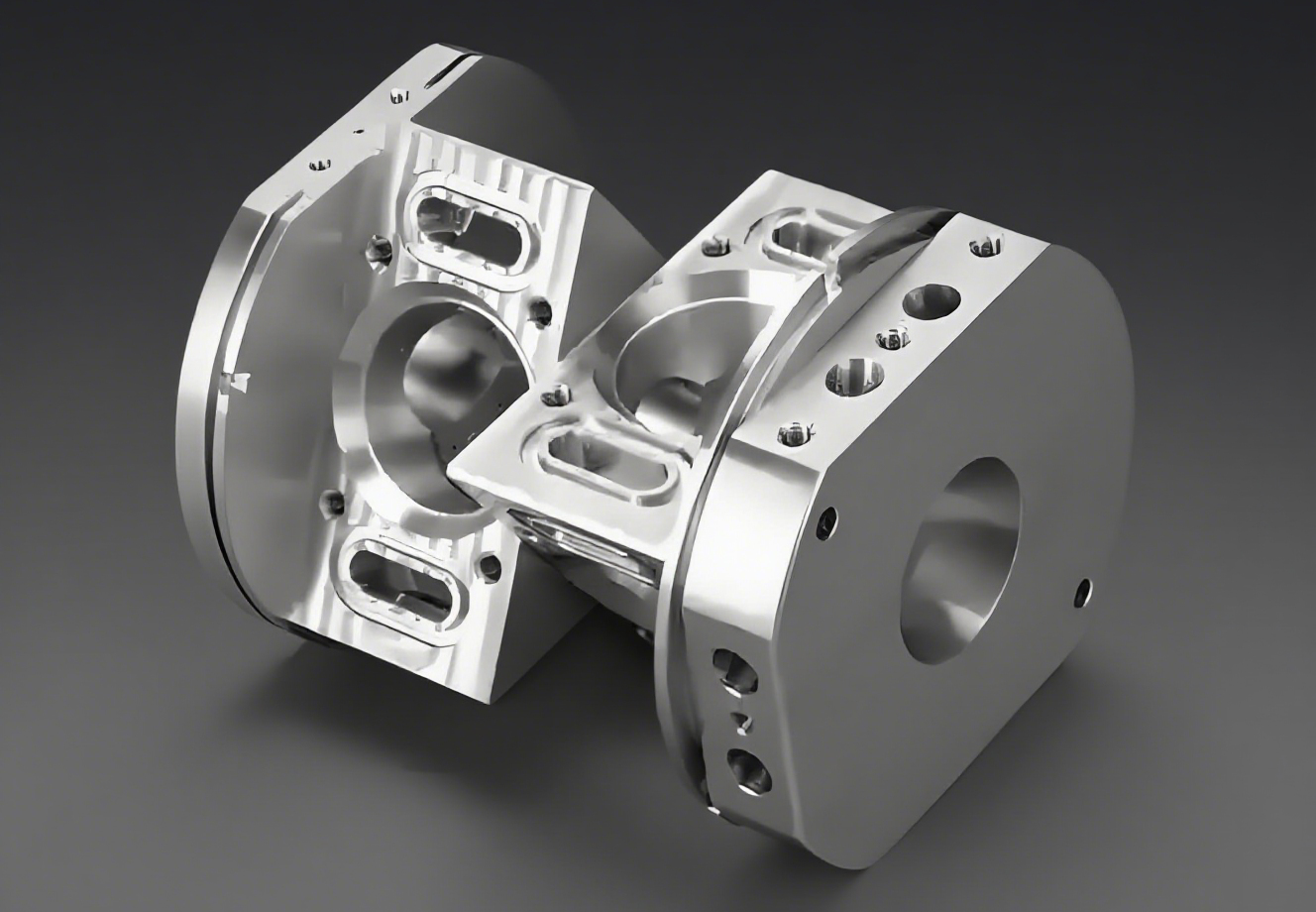
5-axis simultaneous machining of complex aluminum robotic structural parts
Standardized Full-Process Machining Workflow
PartsMastery uses a standardized workflow for aluminum robotic parts.
It covers every stage from design review to final delivery.
Notably, it ensures both high machining efficiency and consistent batch quality.
Our step-by-step process includes:
- DFM Design Review: Checks 3D models and 2D engineering drawings.
We confirm alloy grade, tolerances, hole positions and thread specs.
We also review surface finish requirements and offer manufacturability tips. - Process Planning: Selects the right machining method for each part.
We choose from 3-axis to 5-axis milling, turning or mill-turn setups.
We also map out machining sequences and workholding plans. - Production Preparation: Verifies material grade, specs and batch traceability.
We finalize tool selection and CNC program development.
We also set key parameters like spindle speed and cutting depth. - Workholding & Alignment: Uses dedicated fixtures for thin-wall and complex parts.
We add auxiliary supports and use soft jaws with locating pins.
This prevents deformation from too much clamping force. - Precision Machining: Runs roughing, semi-finishing and finishing in sequence.
Roughing removes excess material quickly.
Semi-finishing stabilizes part contours.
Finishing locks in critical feature dimensions. - Final Inspection: Checks critical dimensions, tolerances and surface roughness.
We use calipers, micrometers, pin gauges and optical tools.
Coordinate measuring machines (CMM) handle the most precise checks. - Post-Processing & Delivery: Applies your specified surface finishes.
We then clean, deburr and add corrosion protection.
Custom packaging ensures safe transit to your facility.
This flexible workflow works for prototypes, small batches and full mass production.
At the same time, it enables full traceability of dimensions and material batches.
Typical Applications & Key Machining Focuses
Aluminum CNC parts serve core components across the entire robotics value chain.
Each application scenario has its own machining priorities.
Robotic Arm & End Effector Components
Robotic arm joints and end effectors change direction and move at high speeds.
Their weight directly impacts dynamic response performance.
Machining focuses on lightweight design via cavities and hollowed slots.
At the same time, it preserves rigidity in load-bearing areas.
We also ensure high precision for mounting holes and locating surfaces.
This supports reliable assembly with motors, bearings and linear guides.
Collaborative Robot & AGV Components
Collaborative robots have very compact internal structures.
They must fit motors, sensors, gearboxes and controls in tight spaces.
Key machined parts include mounting bases, connecting blocks and sensor brackets.
For AGVs and mobile robots, priorities shift slightly.
Chassis rigidity and lightweight design are most important.
Common parts include motor brackets, wheel mounts and control box supports.
General Automation Equipment Components
This category includes linear guide bases, inspection platforms and fixtures.
It also covers positioning modules for automation lines.
The main focus here is structural flatness and hole position accuracy.
Consistent quality across batches also matters greatly.
These factors improve overall assembly precision for automation equipment.
Precision Control & Quality Assurance System
Aluminum alloys offer excellent overall machinability.
However, thin walls, deep cavities and lightweight shapes pose risks.
These parts can deform from cutting forces, clamping pressure and heat.
To solve this, PartsMastery uses a full-process quality control system.
It ensures consistent part accuracy and structural stability.
Our key control measures include:
- Deformation Control Measures: We optimize workholding with auxiliary supports to spread clamping force.
We use dedicated aluminum cutting tools and monitor tool wear.
Layered cutting strategies gradually release internal stress.
We also optimize cooling to reduce thermal deformation. - Full-Process Quality Inspection: First article checks confirm process stability.
In-process inspections monitor all critical dimensions.
Final inspection verifies every requirement on the drawing.
We use tighter criteria for precision holes, mating surfaces and alignment datums. - Batch Consistency Assurance: We use standardized CNC programs and process parameters.
Dedicated documentation and inspection standards support this work.
The result is consistent dimensions and full traceability across batches.
Surface Finishing & Assembly Operation Guidelines
The right surface finish depends on operating environment and performance needs.
You can choose from several common options:
- Standard anodizing: Improves corrosion resistance and surface hardness for general indoor use.
- Hard anodizing: Significantly boosts wear resistance for parts with frequent friction.
- Sandblasting & brushed finish: Enhances appearance and creates uniform surface texture.
Beyond surface finishing, follow these assembly and maintenance tips:
- Clear chips and burrs from holes, threads and locating surfaces before assembly.
This prevents damage and preserves assembly accuracy. - Control tightening torque for aluminum parts that disassemble frequently.
This helps avoid thread stripping damage. - Check connections regularly for looseness and abnormal wear during operation.
Also keep critical mating surfaces clean and free of debris.
Conclusion
Aluminum alloy CNC machining is central to lightweight, high-precision robotic equipment.
Proper material selection, process planning and quality control drive component performance.
PartsMastery specializes in custom precision parts for the industrial sector.
We have deep experience machining aluminum robotic components.
Our one-stop services range from DFM optimization to batch delivery.
We support industrial robots, cobots, AGVs and all types of automation equipment.