


In modern industrial manufacturing, material integrity, controllable costs, and stable delivery efficiency are the core indicators that engineers and procurement teams prioritize. Traditional thermal cutting processes often cause thermal deformation, edge hardening, and structural changes, which lead to secondary processing and additional costs. As a high-precision cold cutting solution, waterjet cutting eliminates heat-induced defects and supports almost all types of materials, making it widely used in aerospace, precision machinery, medical parts, and architectural decoration industries.
This article systematically introduces the principles, working procedures, two cutting modes, applicable materials, process comparisons, quality standards, and cost-saving strategies of waterjet cutting to help you make accurate manufacturing selections.
1. What Is Waterjet Cutting?
Waterjet cutting, also known as ultra-high pressure water jet cutting, is a purely physical cold working process. It removes material through continuous high-speed water impact or water-abrasive mixture erosion. Since no heat is generated during the entire cutting process, there is no thermal distortion, no edge oxidation, and no change in material molecular structure.
Modern industrial waterjet equipment is fully CNC-controlled, supporting complex 2D profiling and 5-axis three-dimensional cutting. It adapts to rapid prototyping and mass production, especially suitable for heat-sensitive alloys, composite materials, and fragile substrates that cannot be processed by laser or plasma cutting.
2. Working Principle and Complete Process
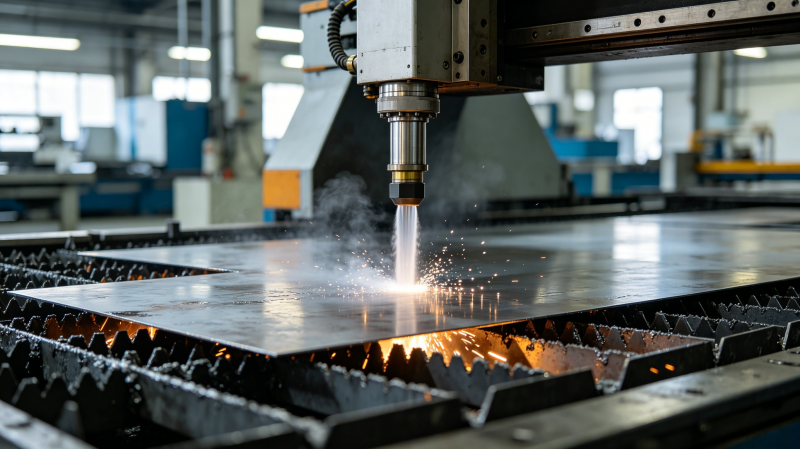
All industrial waterjet cutting systems follow three standardized and stable processing stages: water pressurization, high-speed nozzle acceleration, and abrasive mixing (for hard materials).
2.1 Water Pressurization
Ordinary tap water is filtered and softened before entering the high-pressure pump system. The standard industrial working pressure ranges from 30,000 to 90,000 psi, while advanced heavy-duty equipment can reach 100,000 psi. Two pump types are adopted: crankshaft direct-drive pumps for stable low-pressure cutting and intensifier pumps for ultra-high pressure heavy cutting tasks.
2.2 Nozzle Acceleration
Pressurized water passes through precision micro holes made of sapphire, ruby, or diamond. Pressure energy is instantly converted into powerful kinetic energy, ejecting water flow at up to three times the speed of sound to form an ultra-fine, high-density cutting beam.
2.3 Abrasive Mixing (Hard Material Cutting)
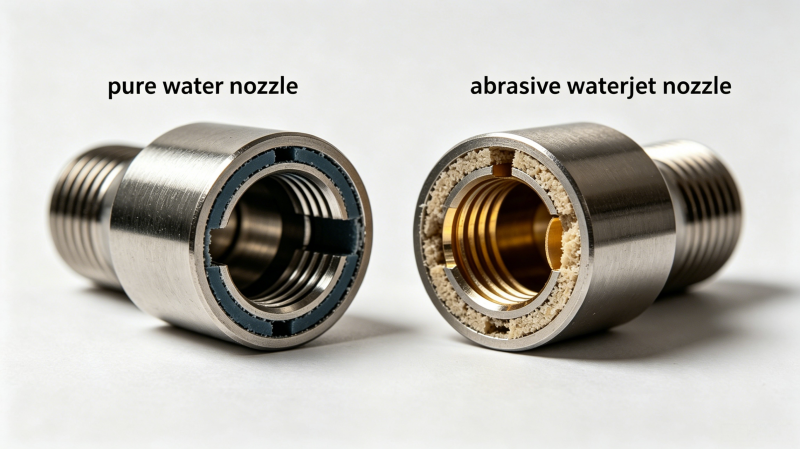
High-speed water creates vacuum negative pressure inside the mixing chamber, automatically inhaling garnet abrasive particles. The water-abrasive mixture is further accelerated in the focusing tube and removes hard materials through continuous micro-erosion. The machine supports free switching between pure water mode and abrasive mode without tool replacement.
3. Two Core Waterjet Cutting Modes
Waterjet technology is divided into pure water cutting and abrasive waterjet cutting according to different processing scenarios.
3.1 Pure Water Cutting (Abrasive-Free)
This mode relies entirely on high-velocity water flow. It features an extremely narrow kerf, zero residue, and no secondary pollution.
Ideal materials: Foam, rubber, textiles, leather, paper, food materials, thin plastic, cork, and other soft substrates.
メリット Fast cycling speed, low operating cost, and no surface damage to delicate materials.
3.2 Abrasive Waterjet Cutting (Industrial Mainstream)
Abrasive waterjet cutting adds garnet or alumina abrasives to the water flow, greatly improving cutting ability for dense and rigid materials. It covers most industrial custom cutting applications.
Ideal materials: Stainless steel, aluminum, titanium, copper, hardened steel, glass, stone, tiles, ceramics, carbon fiber composites, and hard plastics.
Professional Tip: For ultra-hard ceramic materials, use high-purity alumina abrasives to improve cutting speed and edge finish.
4. Applicable Materials and Processing Limitations
One of the greatest strengths of waterjet cutting is ultra-wide material compatibility. Operators only adjust feed speed and parameters instead of replacing tools. However, it still has clear processing boundaries.
4.1 Processable Materials
Metals: Waterjet cutting performs excellently for aerospace and medical precision parts. It easily cuts reflective metals up to 25 mm thick that interfere with laser cutting, including stainless steel, aluminum alloy, titanium alloy, copper, and hardened steel.
Composites, Glass & Stone: The cold cutting process prevents delamination and resin melting when cutting carbon fiber and fiberglass. It safely processes standard glass, art glass, and bulletproof glass up to 50 mm thick with low-pressure piercing technology. Granite, marble, and tile cutting achieves edge-free, dust-free, and heat-damage-free results.
4.2 Unprocessable Materials
Tempered glass shatters instantly after piercing due to internal stress. Diamond cannot be cut because its hardness exceeds standard garnet abrasives. Advanced ceramics above Mohs 8.5 require specialized silicon carbide abrasives instead of ordinary garnet.
5. Waterjet Cutting vs Laser, Plasma & Wire EDM
The following comparison helps manufacturers select the optimal process based on thickness, precision, and material characteristics.
|
Cutting Process
|
素材適合性
|
Max Cutting Thickness
|
Heat Affected Zone
|
Precision
|
Tool Change
|
Secondary Machining
|
|
ウォータージェット切断
|
Almost all materials (except tempered glass)
|
304mm (max 600mm)
|
None
|
±0.025mm
|
No
|
Minimal
|
|
レーザー切断
|
Non-reflective metals, partial plastics
|
Mild steel 25mm, Aluminum 10mm
|
Yes
|
±0.025mm
|
Yes
|
中程度
|
|
プラズマ切断
|
All metals
|
150mm
|
Yes
|
±0.25mm
|
Yes
|
中程度
|
|
ワイヤー放電加工機
|
Conductive materials only
|
300mm
|
Slight
|
±0.025mm
|
Yes
|
Minimal
|
Selection Advice: Laser cutting is faster and more cost-effective for thin metal sheets under 3mm. Waterjet cutting dominates for thick plates, reflective metals, heat-sensitive composites, and fragile materials.
6. Cutting Quality Grades & Tolerance Standards
Waterjet cutting quality is divided into five grades from Q1 (fastest, roughest) to Q5 (slowest, ultra-smooth). More than 90% of Q5-level cuts require no secondary finishing. For a 4-inch aluminum plate, Q1 cutting speed is 5.8 times faster than Q5.
For workpieces under 1 inch thick, the standard tolerance ranges from ±0.075mm to ±0.125mm, with a maximum precision of ±0.025mm. Ordinary waterjet produces a tiny taper below 1°, while 5-axis waterjet machines completely eliminate taper by tilting the cutting nozzle.
7. Custom Waterjet Cutting Cost Control Strategies
Manufacturers can significantly reduce production costs through optimized processing methods:
-
Optimize CAD nesting: The ultra-narrow kerf of waterjet allows dense part layout, improving material utilization by 15%–30% compared with traditional processing.
-
Multi-layer stack cutting: Cut multiple sheets simultaneously to shorten lead time.
-
Professional digital manufacturing platform: Obtain instant quotations and DFM analysis to avoid communication delays and ensure ISO-standard quality.
8. よくある質問
Does waterjet cutting require secondary finishing? Almost unnecessary. Waterjet edges are burr-free, slag-free, and oxidation-free, achieving finished-level surface quality directly.
Can waterjet cut painted or coated materials? Yes. The cold physical cutting process will not damage surface coatings, painting, or electroplating layers.
Does waterjet require purified water? Ordinary tap water is acceptable. Softening and filtration can extend the service life of high-pressure pumps and nozzles.
Is garnet abrasive environmentally friendly? Garnet is non-toxic and recyclable, with a recycling rate of over 70%, meeting green manufacturing standards.
結論
Waterjet cutting provides unmatched material versatility, zero thermal damage, and superior edge quality. It perfectly solves the processing pain points of thermal cutting and is the ideal solution for thick plates, composite materials, and high-precision industrial parts. For projects with strict requirements on material performance and cutting accuracy, waterjet technology remains one of the most reliable manufacturing choices.