





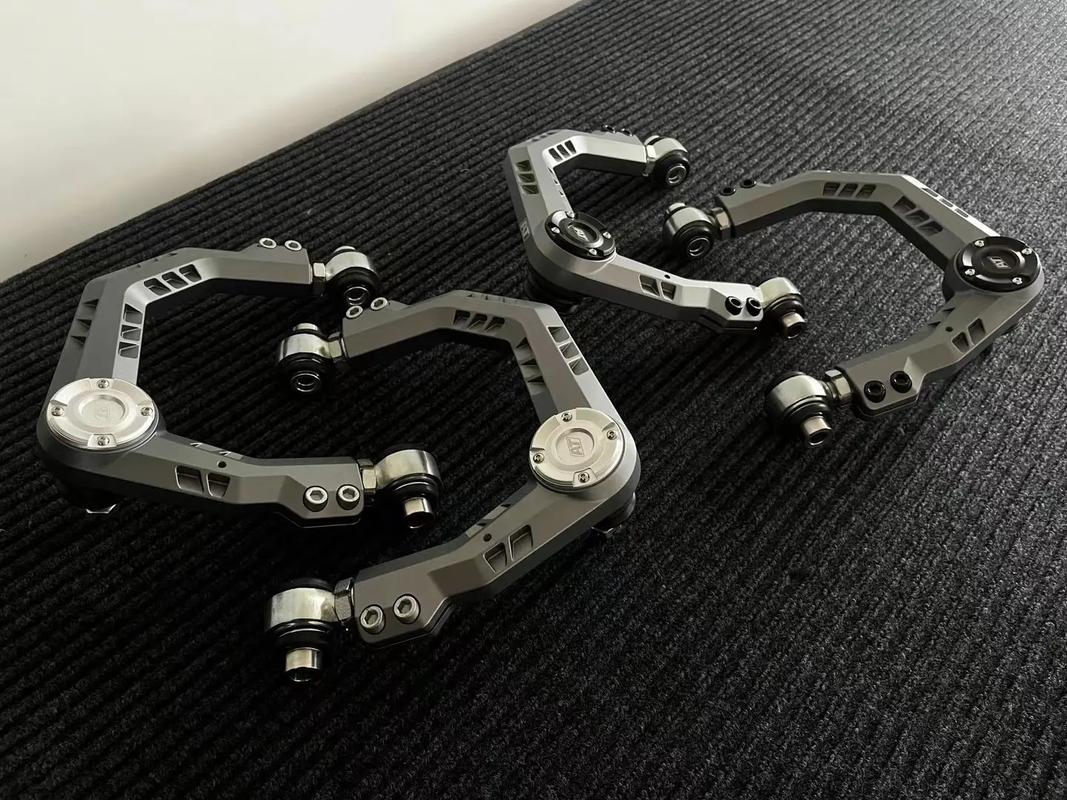
Off-road vehicles operate consistently across harsh terrain, from rocky gravel roads and muddy trails to steep mountain forest tracks. As the core assembly that supports the chassis, absorbs impact, and governs handling, the suspension system must withstand repeated shock loads, high-frequency vibration, and extreme dynamic forces. Put simply, the manufacturing precision and performance of core components—including control arms, steering knuckles, shock mounts, suspension links, wheel hubs, and bushings—directly define a vehicle’s ride stability, handling limits, and overall safety.
Compared to standard passenger vehicles, off-road suspension components face far stricter requirements for material strength, hole positioning accuracy, geometric tolerances, and assembly consistency. To meet these demands, CNC precision machining — built around 3-axis, 4-axis, and 5-axis milling plus CNC turning — delivers tailored manufacturing solutions matched to the structural and material properties of each suspension part. In fact, it is the foundational production process that ensures component reliability for all-terrain vehicles (ATVs), utility task vehicles (UTVs), off-road motorcycles, and other power sports equipment.
At PartsMastery, we specialize in precision component manufacturing for the power sports industry. Backed by a complete in-house CNC machining and quality control system, we provide custom manufacturing services for the full range of off-road suspension components. Notably, our support covers the entire project lifecycle, from prototype development and low-volume trial runs to full-scale mass production.
1. Core Machining Requirements for Off-Road Suspension Components
1.1 Precision Hole Positioning and Geometric Tolerance Control
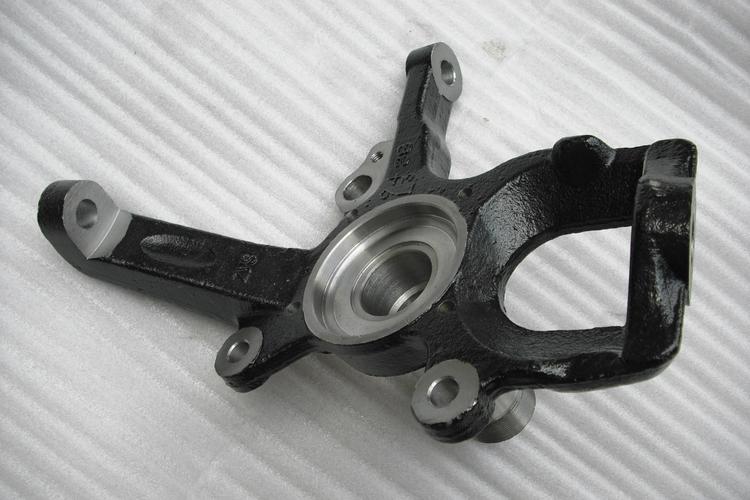
Off-road suspension components typically integrate multiple sets of mounting holes, bearing bores, threaded holes, datum surfaces, and curved geometries. For this reason, geometric tolerances such as hole spacing, concentricity, flatness, and position accuracy directly impact assembly fit and kinematic performance.
Out-of-tolerance hole positioning causes more than just assembly difficulties. Beyond that, it can lead to suspension binding, uneven load distribution, accelerated wear, and even catastrophic component failure. For this reason, a stable datum system, precise control of critical hole locations, and strict geometric tolerance management are essential throughout the entire machining process.
1.2 Balanced Strength and Lightweight Design
Above all, suspension components must withstand extreme impact loads while minimizing unsprung mass to boost vehicle dynamic response and handling. For structural parts such as control arms and mounting brackets, high-strength aluminum alloys including 6061-T6 and 7075-T6 are the preferred choice thanks to their exceptional strength-to-weight ratio.
On the other hand, for components with higher load and wear requirements such as steering knuckles and pivot pins, alloy steels and stainless steels are used instead. In the end, optimized material selection and structural design deliver maximum weight reduction without compromising structural integrity.
1.3 Surface Performance for Harsh Environments
In real-world off-road conditions, suspension components are continuously exposed to mud, moisture, sand, dust, and constant rock impact. As a result, they are highly prone to corrosion and abrasive wear over time.
After CNC machining, various surface treatments can be applied based on material and application. Common options include anodizing, hard anodizing, sandblasting, passivation, and e-coating. All of these treatments significantly improve corrosion resistance, wear resistance, and environmental durability, effectively extending component service life.
2. Key CNC Machining Processes for Off-Road Suspension Components
Suspension components with different structural features require matched CNC machining processes. When implemented correctly, this achieves the optimal balance of precision, efficiency, and production cost.
2.1 CNC Milling
Looking first at CNC milling, components such as control arms, shock mounts, steering knuckles, and suspension mounting brackets typically feature complex outer contours and multiple hole patterns. For this reason, they are ideally suited for this production method.
With optimized tool path planning, the process delivers precision machining of planes, curved surfaces, pockets, slots, and chamfers. Additionally, it ensures consistent dimensional and geometric accuracy across every production batch.
2.2 CNC Turning
Moving to rotary parts, suspension components such as pivot pins, bushings, shims, and wheel hubs are manufactured efficiently and accurately via CNC turning. This process provides tight dimensional control over outer diameter, inner bore, end faces, grooves, and threads.
This level of control ensures excellent dimensional consistency and fit accuracy across production runs. Furthermore, it works equally well for prototype development and volume production, offering maximum manufacturing flexibility.
2.3 5-Axis Simultaneous Machining
For the most complex geometries, some off-road suspension components feature angled surfaces, 3D contours, and multi-directional machining features. Unfortunately, traditional 3-axis machining requires multiple setups, which introduces cumulative positioning error.
By contrast, 5-axis simultaneous machining completes multi-sided machining in a single setup. This reduces setup count and alignment error, allows tools to approach the workpiece at optimal angles, and greatly improves machining efficiency and positional accuracy for complex parts.
3. Machining Solution Matrix for Common Off-Road Suspension Components
Different suspension components have distinct structural features and performance priorities. Accordingly, their corresponding machining processes and quality control focus points also vary. The matching matrix is outlined below:
| Suspension Component | Primary Machining Process | Key Quality Control Points |
|---|---|---|
| Control Arm | CNC Milling, 5-Axis Machining | Hole position accuracy, flatness, overall profile tolerance |
| Steering Knuckle | CNC Milling, 5-Axis Machining | Bearing bore accuracy, mounting hole position, geometric tolerance |
| Shock Mount | CNC Milling | Hole spacing, perpendicularity, mounting datum dimensions |
| Suspension Link | Combined CNC Milling & Turning | Bore concentricity, thread quality, dimensional tolerance |
| Pivot Pin | CNC Turning, Precision Grinding | Outer diameter roundness, surface roughness, wear resistance |
| Bushing | CNC Turning | Inner/outer diameter, concentricity, fit tolerance |
| Wheel Hub | Combined CNC Turning & Milling | Concentricity, hole pattern accuracy, end face flatness |
4. PartsMastery End-to-End Machining Quality Control System
At PartsMastery, we have established a complete manufacturing control chain from design intake to final delivery. In doing so, we ensure every suspension component meets the strict demands of off-road operating conditions.
4.1 Drawing Review and DFM Manufacturability Analysis
Before production begins, our engineering team conducts a thorough review of customer-supplied 3D models and 2D engineering drawings. Specifically, we perform a full Design for Manufacturing (DFM) analysis covering wall thickness, bore diameter, chamfers, machining datums, and tool accessibility.
This proactive approach identifies potential manufacturing challenges and design risks early on. Beyond that, it allows us to optimize process plans, reducing downstream production costs and lead times.
4.2 Material Selection and Precision Machining Execution
First, we select the optimal engineering material based on each component’s load rating, operating environment, and lightweight requirements. Next, we develop the optimal machining route, tooling strategy, and fixturing approach based on part geometry.
Appropriate stock allowance is reserved for all critical mating surfaces. Ultimately, final accuracy is ensured through a multi-stage process including roughing, semi-finishing, and finishing operations.
4.3 Full-Dimensional Inspection and Quality Validation
Once machining is complete, all critical parameters undergo full inspection. These include bore diameter, hole spacing, overall dimensions, flatness, concentricity, and position accuracy.
For high-precision suspension components, a Coordinate Measuring Machine (CMM) is used for full-dimensional verification against engineering drawings. In turn, this guarantees every part meets design and assembly specifications.
5. Key Strategies to Improve Suspension Component Machining Efficiency
Off-road suspension production typically involves high-mix, low-volume runs, complex geometry, and high levels of customization. Fortunately, targeted process optimization can significantly improve machining efficiency and reduce overall manufacturing costs.
For complex components such as control arms and steering knuckles, multi-axis machining cuts down on repeated setup and alignment time. When it comes to rotary parts like pins and bushings, by contrast, CNC turning delivers highly efficient volume production.
As for high-mix, low-volume projects, standardized fixturing and modular machining programs streamline changeover and setup time. Altogether, this targeted approach strikes the optimal balance of cost and efficiency.
Conclusion
Whether for ATVs, UTVs, off-road motorcycles, or high-performance custom off-road vehicles, suspension system reliability is ultimately built on precision component manufacturing.
As a trusted manufacturing partner, PartsMastery leverages comprehensive in-house CNC milling, CNC turning, and 5-axis machining capabilities plus a full-cycle quality control system. We deliver tailored precision machining solutions matched to the material, geometry, tolerance, and production volume requirements of any off-road suspension component.
From prototype validation to full volume production, PartsMastery delivers consistent precision, reliable quality, and efficient delivery. In short, we provide solid manufacturing support for off-road power sports vehicles.