





In precision CNC machining, 3+2 axis machining and 5-axis simultaneous machining are often confused. Both systems use three linear axes and two rotary axes, but they follow fundamentally different motion logic during cutting. This difference directly determines the types of parts each process can produce, programming workload, surface finish quality, production cycle time and final manufacturing cost.
This article systematically breaks down the working principles, performance boundaries and cost structures of the two machining processes, defines their optimal application scenarios, and provides actionable selection methodology. It helps engineers and procurement teams choose the most cost-effective machining solution based on part geometry, tolerance requirements, lead time and budget.
1. Process Definitions and Core Working Principles
1.1 3+2 Axis Machining (Positional 5-Axis Machining)
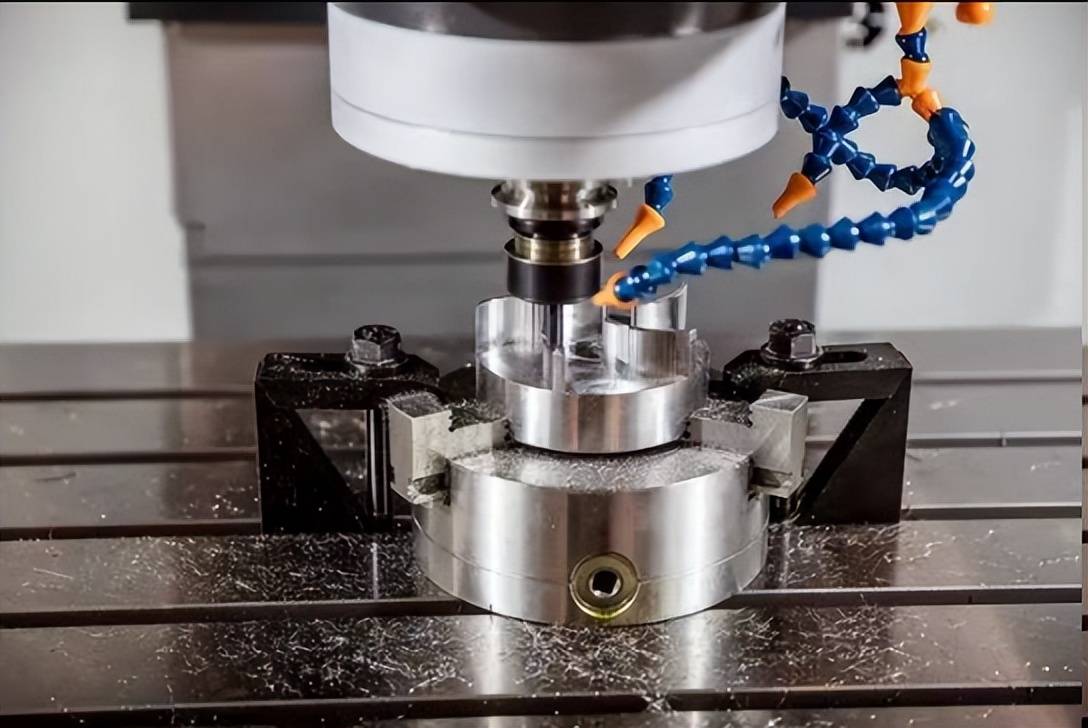
3+2 axis machining, also called indexed 5-axis machining or 5-sided machining, works on a core logic: the two rotary axes tilt the workpiece or spindle to a specified angle and then lock firmly in place, after which cutting operations run in standard 3-axis mode.
After machining one face or feature set, the tool retracts, the rotary axes index to the next position and lock again, and the next stage of 3-axis toolpath execution begins. Through multi-position indexing, operators can machine multiple angled faces, side holes and cavities in a single setup, which greatly reduces manual repositioning work and datum alignment errors.
Since the cutting phase uses mature 3-axis machining strategies, it has a low programming threshold and high process stability. It suits most prismatic parts with angled features, and remains the mainstream solution for balancing efficiency and cost.
1.2 5-Axis Simultaneous Machining

The defining feature of 5-axis simultaneous machining is that the three linear axes and two rotary axes move continuously and synchronously during cutting. The CNC control system calculates the tool’s spatial position and orientation in real time, so the cutting edge always feeds along the normal direction or preset angle of the target surface.
Continuously adjustable tool orientation accommodates special geometric structures such as freeform surfaces, twisted blades, complex undercuts and variable-angle cavities. It also allows the use of shorter, stiffer cutting tools by tilting the tool away from side walls and fixture interference, improving cutting stability.
This process imposes higher requirements on CAM software, post-processors, machine calibration, control systems and programmer capabilities. The full workflow requires a complete collision simulation system to avoid dynamic interference between the tool holder, spindle, fixture and workpiece.
2. Full Comparison of Core Performance Dimensions
The difference between the two processes is not simply a matter of axis count. It reflects a full-spectrum gap in motion logic, application scenarios and return on investment. The key comparison is as follows:
| Comparison Dimension | 3+2 Axis Machining | 5-Axis Simultaneous Machining |
|---|---|---|
| Rotary axis motion mode | Positioned and locked before cutting; stationary during machining | Continuous synchronous motion throughout cutting |
| Cutting execution logic | 3-axis cutting at fixed angles | 5-axis coordinated interpolation cutting |
| Ideal geometry | Prismatic parts, angled holes, fixed-angle cavities | Freeform surfaces, continuously variable angles, complex undercuts |
| Programming & simulation difficulty | Moderate; reuses 3-axis machining strategies | High; requires full tool orientation control and collision simulation |
| Collision interference risk | Check required during indexing; low risk during cutting | Dynamic risk throughout the process; full machine simulation required |
| Surface blending & finish | Tool marks may appear between indexed faces | Smooth continuous surfaces with minimal witness lines |
| Overall machining cost | Lower | Higher |
| Setup reduction benefit | Significantly reduces setups for multi-sided parts | Significantly reduces setups for complex parts |
| Core process value | Efficient multi-sided feature machining with high cost performance | Maximum geometric freedom for complex curved surfaces |
3. In-Depth Analysis of Key Performance Aspects
3.1 Tool Orientation Control and Cutting Rigidity
In 3+2 axis machining, the tool axis stays fixed for each operation, equivalent to running standard 3-axis cutting in a temporary coordinate system. With the rotary axes clamped, the overall machine rigidity is higher, delivering more stable cutting and longer tool life during roughing, drilling and face milling operations.
5-axis simultaneous machining adjusts tool orientation in real time to optimize cutting edge contact angle and avoid interference between the tool holder and workpiece side walls. This allows shorter tool overhang and improved rigidity. However, continuous rotary motion places higher demands on the machine’s dynamic accuracy. Poorly optimized toolpaths can reduce cutting stability and introduce surface chatter marks.
3.2 Geometric Accessibility Boundaries
3+2 axis machining works well for parts with features distributed across multiple planes, where each feature can be machined from a fixed angle. Typical examples include housings with side holes, brackets with angled mounting faces, fixtures with multi-sided cavities and valve bodies with cross flow channels. A single setup covers 5-sided machining and effectively eliminates cumulative datum errors from repeated fixturing.
5-axis simultaneous machining serves scenarios where the tool angle must change continuously, such as turbine blades, impellers, orthopedic implants, complex mold cavities and aerospace skins. These parts cannot be broken down into a limited number of fixed machining planes. Forcing indexed machining would result in unmachined areas, step marks or poor tool contact.
3.3 Accuracy and Surface Quality Performance
“5-axis is always more accurate than 3+2” is a common misconception. Machining accuracy depends on machine calibration, fixture rigidity, tool condition and inspection systems, not simply the number of axes.
3+2 axis machining achieves extremely high positional accuracy for holes, planes, cavities and angular features. Locked rotary axes eliminate motion chain backlash, making dimensional consistency easier to control. Machining multi-sided features in one setup also removes cumulative errors from repeated positioning.
The strength of 5-axis simultaneous machining lies in the contour accuracy and surface finish of continuous curved surfaces. It delivers seamless finish machining without witness marks, and shorter tools reduce deflection for deep-cavity thin-wall parts. Even so, final surface quality still depends directly on rotary axis follow-up accuracy, machine calibration, stepover distance and feed control.
3.4 Programming, Simulation and Process Control Requirements
3+2 axis programming has a lower barrier. Programmers only need to define indexing angles and work planes, then apply proven 3-axis toolpath strategies. They only need additional collision checks during indexing movements.
5-axis simultaneous programming requires continuous tool vector control. The CAM system must calculate tool approach angles, feed rates, tilt limits, machine travel limits and collision avoidance all at once. A reliable process must include full digital twin simulation of the machine, covering the spindle, rotary table, fixture, blank, tool holder and cutting tool, to avoid the common risk of verifying only the tool tip while ignoring tool holder collisions.
Post-processor matching is equally critical. The post-processor must precisely match the machine’s kinematic structure and control system parameters. Otherwise, a toolpath that passes CAM simulation may still produce unexpected rotary motions on the actual machine.
4. Full-Spectrum Machining Cost Comparison
The cost difference between the two processes goes far beyond hourly machine rates. It covers the full cost chain of programming, fixturing, tooling, simulation, inspection and production risk. More advanced processes are not always more expensive; proper selection can optimize total cost.
4.1 Equipment and Machine Hour Costs
Machine tools capable of high-precision 5-axis simultaneous machining require higher-accuracy rotary tables, encoders, servo systems and calibration routines. Their purchase and maintenance costs are significantly higher, which translates into higher hourly machining rates.
3+2 axis machining can run on dedicated 5-axis machines or on 3-axis machines upgraded with an indexing rotary table, resulting in lower equipment investment. Even when running 3+2 programs on a 5-axis machine, programming and verification costs are much lower than full simultaneous machining, delivering better overall cost efficiency.
4.2 Programming, Fixturing and Inspection Costs
3+2 axis programs take less time to prepare, because they can reuse mature 3-axis toolpaths and canned cycles. Programming time is typically 30–50% of that for 5-axis simultaneous machining. Fixture design must avoid rotary interference, but is still far less complex than fixtures for simultaneous machining.
5-axis simultaneous machining requires more engineering hours for tool orientation optimization, collision avoidance, toolpath smoothing, post-processor validation and first-article verification. In addition, inspection of freeform parts requires CMM scanning and profile evaluation, which also raises quality control costs.
4.3 Impact of Part Complexity and Production Volume
For simple multi-sided parts, 3+2 axis machining has a clear cost advantage: it reduces manual setup work and avoids the extra programming overhead of simultaneous machining.
As part geometry complexity increases, 5-axis simultaneous machining can offset its higher programming and machine costs by reducing operation steps, shortening finish paths and eliminating manual polishing operations.
Production volume also shapes the cost model. For single prototypes, programming and fixturing costs fall entirely on one part, making 3+2 axis machining more attractive. For production batches, upfront preparation costs spread across multiple parts, so cycle time and tool life become the dominant cost factors. At that point, teams must evaluate the unit output efficiency of both processes comprehensively.
4.4 Hybrid Strategy as the Optimal Cost Solution
In industrial practice, a hybrid strategy of “3+2 roughing + 5-axis simultaneous finishing” usually delivers the best cost-performance ratio.
Roughing, drilling and face milling operations use stable 3+2 indexed machining, and only complex surfaces that require continuous tool motion run in 5-axis simultaneous finishing mode. This model avoids paying a premium process price for every feature, while fully leveraging the quality benefits of 5-axis capability. It has become the mainstream optimization direction in precision machining.
5. Typical Application Scenarios and Industry Adaptation
Process selection should never rely only on the visual complexity of a part. Instead, engineers should break features down one by one: a complex-looking part may be dominated by flat faces and angled holes, while a seemingly simple part may contain a surface that requires simultaneous machining.
5.1 Best-Fit Scenarios for 3+2 Axis Machining
- Multi-sided feature parts: valve bodies, manifolds, electronic housings, machine brackets, transmission covers, fixture base plates, etc.
- Angled hole and feature parts: parts requiring multi-angle drilling, reaming, countersinking and tapping. Indexing aligns the hole axis with the spindle for stable, accurate hole production.
- Deep cavity parts: tilting the workpiece shortens tool length, reduces chatter and tool deflection, and improves deep cavity machining quality.
- Mold inserts with fixed draft angles, medical device structural parts with multi-sided features, and similar components.
5.2 Best-Fit Scenarios for 5-Axis Simultaneous Machining
- Freeform surface parts: impellers, turbine blades, blisks, propellers, aerodynamic profile parts, etc.
- Medical implants: orthopedic prostheses, bone plates, anatomical surgical instruments and other parts with complex transition surfaces.
- Complex molds: deep cavity dies, forming tools with steep walls or undercuts, engraved cavities. The process reduces witness lines and manual bench work.
- Complex tube ports, variable-angle chamfers, continuous undercuts and other features that cannot be efficiently machined from fixed angles.
5.3 Industry-Specific Selection Patterns
Aerospace: Structural brackets and housings mostly use 3+2 axis machining; blades, blisks and aerodynamic surfaces require 5-axis simultaneous machining.
Medical industry: Instrument bodies and device housings work with 3+2 axis machining; implants and curved surgical components need 5-axis simultaneous finishing.
Automotive industry: Housing and bracket parts fit 3+2 axis machining; intake ports and complex surface prototypes require simultaneous motion.
Mold making: Roughing and hole features use 3+2 strategies; cavity surfaces, deep ribs and complex chamfers receive 5-axis simultaneous finishing.
Industry category only serves as a reference. Different parts within the same product, or even different features on the same part, may correspond to different optimal processes.
6. Scientific Selection Methods and Common Misconceptions
6.1 Core Steps for Process Selection
- Disassemble part features: Break the part model into individual features, judge whether each can be machined from fixed angles, and count the required indexing positions.
- Match accuracy and surface requirements: Distinguish critical surfaces from non-critical ones. Sealing faces, fitting holes and cosmetic surfaces each correspond to different process solutions.
- Evaluate full-chain costs: Compare the total cost of programming, fixturing, machine time, tooling and inspection, not just hourly machine rates.
- Prioritize hybrid strategies: Prefer a “3+2 primary, 5-axis simultaneous secondary” hybrid approach to control costs while guaranteeing quality.
6.2 Typical Selection Misconceptions
Misconception 1: 5-axis simultaneous machining is always more advanced and better performing
5-axis simultaneous machining only means greater geometric freedom. It does not mean it outperforms 3+2 axis machining in accuracy and efficiency across the board. For facing, drilling, roughing and similar operations, fixed-index 3+2 axis machining offers better rigidity, higher efficiency and lower cost. Forcing simultaneous machining can actually reduce process stability.
Buyers should also clarify what “5-axis machining” means in a quotation. Some machines advertised as 5-axis only support 3+2 indexed machining, not continuous simultaneous motion. Parts requiring continuous contour machining should be clearly specified as 5-axis simultaneous.
Misconception 2: Ignoring tool accessibility and fixture interference
A 5-axis machine is not universal. Fixtures, clamps, tables, spindles and tool holders still occupy physical space and limit accessible angles. Part designers should reserve enough clearance around deep walls, chamfers and closely spaced features. Internal corner radii should match actual tool sizes, and deep cavities should not force unnecessarily long tools.
Datum selection is also critical. The machining plan must keep critical features tied to stable reference points. Reducing setup count only makes sense if the fixture locates the part reliably and the datum strategy supports downstream inspection. Otherwise, it introduces greater quality risks.
7. Frequently Asked Questions
Q1: Is 5-axis machining always more efficient than 3+2 axis machining?
A: For complex curved parts, 5-axis simultaneous machining is faster overall because it reduces setup count and operation steps. For simple prismatic and hole-dominated parts, 3+2 axis machining delivers better cutting and programming efficiency, with faster overall delivery.
Q2: What are the main limitations of 5-axis simultaneous machining?
A: Its core limitations are high equipment cost, high programming and simulation barriers, and strict process control requirements. For geometrically simple parts, using 5-axis simultaneous machining creates process redundancy, which sharply increases manufacturing cost without delivering quality benefits.
Q3: Does 5-axis machining inherently deliver higher accuracy?
A: No. Machining accuracy depends on machine calibration status, fixture rigidity, tool precision, temperature control and inspection systems. A well-controlled 3+2 axis process can easily achieve higher dimensional accuracy than a poorly managed 5-axis process.
Q4: Can 3+2 axis machining replace multiple 3-axis setups?
A: Yes. One of the core values of 3+2 axis machining is to replace manual multi-setup work with indexing. It not only cuts setup time, but also eliminates datum errors from repeated positioning and improves positional consistency across multi-sided features.
Conclusion
There is no absolute superiority between 3+2 axis and 5-axis simultaneous machining. The right choice depends on matching the process to a part’s geometric features and performance requirements. 3+2 axis machining offers a cost-effective solution for multi-sided parts, angled holes and cavities. 5-axis simultaneous machining is essential for complex surfaces and continuously variable-angle structures.
In actual production, a flexible hybrid strategy combining both processes usually achieves the best balance of quality, efficiency and cost. PartsMastery specializes in precision CNC machining services for complex prototypes and low-volume production parts. We evaluate tool accessibility, orientation requirements, workholding solutions, tolerances, surface finish and production requirements feature by feature, and deliver customized 3+2 axis, 5-axis simultaneous or hybrid process solutions to ensure part quality at optimal cost efficiency.