






With the advancement of precision CNC machining technology, engineering plastics are no longer limited to low-end cosmetic parts. Today, manufacturers machine them into high-precision, complex-structured, performance-stable industrial functional components. CNC plastic machining controls tool movement via numerical control programs to perform accurate cutting on engineering plastic rods, sheets and billets, producing finished components that fully match design specifications.
Compared with metal parts, engineering plastic components offer unique advantages including light weight, excellent electrical insulation, strong corrosion resistance and low friction coefficient. For this reason, they see wide use across electronics, semiconductor, automotive, medical device and automation equipment industries. Different plastic materials deliver very different performance profiles, so material selection directly determines the final service life and reliability of each part.
This guide systematically breaks down the core part categories, material selection logic and industry application scenarios for CNC plastic machining, providing structured professional reference for product developers, process designers and procurement teams.
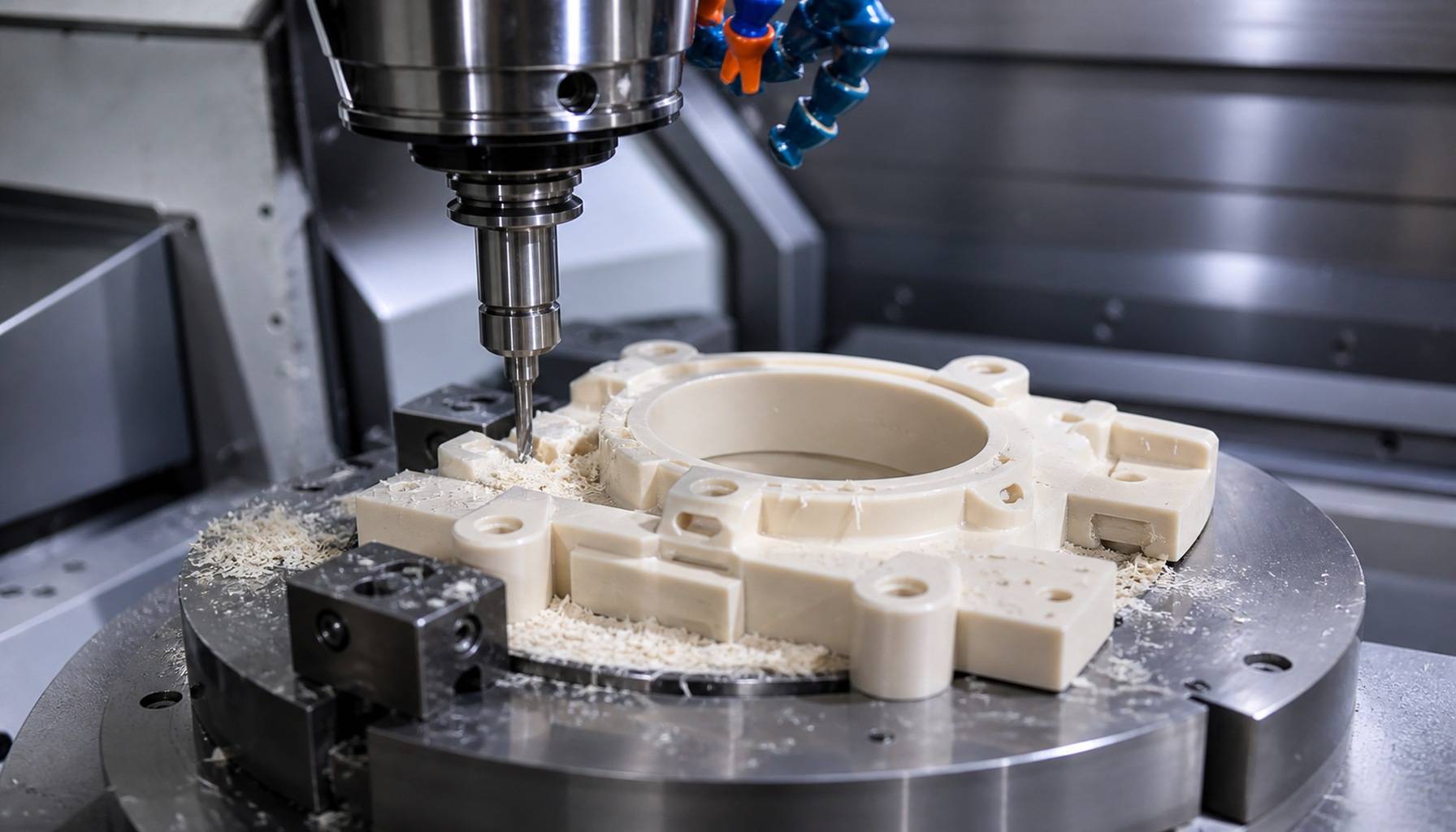
1. Core Technical Characteristics of CNC Plastic Machining
Unlike injection molding, 3D printing and other plastic manufacturing processes, CNC cutting offers irreplaceable advantages in accuracy, material performance and design flexibility. It stands as the preferred solution for low-volume, high-precision plastic parts.
- Micron-level dimensional accuracy: Standard machining tolerances stay reliably within ±0.01 mm, and high-precision mating surfaces can reach ±0.005 mm. Surface roughness drops as low as Ra 0.8 μm, meeting strict assembly and sealing requirements.
- Fast delivery without tooling: The process requires no upfront mold investment. Production can start with only a 3D drawing, delivering much shorter lead times for prototypes and low-volume parts than injection molding, with extremely low design revision costs.
- Full retention of material properties: Manufacturers cut parts directly from solid billet material. This eliminates internal stress, shrinkage deformation and molecular orientation issues common in injection molded parts, resulting in better mechanical strength, wear resistance and dimensional stability.
- Strong adaptability to complex structures: It handles deep cavities, thin walls, shaped slots, precision inner bores and other complex structures. It also supports fully custom design without the constraints of mold geometry.
2. Core Manufacturable Part Categories and Technical Requirements
CNC plastic machining covers a very wide range of part types. By function and application scenario, we can group them into four core categories, each with its own material selection standards and accuracy requirements.
2.1 Mechanical Transmission and Wear-Resistant Parts
This category represents the core application of engineering plastics in the mechanical field. Its key requirements include wear resistance, self-lubrication and dimensional stability. In low-load scenarios, these parts can replace metal components to achieve noise reduction, weight reduction and lubrication-free operation.
- Plastic gears and transmission components: These include spur gears, helical gears, worm gears and sprockets. CNC machining delivers precise control over tooth profile dimensions, pitch accuracy and center hole position to prevent binding and abnormal noise during operation. Common materials include POM, PA and PEEK, and the parts see wide use in transmission systems for automation equipment, office devices and precision instruments.
- Bushings, sliders and guide assemblies: These parts mainly perform support, guiding, friction reduction and cushioning functions. Plastic bushings avoid direct metal-on-metal contact, reduce wear and operating noise, and cut down on lubrication maintenance. POM bushings, PA sliders and PTFE guide components are standard parts in automated production lines, packaging machinery and conveyor systems.
2.2 Workholding Fixtures and Positioning Jigs
Assembly, inspection and machining operations in production rely heavily on auxiliary tooling to secure and position workpieces accurately. Plastic fixtures are extremely popular in electronics manufacturing thanks to their light weight, non-scratching properties and insulating, anti-static performance.
Common products include assembly fixtures, PCB test jigs, positioning pressure plates and workpiece trays. For delicate electronic housings, glass panels and optical components in particular, plastic fixtures effectively prevent scratches and indentations that metal fixtures would cause. CNC machining produces complex positioning structures tailored to exact workpiece shapes, with stable repeatable positioning accuracy ideal for high-mix, low-volume production environments.
2.3 Electronic, Electrical and Insulating Structural Parts
The electronics and semiconductor industries impose strict requirements for insulation performance, dimensional accuracy and cleanliness. Metal parts carry risks of electrical conduction and signal interference, making engineering plastics an ideal alternative.
- General insulating components: These include insulating gaskets, electrical support bases, connection structures and circuit board test jigs. Common materials such as FR4, POM and PEEK ensure electrical safety while meeting structural strength requirements.
- Semiconductor-specific components: These include wafer positioning seats, vacuum chuck parts, inspection jigs and insulating structures. These parts operate in high-cleanliness, chemically aggressive or high-temperature environments, so most use high-performance plastics such as PEEK and PPS to meet strict requirements for low outgassing, chemical resistance and dimensional stability.
2.4 Equipment Housings and Functional Structural Parts
For prototype development, special-purpose equipment and low-volume electronic products, CNC machining is a highly efficient manufacturing solution for housings and structural components.
Manufacturers use it to produce instrument housings, control boxes, equipment panels and protective covers, commonly using ABS, PC and PMMA materials. Compared with injection molded housings, CNC machining responds faster to design changes and supports repeated iterative validation. For transparent viewing windows and protective covers, it can directly process PMMA and PC materials to achieve high light transmission after polishing, with no additional tooling required.
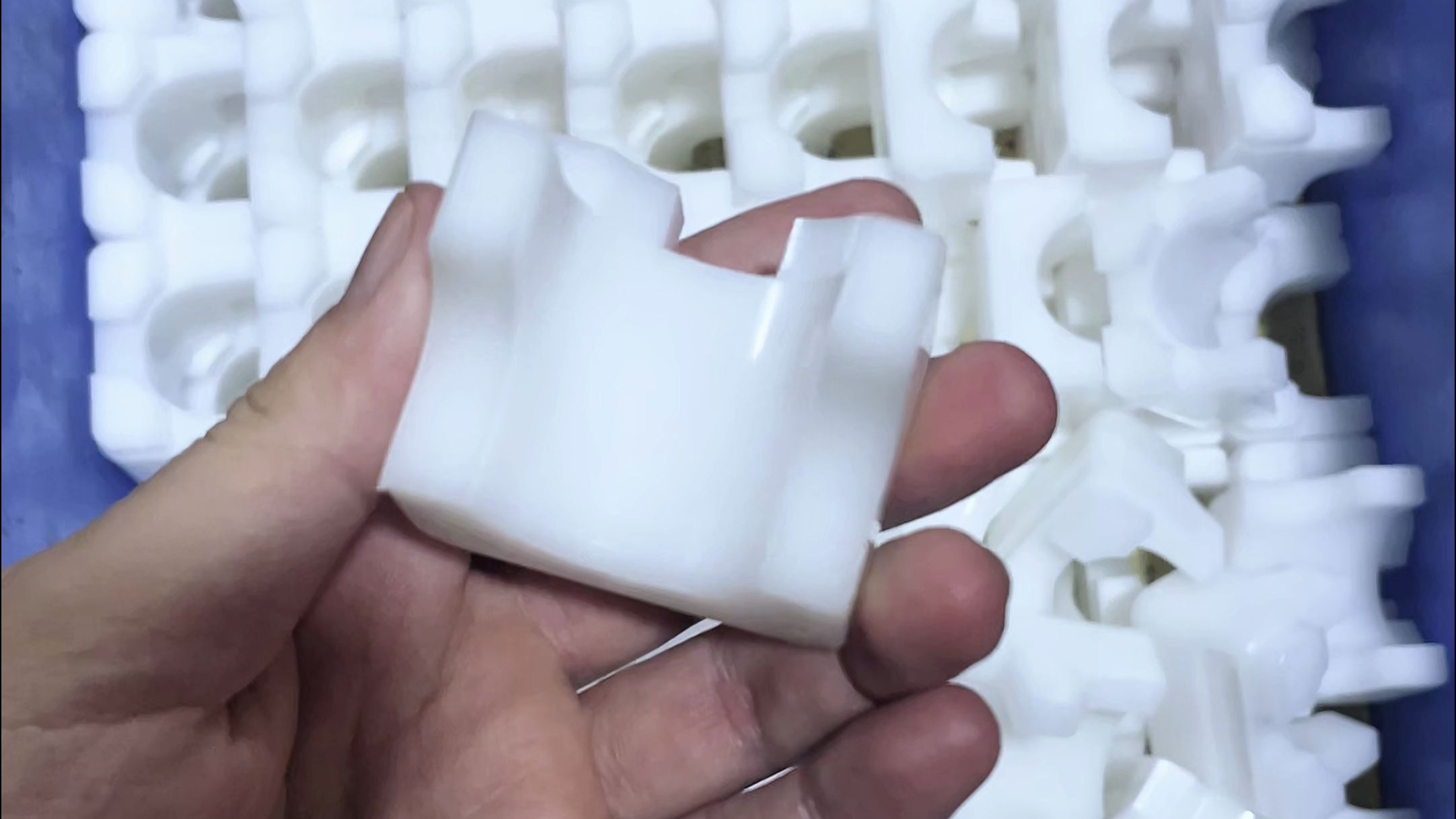
3. Key Industry Application Scenarios
3.1 Industrial Automation and Machinery
Automation equipment uses large numbers of low-load, continuous-operation transmission and guiding components well suited for engineering plastic construction. Plastic gears, bushings, sliders and chain guides leverage their self-lubricating properties to reduce equipment operating noise, cut lubrication maintenance and lower overall equipment weight. In food, pharmaceutical and other production environments with cleanliness requirements, engineering plastics also eliminate contamination risks from metal wear debris.
3.2 Electronics and Semiconductor Manufacturing
The electronics industry represents one of the core application areas for CNC plastic parts. Housings and internal structural components for consumer electronics and industrial control equipment, plus production line test jigs and positioning tooling, are widely produced from engineering plastics. In semiconductor manufacturing, wafer handling, vacuum equipment and inspection components impose even higher demands on material cleanliness and chemical resistance, where high-performance specialty plastics serve as the core solution.
3.3 Automotive and New Energy Industries
The automotive lightweighting trend continues to drive higher adoption of engineering plastic components. Traditional fuel vehicles use CNC machining for low-volume validation and custom production of dashboard structures, sensor brackets and auxiliary transmission parts. In new energy vehicles, battery insulating components, high-voltage connection protectors and electronic control system structures require both excellent insulation performance and lightweight structural strength, and engineering plastics satisfy multiple requirements at once.
3.4 Medical and Aerospace Sectors
The medical device industry imposes extremely high requirements for biocompatibility, sterilization resistance and dimensional accuracy. High-performance plastics such as PEEK withstand repeated high-temperature sterilization and offer good biocompatibility, making them ideal for surgical instrument components, testing equipment parts and laboratory instrument structures.
In the aerospace sector, manufacturers use engineering plastics for their low density and high strength to produce lightweight structural parts, insulating assemblies and equipment connectors. These materials improve overall structural efficiency and achieve better balance between weight and performance without compromising reliability.
4. Common Engineering Plastic Selection Reference Table
Material selection sits at the heart of plastic part manufacturing. Teams should make decisions based on working environment, load requirements and budget constraints. The table below summarizes the properties and use cases for mainstream engineering plastics:
| Material Name | Core Characteristics | Typical Applications | Recommended Machining Tolerance |
|---|---|---|---|
| POM (Acetal) | High wear resistance, self-lubricating, dimensionally stable, cost-effective | Gears, bushings, sliders, general structural parts | ±0.01 mm |
| PA (Nylon) | Good toughness, impact-resistant, excellent wear resistance | Transmission gears, sliders, guides, fasteners | ±0.015 mm |
| PEEK | High temperature resistance, chemical resistant, high strength, biocompatible | Semiconductor components, medical parts, high-temperature structures | ±0.005 mm |
| PC (Polycarbonate) | High transparency, impact-resistant, stronger than acrylic | Transparent protective covers, viewing windows, equipment housings | ±0.01 mm |
| ABS | Easy to machine, good toughness, low cost, highly finish-friendly | Equipment housings, prototypes, general structural parts | ±0.015 mm |
| PMMA (Acrylic) | High light transmission, excellent surface finish, easy to polish | Transparent windows, optical panels, decorative parts | ±0.01 mm |
| PPS | High temperature resistance, chemical resistant, exceptional dimensional stability | Electronic insulators, high-temperature structural components | ±0.01 mm |
| PTFE (Teflon) | Extremely low friction coefficient, strong corrosion resistance, non-stick | Guides, seals, corrosion-resistant liners | ±0.02 mm |
5. Common Process Selection FAQs
Q1: What production volumes work best for CNC plastic machining?
CNC plastic machining works best for prototypes, one-off custom parts and small-to-medium production runs (from a few pieces to several thousand pieces). For very high volumes of hundreds of thousands of parts or more, injection molding delivers better cost efficiency thanks to economies of scale. For custom parts in quantities of tens to hundreds, high-precision parts with complex geometries, and products in the development phase that require frequent design changes, CNC machining delivers the highest overall value.
Q2: What are the core differences between CNC machined plastic parts and injection molded parts?
The core differences fall into three areas. First, performance: CNC machined parts are cut directly from solid billet, so they have no internal stress or shrinkage issues common to injection molding, and offer better mechanical performance and dimensional stability. Second, lead time: CNC machining requires no tooling, so delivery is faster and design changes cost much less. Third, cost: CNC machining has lower cost at low volumes, while injection molding offers clear per-unit cost advantages at high volumes.
Q3: What considerations apply to transparent plastic machining?
When machining transparent materials such as PC and PMMA, technicians must use sharp cutting tools and optimized cutting parameters to avoid tool marks, melt lines and stress whitening on the surface. After machining, a polishing step improves surface finish and light transmission, while protective handling prevents scratches. For optical-grade parts, manufacturers must also control internal stress to ensure uniform optical performance.
Conclusion
All in all, CNC plastic machining is an indispensable process in the modern precision manufacturing ecosystem. It covers everything from simple structural parts to high-performance precision components. From mechanical transmission parts and tooling jigs to electronic insulators and specialty medical and aerospace parts, teams can achieve the optimal balance of performance and cost through proper material selection and process design.
PartsMastery provides full-spectrum CNC precision plastic machining services, covering the entire lifecycle from prototype validation to low-to-medium volume production. We work with dozens of engineering plastics including POM, PA, PEEK and PC. Our professional multi-axis machining equipment and complete quality inspection system deliver consistent machining accuracy down to ±0.005 mm. We provide high-precision, highly consistent custom plastic part solutions for customers across industrial automation, electronics, semiconductor, automotive and medical industries.