





数控铣削成本:定价与节省

Calculating CNC milling costs doesn’t require waiting for supplier quotes — it hinges on several controllable factors: material type, machining time, setup complexity, and machine axis configuration. Small design tweaks, such as tighter tolerances or switching from 3-axis to 5-axis machining, can raise costs by 2–5 times before production begins. Drawing on thousands of real manufacturing cases, these cost drivers follow predictable patterns that can be optimized early in the design stage.

This guide breaks down how each factor impacts final pricing, and shares actionable ways to lower costs before sending designs to production. For quick baseline estimates, the PartsMastery CNC Milling Cost Calculator generates instant results based on material, part geometry and batch size, integrating standard machine rates and setup costs to support early design decisions.

How Total CNC Milling Cost Is Calculated

You can’t optimize pricing without understanding its core components. Total CNC milling expense goes far beyond machine runtime, and follows a clear formula:

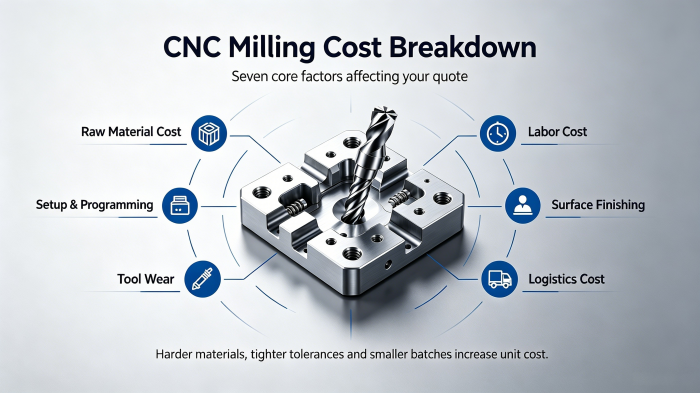
Total CNC Milling Cost = Raw Material + Setup & Programming + Machining Time + Labor + Tool Wear + Finishing + Logistics


Hourly Rates by Machine Type

Your choice of milling equipment sets the baseline hourly cost. Machines with more axes deliver higher precision and faster setup for complex parts, but come with a price premium.

  • 3-Axis CNC Mill: $35–$120 per hour. Best for flat features and simple geometries.
  • 4-Axis CNC Mill: $50–$150 per hour. Ideal for parts needing single-axis rotation.
  • 5-Axis CNC Mill: $75–$250+ per hour. Required for complex aerospace and medical parts.
  • Simple Micro-Machining: $20–$50+ per hour.

Setup fees also vary widely by complexity. A simple aluminum bracket may carry a $50–$150 setup charge. A highly complex titanium turbine blade can require $500–$1000+ in programming and fixturing before any cutting starts.


How Material Choice Affects Pricing

Material selection impacts both raw material cost and machining speed. Harder materials wear cutting tools faster and require slower feed rates, driving up milling costs significantly.

Titanium and stainless steel are notoriously difficult to machine. Aluminum is highly machinable, offering the best balance of strength and cost efficiency.

材料 Cost (6×6×1 in Blank) 可加工性 说明
Stainless Steel 304 $90 High tool wear
铝 7075 $80 中型 High strength
Nylon 6 $30 Cost-effective plastic
Delrin $27 Good dimensional stability
Aluminum 6061 $25 Most economical metal
ABS $17 非常高 Easy to machine

Hidden Cost Drivers: Design for Manufacturability

CAD design choices directly affect your final invoice. Thin walls, sharp internal corners and deep cavities force machinists to use specialty tools and slower speeds, adding time and cost.


Tolerances and Precision

Applying tight tolerances across an entire part is a common costly engineering mistake. High precision requires slower cutting passes, premium multi-axis equipment and extensive quality inspection.

PartsMastery follows ISO 2768-m (±0.1mm) for standard CNC tolerances, and can achieve precision tolerances down to ±0.01mm on request. To keep costs down, only apply strict tolerances to critical mating surfaces.

You can calculate costs manually, or upload your STEP file to PartsMastery’s instant quoting platform. Our intelligent system generates real-time quotes and free DFM reports, automatically flagging high-cost features like deep threads and undercuts.

Batch Volume and Sourcing Strategy

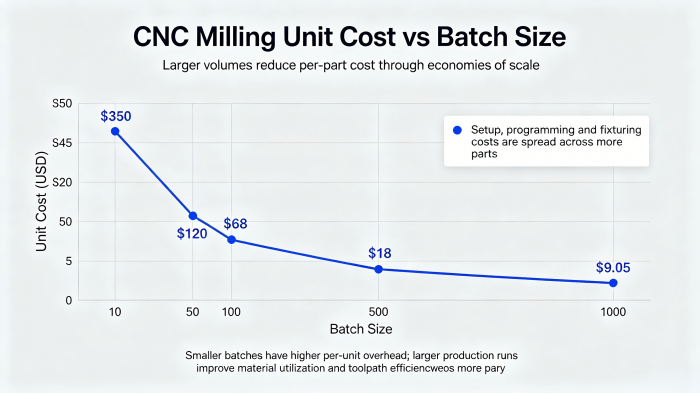
Per-part cost drops sharply as order volume increases. For example, a prototype batch of 10 simple aluminum parts might total $3500. Scaling to 1000 parts can bring the unit price down to around $9.05.

This savings comes from amortizing one-time setup, programming and fixturing fees across more units. Higher volumes also enable optimized toolpaths and better material utilization.


Domestic vs. Overseas Sourcing

Manufacturing location directly impacts total cost and process visibility. Western platforms like Xometry or Protolabs act as intermediaries, adding margins to outsourced production and limiting transparency into actual machining. A direct manufacturing model removes these extra layers, offering better pricing, tighter quality control and more predictable lead times. Multi-supplier networks can also cause pricing inconsistency at high volumes, making large-batch scaling more difficult.

Partnering with a manufacturer based in a mature supply chain hub changes the cost equation. PartsMastery is headquartered with production facilities in Shenzhen, China, with direct access to a robust supply chain and competitive cost structure.

Competitors often take 1–2 days to return quotes, while PartsMastery’s AI-powered quoting engine delivers detailed pricing in 3 minutes.

12 Rules to Reduce CNC Milling Costs

Engineering and sourcing teams can cut custom milling budgets significantly by applying these lean principles:


  1. Switch to Machinable Materials
    Use Aluminum 6061 or engineering plastics (ABS, Delrin) instead of stainless steel or titanium unless structurally required.
  2. Simplify Part Geometry
    Remove unnecessary deep cavities, thin walls and purely cosmetic features.
  3. Relax Non-Critical Tolerances
    Stick to standard ±0.127mm tolerances unless a dimension requires a precision fit.
  4. Increase Batch Size
    Raise order volume where feasible to amortize setup and programming fees.
  5. Skip Premium Finishes
    Use standard as-milled finish instead of paying $100–$500+ for anodizing, plating or powder coating.
  6. Optimize for Standard Tools
    Design parts to be machined with standard end mills to avoid custom tooling costs.
  7. Limit Thread Depth
    Keep tapped holes to a maximum of 3x the hole diameter to reduce tool wear.
  8. Add Internal Fillets
    Replace sharp internal corners with fillets to reduce machine stops and tool changes.
  9. Split Complex Parts
    Break highly complex parts into simpler 3-axis components and assemble them later.
  10. Use Standard Blank Sizes
    Align part dimensions with standard raw material sizes to reduce waste.
  11. Leverage Overseas Manufacturing
    Work with verified platforms like PartsMastery to access high-quality China CNC milling at competitive rates.
  12. Run Early DFM Checks
    Use automated DFM tools to catch costly geometries before finalizing designs.

Optimize Costs Before Production

Understanding the variables behind CNC milling quotes lets you build cost efficiency into parts before procurement. By optimizing materials, tolerances and batch sizes, you can keep projects financially viable without sacrificing performance.

Ready to get an exact cost for your part? Upload your CAD files to the PartsMastery Instant Quoting Engine today for real-time pricing and a free DFM analysis.

常见问题解答

Is buying a CNC mill cheaper than outsourcing?

An industrial Haas or entry-level Tormach mill can cost $15,000 to $100,000+, plus ongoing maintenance, tooling and labor. Outsourcing to an online CNC milling service eliminates upfront capital expense and lets you plan around predictable per-part costs.

What’s the average hourly rate for CNC milling?

Standard 3-axis mills average $35–$120 per hour. Advanced 5-axis rates can exceed $250 per hour, depending on material and regional labor costs.

Why is 5-axis milling more expensive?

5-axis machines have much higher purchase and maintenance costs, and require highly skilled programmers for complex toolpaths. The premium reflects their ability to process complex geometries without manual repositioning.

Does surface finishing add to the cost?

Yes. Basic deburring adds only a small fee. Multi-step treatments like hard anodizing, electroplating or powder coating add significant time and cost to orders.

How fast can custom CNC milling be done?

Standard prototyping lead times are typically 3–5 days. For urgent projects, PartsMastery offers expedited CNC machining with turnaround as fast as 1 day.

联系我们

    您所在的行业 *

    上传 2D/3D 图纸

    上传文件,立即获得报价(请附上任何格式的二维 CAD 图纸和三维 CAD 模型,包括 STEP、IGES、DWG、PDF、STL、ZIP 等)。.

    最大文件大小:20MB

    项目详情(请包括:部件名称/数量/材料/颜色/表面处理)