








Why Precision Injection Molding Company Demands More Than Standard Manufacturing
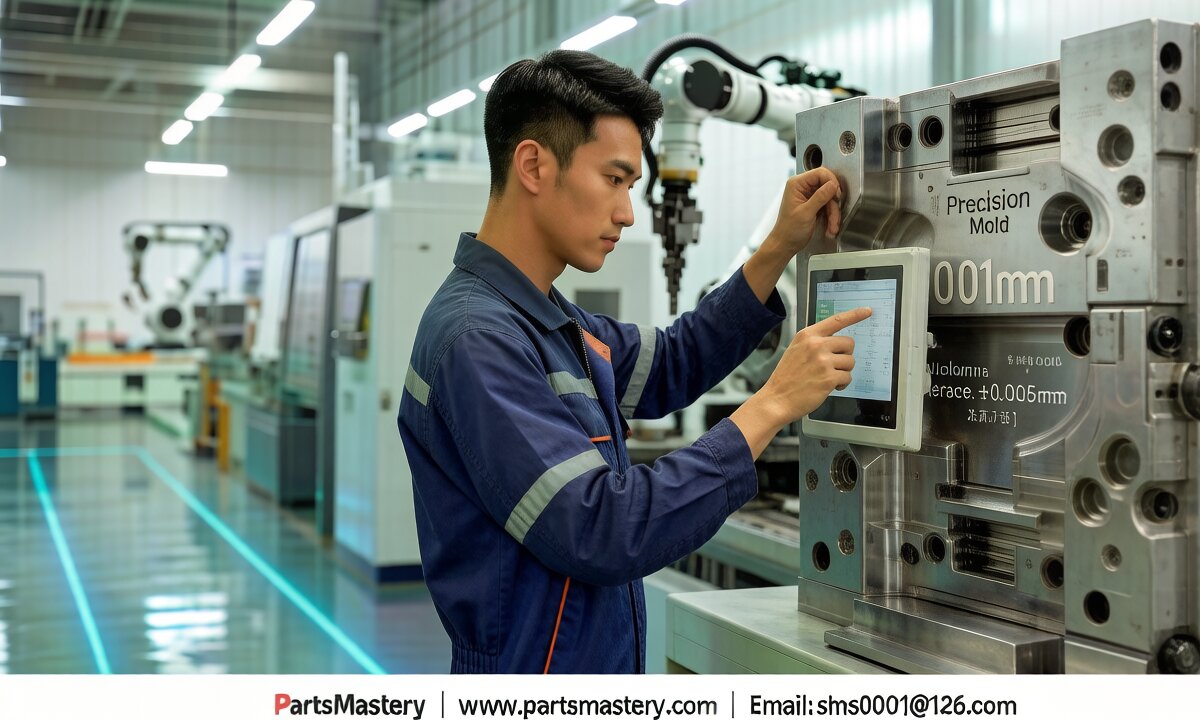
In industries where failure is not an option—medical devices, aerospace, automotive safety systems, and micro-electronics—there is no room for “close enough.” This is where a true precision injection molding company separates itself from standard molders. Precision molding is not simply about holding tight tolerances; it is about understanding material behavior, thermal dynamics, and statistical process control at the most granular level. At PartsMastery, we have built our entire operation around the philosophy that every micron matters. This article explores what precision injection molding actually entails and how to evaluate a partner capable of delivering it.
Defining Precision Injection Molding
Standard injection molding typically holds tolerances of ±0.1mm to ±0.2mm. A precision injection molding company, by contrast, operates in the range of ±0.01mm to ±0.05mm (10 to 50 microns). For context, a human hair is approximately 70 microns thick. Precision molding produces parts significantly thinner than a strand of hair.
But tight tolerances alone do not define precision. True precision molding also requires:
-
Repeatability: The same dimension across 1 million cycles, not just the first 100.
-
Stability: Minimal sensitivity to ambient temperature, humidity, or machine wear.
-
Surface integrity: No sink marks, warpage, or residual stress that could cause post-mold deformation.
Achieving these simultaneously demands world-class equipment, metrology, and process expertise.
The Critical Role of Machine Selection
Not every injection molding machine can produce precision parts. A specialized precision injection molding company invests in:
-
All-electric presses: Unlike hydraulic machines, all-electric units offer ±0.01mm shot-to-shot repeatability, faster response times, and cleaner operation. Brands like Fanuc, Sumitomo, and Arburg are industry standards.
-
Closed-loop process control: Real-time sensors monitor injection pressure, screw position, melt temperature, and mold cavity pressure. The machine adjusts parameters automatically within milliseconds.
-
High injection velocity: Precision parts often require fill times under 0.1 seconds to prevent premature freezing of thin walls.
If a molder cannot specify the make, model, and age of their press fleet, they likely lack precision capabilities. At PartsMastery, our all-electric Fanuc and Sumitomo presses (90T to 300T) are calibrated weekly to maintain peak accuracy.
Mold Design for Precision
The mold itself is the second critical variable. A precision injection molding company designs tools specifically for dimensional stability, not just part geometry. Key design features include:
Balanced Cavity Filling
In multi-cavity molds, runners must be geometrically balanced so that all cavities fill simultaneously at the same pressure. Unbalanced filling leads to cavity-to-cavity variation—unacceptable for precision work.
Optimized Cooling
Temperature variation across the mold cavity causes uneven shrinkage. Precision molds use conformal cooling channels (3D-printed or CNC-machined complex curves) that follow the part contour. This maintains uniform cavity temperature within ±2°C.
Stainless or Hardened Steel
Precision molds cannot use soft P20 steel. Hardened H13 or S136 stainless (48-52 HRC) resists wear and maintains critical dimensions through millions of cycles. Softer steels would gradually erode, increasing part dimensions over time.
Precision Guide Systems
Standard guide pins and bushings have play (clearance). Precision molds use roller bearing guide systems or tapered interlocks with zero clearance to ensure perfect parting line alignment every shot.
Material Selection and Drying
Many precision defects trace back to improper material handling. A reputable precision injection molding company maintains strict protocols:
-
Drying: Hygroscopic resins (nylon, PC, PET) absorb atmospheric moisture. Undried material hydrolyzes, causing splay marks, brittleness, and dimensional instability. Precision molders use dehumidifying dryers with dew points below -40°C.
-
Regrind management: Recycled material (regrind) has different flow properties than virgin resin. For precision parts, regrind percentage is either zero or tightly controlled (typically under 15%).
-
Batch traceability: Every resin lot receives a certificate of analysis (COA) for melt flow index (MFI) and moisture content.
Without these controls, the same mold and machine will produce different parts on Monday versus Friday.
The Metrology Backbone: Measuring What Matters
Precision manufacturing is impossible without precision measurement. A true precision injection molding company operates an in-house metrology lab equipped with:
-
CMM (Coordinate Measuring Machine): Touch-probe or laser scanning to measure complex 3D geometries with ±0.001mm accuracy.
-
Optical comparator: 2D inspection of contours, radii, and angles.
-
Surface roughness tester: Measures Ra (average roughness) to verify finishes down to 0.05μm.
-
Vision measurement system: Automated measurement of small features (gates, ribs, bosses).
-
Humidity and temperature-controlled inspection room: Prevents thermal expansion from skewing measurements.
En PartsMastery, we provide a full CMM report with every shipment, showing measured values versus nominal CAD dimensions for every critical feature.
Statistical Process Control (SPC) in Precision Molding
Precision is not achieved by inspecting defects out; it is achieved by controlling the process so defects never occur. A serious precision injection molding company uses SPC to monitor real-time production:
-
Control charts: X-bar and R charts track critical dimensions every hour. If a trend (six consecutive points rising) is detected, the process is adjusted before parts go out of spec.
-
Cp and Cpk values: These indices measure process capability. A Cpk of 1.33 indicates acceptable precision; a Cpk of 1.67 or higher is world-class. Precision medical molding often demands Cpk ≥ 1.67.
-
Automated data logging: Every cycle’s parameters (peak pressure, fill time, screw position) are recorded. If a non-conforming part is found, the data can identify exactly which cycle produced it.
If a molder cannot provide historical SPC data, they are likely relying on end-of-line inspection rather than process control.
Applications That Demand Precision Molding
Which industries require a precision injection molding company? The list includes:
-
Medical devices: Syringe barrels (tolerance on inner diameter: ±0.02mm), surgical instrument handles, inhaler components, IV connector hubs.
-
Automotive safety: Airbag housings, ABS brake sensor components, fuel system parts.
-
Electronics: USB and HDMI connector housings, battery enclosures for wearables, SIM card trays.
-
Optics: Light guides, LED lenses, camera housings.
-
Micro-molding: Parts weighing less than 0.1 grams, with wall thicknesses under 0.2mm.
Each of these applications has zero tolerance for flash, short shots, or dimensional drift.
Cleanroom and Contamination Control
Precision parts often serve clean-critical environments. A qualified precision injection molding company offers:
-
Class 8 (100,000) cleanroom molding: For medical devices and electronics assembly.
-
HEPA-filtered air handling: Positive pressure to keep dust and fibers out.
-
Controlled humidity: Prevents moisture absorption in hygroscopic resins.
-
Dedicated cleanroom presses: Machines never exposed to shop-floor contaminants.
En PartsMastery, our cleanroom molding cell maintains Class 8 conditions, allowing us to produce implantable-grade components and optical parts without surface defects.
Secondary Operations Without Compromising Precision
Precision does not end at the molding press. A full-service precision injection molding company also performs secondary operations with equal rigor:
-
CNC trimming: Removing gates and flash with positioning accuracy of ±0.05mm.
-
Ultrasonic welding: Aligning two molded halves with precision fixtures.
-
Laser marking: Permanent, high-contrast date codes or logos without surface damage.
-
Degating robots: Automated gate removal with consistent cut depths.
By controlling secondary processes in-house, we eliminate variability introduced by external vendors.
Common Precision Molding Defects (And How to Prevent Them)
Even a precision injection molding company must actively combat defects. Here are the most common and their solutions:
| Defect | Root Cause | Precision Solution |
|---|---|---|
| Sink marks | Excessive local shrinkage | Add ribs, reduce wall thickness, increase packing pressure |
| Warpage | Uneven cooling | Conformal cooling channels, balanced mold temperature |
| Flash | Clamp force too low or parting line damage | Hardened steel, precision ground parting surfaces |
| Short shot | Insufficient material or low injection speed | Larger gate, higher injection velocity |
| Jetting | Melt front folding | Optimize gate location, slower initial fill |
| Burn marks | Trapped air | Add vents (0.02mm depth) at weld line locations |
Why PartsMastery is Your Precision Partner
As a dedicated precision injection molding company, PartsMastery combines advanced equipment, rigorous metrology, and deep process expertise. We deliver:
-
Tolerances as tight as ±0.008mm on critical features.
-
All-electric Fanuc and Sumitomo presses with closed-loop control.
-
In-house CMM and optical inspection with full SPC documentation.
-
Class 8 cleanroom molding for medical and optical components.
-
ISO 9001:2025 certification with full lot traceability.
Whether you need a precision mold built or production parts delivered with Cpk ≥ 1.67, we have the systems and experience to succeed.
Start Your Precision Project Today
Do not trust your critical components to general-purpose molders. Partner with a precision injection molding company that treats every micron as a requirement, not a suggestion.
Contact PartsMastery Now:
-
Phone / WeChat: +86 13530838604
-
Brand: PartsMastery
-
Website: www.partsmastery.com
Send your CAD file and tolerance requirements for a free precision feasibility analysis. Let us engineer the accuracy your product deserves.