








The Critical Role of Injection Mold Design Services in Manufacturing Success
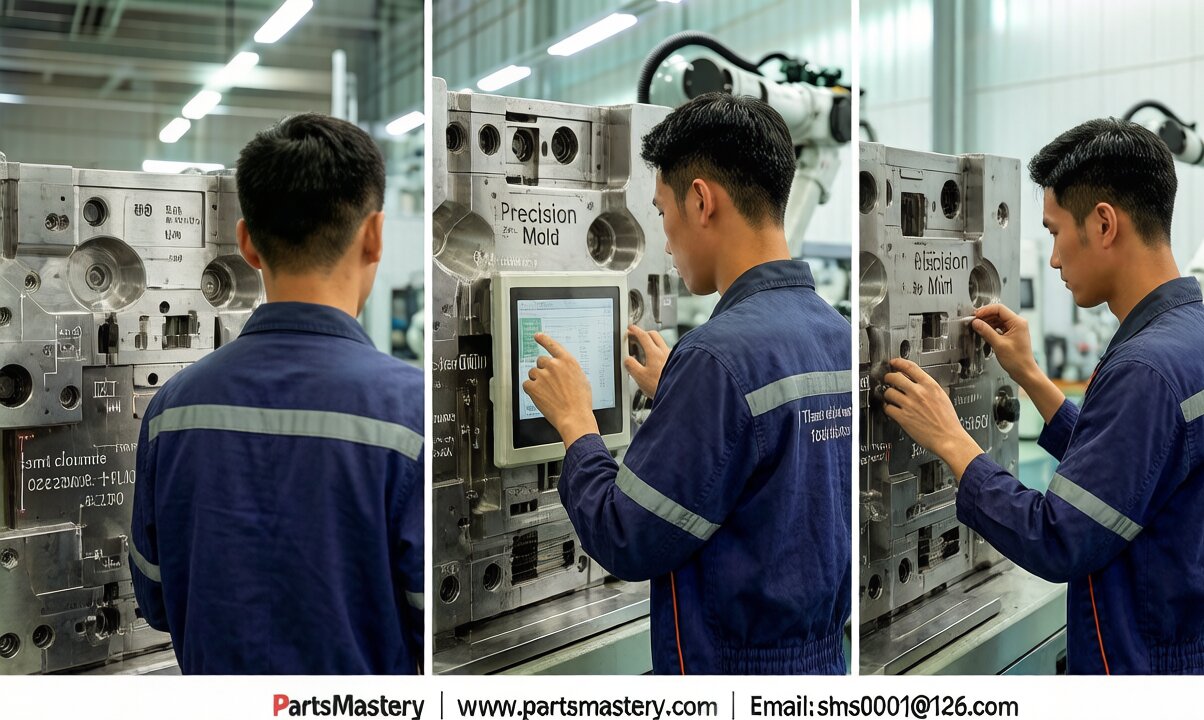
Before any plastic part is mass-produced, before any steel is cut, and before any machine cycles, there is the design phase. Yet surprisingly, this phase is often rushed or treated as an afterthought. Professional injection mold design services are not merely about converting a 3D part model into a mold base layout. They are about predicting flow behavior, managing thermal dynamics, planning ejection strategies, and optimizing cycle efficiency—all before a single machining operation begins. At PartsMastery, we have seen well-intentioned product designs fail simply because the mold was poorly conceived. This article explains what true mold design engineering entails and why it is the most cost-effective investment in your production line.
Why Mold Design Determines Everything
A common misconception is that any mold maker can take any part file and produce a functional tool. In reality, the quality of the mold design directly impacts:
-
Part dimensional accuracy: Gate placement, cooling layout, and venting all affect shrinkage and warpage.
-
Cycle time: Poor cooling design can double your seconds-per-part, destroying profitability.
-
Mold lifespan: Inadequate steel support or sharp corners lead to premature cracking.
-
Ease of maintenance: A design without accessible components makes cleaning and repairs expensive.
Professional injection mold design services address every one of these factors systematically, using simulation tools and decades of empirical knowledge.
The Five Pillars of Professional Mold Design
When you engage a provider for injection mold design services, you should expect expertise across five core disciplines:
1. Part Design for Manufacturability (DFM)
Before designing the mold itself, the part geometry must be evaluated. A DFM analysis checks for:
-
Uniform wall thickness (avoiding thick sections that cause sink marks).
-
Draft angles (typically 1 to 3 degrees per side for ejection).
-
Radii at internal corners (sharp corners create stress risers).
-
Rib-to-wall thickness ratios (ribs should be 50-60% of the nominal wall).
-
Undercuts and side actions (identifying where sliders or lifters are needed).
A DFM report typically includes specific change recommendations, annotated directly on your CAD file.
2. Cavity and Core Layout
The mold designer determines how many cavities the mold will have (single, 2, 4, 8, 16, 32, etc.). Factors influencing cavity count include:
-
Annual production volume.
-
Available machine tonnage and platen size.
-
Part size and complexity.
-
Required tolerance consistency.
For high-volume parts, a 4-cavity or 8-cavity family mold dramatically reduces per-part cost—but only if the runner system is perfectly balanced.
3. Runner and Gate System Design
The runner delivers molten plastic from the machine nozzle to the cavity. The gate is the entry point into the cavity. Professional injection mold design services carefully select:
| Gate Type | Best For | Advantage |
|---|---|---|
| Edge gate | Flat parts, simple geometries | Easy to manually trim |
| Submarine (tunnel) gate | Automatic degating | Gate shears off during ejection |
| Fan gate | Thin, wide parts | Reduces jetting and stress |
| Diaphragm gate | Cylindrical parts (tubes, cups) | Concentric filling |
| Hot valve gate | Cosmetic surfaces | No gate vestige |
Gate location is arguably the most critical decision. A poorly placed gate can cause weld lines on a load-bearing surface or air traps in a cosmetic area.
4. Cooling System Design
Cooling typically accounts for 60-80% of the total cycle time. A mold that cools inefficiently is a mold that loses money. Advanced injection mold design services use conformal cooling—cooling channels that follow the 3D contour of the part—rather than simple straight drilled lines.
Key cooling design principles:
-
Channels should be as close to the cavity surface as possible (typically 1.5 to 2 times the channel diameter).
-
Turbulent flow (Reynolds number > 4000) maximizes heat transfer.
-
Inlet and outlet temperatures should differ by less than 3°C across the mold.
-
Baffles or bubblers direct coolant into deep core areas.
5. Ejection System Design
Once the part is cooled, it must be ejected cleanly. The design must include:
-
Ejector pin placement (avoiding cosmetic surfaces and thin ribs).
-
Return pins (to push the ejector plate back before mold closing).
-
Ejector blades for ribbed or complex geometries.
-
Air poppets for deep-drawn parts or thin walls.
-
Stripper plates for cylindrical parts (prevents pin marks).
A common failure in mold design is insufficient ejector pin surface area, leading to part deformation or ejection marks.
Hot Runner vs. Cold Runner Design Considerations
A significant decision in injection mold design services is whether to specify a hot runner system. Each approach has distinct design implications:
Cold Runner Design:
-
Simpler CAD modeling (standard runner cross-sections: trapezoidal, full-round, or semi-circular).
-
Lower upfront design time.
-
Requires planning for runner scrap removal or regrinding.
Hot Runner Design:
-
Requires manifold plate with internal heated channels.
-
Valve gate sequencing (which gate opens when) must be modeled.
-
Thermal expansion gaps must be calculated (typically 0.5-1.0mm per 100mm).
-
Leak-proof seals between manifold and nozzle tips.
Hot runner design adds 20-40 hours of engineering time but eliminates runner waste and reduces cycle times by 15-30%.
Simulation: The Non-Negotiable Step
No professional injection mold design services should be delivered without Mold Flow simulation. This software predicts:
-
Fill pattern: Does the plastic reach all cavity extremities simultaneously?
-
Weld line location: Where do two flow fronts meet? Is that location structurally acceptable?
-
Air traps: Where will air be compressed? Vents must be placed there.
-
Pressure drop: Is the required injection pressure within machine limits?
-
Cooling time: What is the predicted solidification time?
-
Shrinkage and warpage: Will the part deform after ejection?
A full Mold Flow report typically includes 15-20 pages of analysis, complete with recommended gate size adjustments and cooling circuit modifications.
Steel Selection and Mold Base Sizing
The mold design must specify materials. Common choices include:
| Steel Grade | Hardness | Aplicación |
|---|---|---|
| P20 (pre-hardened) | 30-32 HRC | Low to medium volume, prototypes |
| H13 (hardened) | 48-52 HRC | High volume, glass-filled materials |
| S136 (stainless) | 48-52 HRC | Optical, medical, corrosive resins |
| 420 stainless | 50-54 HRC | Abrasive resins, high wear applications |
The mold base (the structural frame holding the cavities) is typically made of 50mm to 150mm thick steel plates. The designer must calculate clamp tonnage requirements to prevent flashing.
Design for Maintenance and Repair
A often-overlooked aspect of injection mold design services is maintenance access. A well-designed mold includes:
-
Interchangeable core pins (not welded-in features).
-
Access holes for removing broken ejector pins without disassembling the entire mold.
-
Water line labels (IN/OUT and circuit numbers).
-
Hardened wear plates on slider bases.
-
Spare part kits with ejector pins, core pins, and guide bushings.
Without these features, a simple broken pin can become a week-long repair job.
Common Design Mistakes (And How to Avoid Them)
Even experienced designers can make errors. Here are the most frequent issues found in substandard injection mold design services:
| Mistake | Consequence | Solution |
|---|---|---|
| No draft angle | Part sticks in cavity, ejection failure | Add minimum 1° per side |
| Sharp internal corners | Stress cracking, mold breakage | Add 0.5mm minimum radius |
| Unbalanced runners | Cavity-to-cavity variation | Use flow simulation to balance |
| Insufficient venting | Burn marks, short shots | Add vents at all weld lines |
| Poor cooling near gate | Gate freezes prematurely | Add dedicated cooling near gate |
| Ejector pins on textured surface | Visible pin marks | Relocate pins to ribs or hidden areas |
The PartsMastery Approach to Mold Design
En PartsMastery, our injection mold design services follow a rigorous, phase-gated process:
Phase 1: DFM Review – We examine your part geometry and issue a detailed report with specific recommendations.
Phase 2: Preliminary Mold Layout – We propose cavity count, runner type, gate locations, and ejection strategy.
Phase 3: Mold Flow Simulation – We validate the design virtually and optimize gate size, cooling, and venting.
Phase 4: Detailed CAD Modeling – We create full 3D solid models of every mold component (cavities, cores, sliders, lifters, hot manifold, cooling circuits, ejector system).
Phase 5: Design Review – We present the complete design for your approval, including 2D drawings with GD&T.
Phase 6: Steel Cutting – Only after your sign-off do we begin machining.
Why Choose PartsMastery for Your Mold Design?
We are not just a mold builder; we are an engineering firm that happens to build molds. Our team includes tooling engineers with an average of 15 years of experience across automotive, medical, electronics, and consumer goods. We use Siemens NX and SolidWorks for design, and Moldflow Insight for simulation.
Every design we deliver includes:
-
Full 3D CAD model (STEP, IGES, or native SolidWorks).
-
2D detailed drawings with tolerances.
-
Mold Flow simulation report.
-
BOM (bill of materials) with steel grades and component sources.
-
Maintenance and spare parts documentation.
Ready to Design Your Production-Ready Mold?
Do not let a rushed or inexperienced design compromise your product quality. Professional injection mold design services pay for themselves many times over through faster cycles, fewer defects, and longer mold life.
Contact PartsMastery Today:
-
Phone / WeChat: +86 13530838604
-
Brand: PartsMastery
-
Website: www.partsmastery.com
Send us your 3D part file. We will return a free DFM analysis and mold design proposal within 48 hours. Let us engineer your success from the first sketch to the last shot.