





Oil valve bodies are core pressure-bearing components in oil and gas transmission and control systems, and their manufacturing quality directly determines the safety and sealing performance of pipeline operations. There is a common industry misconception that prioritizes dimensional accuracy over blank preparation and process control. In fact, qualified valve bodies are not simply shaped by CNC cutting. They require a complete process chain integrating blank forming, precision machining, non-destructive testing and pressure verification to meet long-term service requirements under harsh conditions such as high pressure and strong corrosion.
Core Process Logic of Oil Valve Body Manufacturing
1. Blank Forming as the Foundation of Pressure-Bearing Performance
The service performance of high-pressure oil valve bodies first depends on the quality of blank forming, not subsequent cutting operations. Based on pressure rating, structural complexity and applicable standards, valve body blanks are mainly divided into two process routes: forging and casting.
Forged valve bodies refine metal grains through forging processes, improving material density and overall mechanical properties. They are suitable for harsh working conditions with high pressure and high impact loads, and are the mainstream choice for high-pressure wellhead and gathering pipeline valves. Cast valve bodies can integrally form complex flow passages, special-shaped cavities and integrated structures, greatly reducing the machining difficulty and material loss of complex internal geometries. They are applicable to medium and low pressure, large-diameter and multi-flow valve scenarios.
Before entering the machining process, all blanks must undergo material grade verification, geometric dimension sampling inspection and surface quality inspection. Special pressure ratings also require additional non-destructive testing at the blank stage to eliminate internal defect risks from the source.
2. CNC Machining Focuses on Pressure-Bearing and Sealing Key Structures
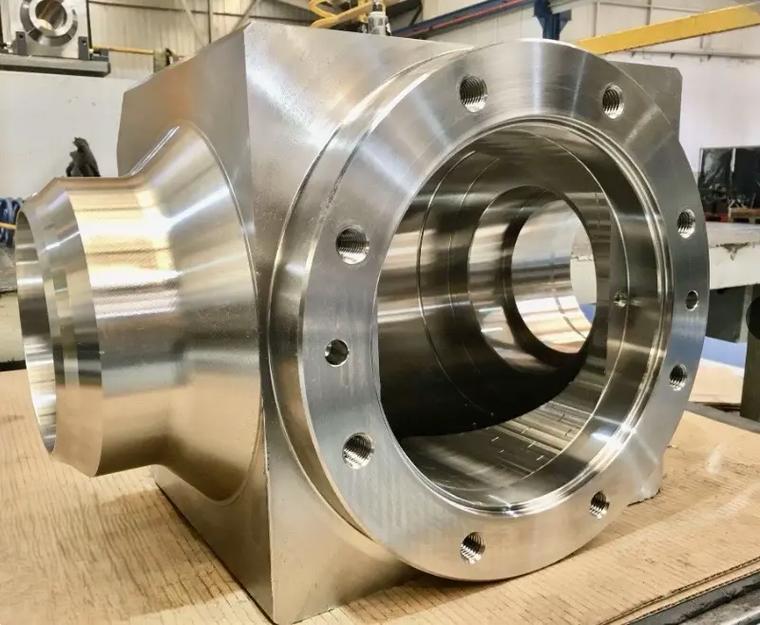
On the basis of qualified blanks, precision CNC machining is responsible for realizing the critical dimensions and functional structures of the valve body. The core machining objects include flange connection surfaces, valve cavities, bolt hole positions, sealing grooves and valve seat mating surfaces.
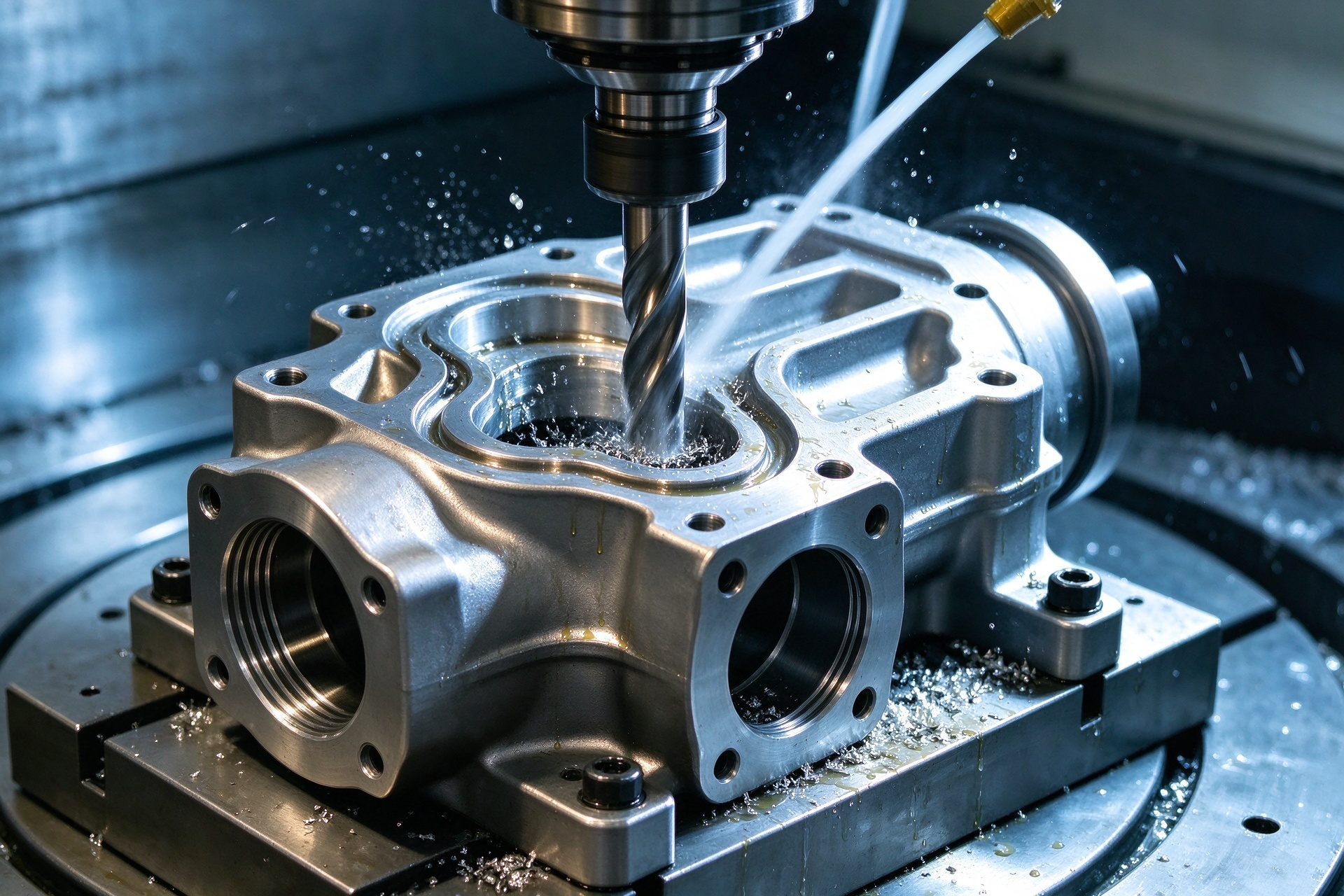
The machining process shall be arranged in stages of roughing, semi-finishing and finishing, with focus on controlling cutting deformation in thin-walled areas, uniform distribution of machining allowance and dimensional tolerance of critical surfaces. Stable machining accuracy is the geometric basis for subsequent valve body assembly, sealing matching and pressure testing.
3. Material and Inspection Systems Require Pre-Planning
Common materials for oil valve bodies include carbon steel, alloy steel, stainless steel and special corrosion-resistant alloys. Material selection shall match medium properties, operating temperature, pressure rating and design life. A complete valve body manufacturing solution must plan blank preparation, mechanical machining and quality verification as a continuous process rather than separate independent procedures.
| Valve Body Type | Recommended Manufacturing Solution | Core Control Points |
|---|---|---|
| High-pressure service valves | Forged blank + precision CNC machining | Blank grain size, material mechanical properties, critical dimensional tolerance |
| Complex flow path valves | Cast blank + precision CNC machining | Casting internal soundness, flow passage smoothness, geometric tolerance |
| High-precision connection valves | Precision CNC milling/turning | Flange flatness, hole position indexing accuracy, fit tolerance |
| Sealing structure valves | Precision machining + surface strengthening treatment | Sealing groove roughness, valve seat mating surface, surface hardness |
| Finished product delivery verification | NDT + hydrostatic/seal test | Internal defects, pressure boundary integrity, sealing leakage |
How CNC Machining Ensures Batch Production Consistency
1. Qualified Blanks as the Machining Starting Point
Pressure-bearing valve bodies cannot be simply equated to “heavily machined metal blocks”. Direct cutting from bar stock cannot meet the mechanical performance requirements of high-pressure working conditions. Three pre-confirmations are required before formal processing: verify the consistency of material grade, heat treatment condition and material certification documents; re-measure key blank dimensions and machining allowance to determine clamping and machining datums; plan reasonable machining procedures and allowance distribution for key pressure-bearing areas.
This process route of “forming the blank first, then precision machining” conforms to the manufacturing logic of pressure-bearing valves.
2. Stable Process Control Reduces Batch-to-Batch Dimensional Deviation
After entering the CNC machining stage, key dimensions such as bore diameter, hole spacing, flange flatness and valve seat coaxiality require strict process control. Standardized machining procedures, optimized cutting parameters, first-piece inspection and in-process patrol inspection can effectively reduce batch-to-batch dimensional fluctuation.
For structurally complex valve bodies, it is also necessary to consider the stress deformation of fixtures and dynamic compensation for tool wear. Through continuous optimization of process data, batch rework rate can be reduced, and on-site assembly adjustment workload can be minimized.
3. Non-Destructive Testing Cannot Be Replaced by Dimensional Inspection
Valve bodies are pressure-bearing components. Dimensional inspections such as coordinate measuring or caliper sampling alone cannot detect potential internal defects such as porosity, cracks and inclusions. According to material type and product standards, corresponding non-destructive testing methods shall be matched:
- Magnetic Particle Testing (MPT): Applicable to ferromagnetic materials, detecting surface and near-surface cracks, inclusions and other defects;
- Ultrasonic Testing (UT): High penetration capability, used to detect internal volumetric defects and delamination;
- Penetrant Testing (PT) and Radiographic Testing (RT): Supplementary testing according to specific product standards and customer requirements.
Testing methods and acceptance criteria must strictly correspond to product design standards and industry specifications.
Full-Spectrum Quality Verification System for Finished Valve Bodies
1. Hydrostatic Test Verifies Pressure Boundary Integrity
The hydrostatic strength test is the core inspection item for oil valve bodies before delivery, used to verify the structural integrity and pressure-bearing capacity of the valve body pressure boundary. The test shall set parameters based on corresponding standards and order requirements, clarify test pressure, test medium, pressure holding duration and acceptance criteria, and monitor the valve body for leakage, plastic deformation or abnormal noise throughout the process.
Hydrostatic testing can effectively verify the design rationality and manufacturing quality of valve bodies, and is the basic guarantee for the safe service of pressure-bearing valves.
2. Special Verification of Sealing and Shut-off Performance
High machining accuracy of the valve body does not mean that the assembled valve has qualified sealing performance. After the valve assembly is completed, multiple performance tests shall be carried out according to standards: low-pressure sealing test verifies the sealing surface fitting performance under low pressure conditions; high-pressure sealing test evaluates the sealing reliability under rated working pressure; back pressure test verifies the reverse sealing capability of valves with back pressure structures; leakage rate testing quantitatively detects the leakage level of sealing pairs according to standards.
Test items for different types of valves shall match corresponding product standards and customer technical requirements.
3. Full-Chain Quality Document Traceability
For valve body procurement in oil and gas projects, quality traceability is as important as the product performance itself. A complete quality documentation package usually includes: raw material certification and heat treatment reports; blank incoming inspection records; key dimensional inspection reports and geometric tolerance data; non-destructive testing reports (including test positions, standards and conclusions); original records of hydrostatic tests and sealing tests.
A complete quality traceability system helps owners confirm the full-process manufacturing status of valve bodies and provides a basis for subsequent operation, maintenance and life evaluation.
Selection Criteria for High-Precision Oil Valve Body Suppliers
1. Synergy Between Blank and CNC Machining Capabilities
When evaluating a valve body supplier, the number of CNC machine tools alone should not be the basis. The core is its ability to coordinate blank preparation and machining processes. A qualified supplier should be familiar with the machining allowance characteristics, datum selection logic and clamping schemes of different blanks such as castings and forgings, and can formulate the optimal machining route according to the valve body structure.
For R&D prototypes and custom non-standard products, rapid CNC forming from solid bar stock can be used as a design verification method, but it should be clarified that it is not equivalent to the mass production process for high-pressure valve bodies.
2. Complete Inspection and Testing Qualifications
Suppliers shall have clear inspection capability boundaries, clarify internal self-inspection items and third-party authoritative inspection items, and issue corresponding reports on demand. Key confirmations during selection: whether NDT items such as magnetic particle, ultrasonic, penetrant and radiographic testing cover product requirements, and whether testing personnel are qualified; whether the implementation standards and acceptance conditions of hydrostatic tests and sealing tests comply with industry specifications; whether material, dimension, inspection and test data have complete traceable correspondence.
3. Full-Process Production Coordination Service Capability
An ideal valve body supplier should provide full-chain manufacturing services, covering all links of blank customization, precision machining, surface treatment, quality inspection, performance testing and document delivery, and can match corresponding process solutions according to structure, material and pressure rating.
Full-process integrated services can reduce the cost and risk of multi-supplier communication, and greatly improve overall project delivery efficiency and quality stability.
The manufacturing of high-pressure oil valve bodies is a systematic engineering integrating material forming, precision machining and quality verification. Lack of control in any link may bury hidden operational safety risks. Only by establishing a full-process control system from blank to finished product can we continuously output high-quality valve body products that meet the harsh working conditions of the oil and gas industry.
PartsMastery specializes in high-precision valve body CNC machining services for the oil and gas industry. We have synergistic forging and casting blank resources, multi-axis CNC machining capacity and a complete inspection and testing system, supporting prototype development, small-batch customization and large-scale mass production. We provide customized machining solutions based on product drawings, pressure ratings, valve types and project specifications, and coordinate the whole process of machining, inspection and delivery through a unified project management system, helping customers reduce supply chain management costs and improve product quality stability.