





Dental implants are precision medical devices placed in the human body. Their structural accuracy directly defines clinical fit and long-term reliability.
Implant features include micro holes, connection holes, positioning blind holes and internal flow channels. These features demand micron-level dimensional tolerances, plus strict standards for hole position accuracy, coaxiality and edge integrity.
Titanium and titanium alloys lead the dental implant market thanks to excellent biocompatibility. But titanium’s unique machining properties create significant challenges for micro hole production. PartsMastery built a full-chain precision machining system to solve these issues. It covers design evaluation, process development, batch production and final inspection, and delivers stable, consistent, high-accuracy micro hole results.
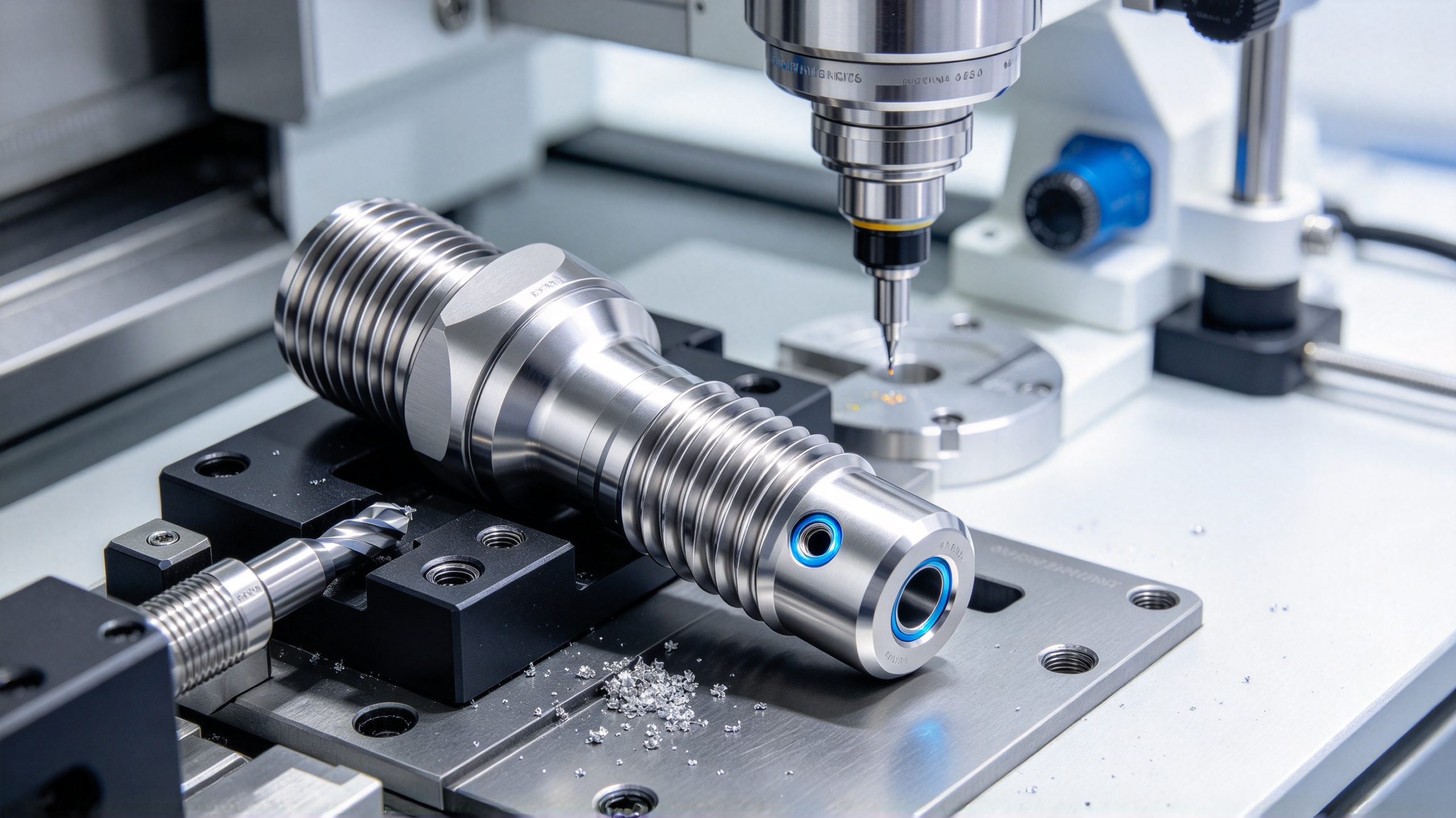
Core Technical Challenges in Dental Implant Micro Hole Machining
1. Dimensional Stability for Small Hole Diameters
Dental implants typically have extremely small micro holes. Tool rigidity limits, cutting vibration and parameter shifts all directly impact hole diameter accuracy.
Titanium alloys conduct heat poorly. Cutting heat builds up at the tool edge during machining, speeds up tool wear and causes diameter drift. Even a few microns of variation can weaken the seal and stability of later abutment connections.
2. Cumulative Error Risks for Hole Position & Coaxiality
Implant micro holes do not work as independent features. They align with strict positional rules relative to the central axis, external threads and connection end faces.
Multi-station sequential machining adds error with every clamp and reposition. These errors stack across processes and easily fall outside allowed tolerance ranges. Complex structures like cross holes and angled holes raise position control difficulty even further.
3. Edge Burrs & Internal Chip Evacuation Bottlenecks
Micro hole machining often leaves tiny burrs along hole edges. These burrs reduce assembly accuracy and may create biosafety risks after implantation.
Blind holes and deep holes bring even harder chip evacuation challenges. Built-up chips scratch hole walls, distort hole roundness and can even break cutting tools. Traditional machining methods struggle to balance speed and edge quality.
PartsMastery’s Full-Loop CNC Micro Hole Machining Solution
PartsMastery built a micro hole machining framework focused on upfront prevention, in-process control and final verification. It systematically resolves dental implant micro hole production pain points.
1. Upfront DFM Analysis to Eliminate Risks Early
At project kickoff, PartsMastery’s engineering team runs a full Design for Manufacturability (DFM) analysis. We use your supplied 3D models and engineering drawings as the baseline.
- We verify micro hole diameter, depth, position and geometric tolerances, and assess current process feasibility;
- We optimize machining datums and clamping setups to cut secondary positioning and lower cumulative error;
- For hard-to-machine materials like titanium alloys, we pre-plan tool selection and cutting parameters, and map out chip and heat management strategies.
For high-risk feature designs, our team shares optimization recommendations early. We lower machining difficulty and cost without compromising product function, and reduce rework in the prototype phase.
2. Custom Process Matching for Diverse Hole Structures
Different micro hole geometries require different optimal production methods. PartsMastery tailors process paths to match each part’s unique features:
- Simple straight holes use precision micro-drilling with high-accuracy spindles for consistent diameter control;
- Cross holes, angled holes and shaped holes use multi-axis simultaneous milling. We complete all directions in one clamp to preserve position accuracy;
- Threaded connection holes combine precision tapping and thread milling for clean thread profiles and reliable fit accuracy.
We simulate all tool paths via programming before production. This step avoids tool interference and overcutting, and keeps machining processes stable.
3. Full-Process Quality Control for Batch Consistency
PartsMastery embeds quality control across every machining stage. This ensures uniform micro hole quality for every part in batch production:
- Tool condition monitoring: We enforce strict tool life tracking and regular inspection schedules for micro cutting tools. We run first-piece checks and in-process sampling for critical holes to prevent batch-to-batch variation from tool wear;
- Clamping accuracy control: We use custom precision fixtures to balance clamping force and part protection. They prevent thin-wall deformation and keep positioning datums consistent across every workpiece;
- Finished part dimensional verification: We use coordinate measuring machines (CMM) and optical gauges to inspect all key parameters. These include hole diameter, depth, position and coaxiality, plus edge burrs and hole wall surface finish.
Full-Cycle Project Service System
1. Flexible Delivery From Prototype to Full Production
PartsMastery supports dental implant projects across every development stage:
- Prototype phase: We offer single-unit or small-batch prototype machining. This validates part structure, fit and manufacturability, and supports fast R&D iteration;
- Small-batch trial: We refine process paths and cost structures, test mass production stability, and prepare for full production ramp-up;
- Large-scale production: We lock in process parameters and quality control workflows for efficient, consistent, cost-controlled ongoing delivery.
2. Robust Quality Management & Supporting Capabilities
PartsMastery operates under ISO 9001 quality management standards. We apply stricter process controls for all medical-grade components.
Beyond core CNC precision machining, we offer complementary secondary operations including surface treatment and cleaning passivation for one-stop delivery. We provide full dimensional inspection reports and production traceability documentation for every project upon request.
Project Guide & Frequently Asked Questions
1. Information Needed for Project Quotation
To deliver fast, accurate solutions and quotes, we recommend you share the following details:
- Complete 3D models (STEP/STP/IGES format) and PDF engineering drawings with marked key dimensions and tolerances;
- Part material and grade specifications;
- Estimated order volume and delivery lead time;
- Surface treatment and inspection report requirements;
- Any additional special process requirements.
2. Frequently Asked Questions
Q: Can CNC machining produce all micro hole features on dental implants?
A: CNC precision machining supports most micro hole structures. The exact process depends on hole diameter, depth-to-diameter ratio, position accuracy and material. We can integrate specialty processes for ultra-fine micro holes when needed.
Q: Does titanium alloy machining compromise micro hole accuracy?
A: Titanium’s cutting properties do add machining complexity. But we effectively control deformation and tool wear with targeted tool selection, optimized cutting parameters and dedicated cooling strategies. This delivers consistent high-precision results.
Q: Can you produce prototype samples before full mass production?
A: Yes. PartsMastery supports prototype sampling and small-batch trial runs. Once parts pass dimensional and performance verification, we move to large-scale batch production. This approach keeps project risks fully controlled.
If you are developing dental implants or other precision medical components with micro hole structures, send your drawings and requirements to the PartsMastery engineering team. We will deliver professional DFM analysis and custom-tailored machining solutions.