





 Producing a few hundred plastic parts is a straightforward manufacturing task. But when you need to make hundreds of thousands of identical units, deliver them on schedule, and keep per-unit prices competitive, you need an entirely different strategy. Specifically, high-volume injection molding solves this exact challenge. It completely changes how teams plan tooling engineering, part design, and quality control.
What Is High-Volume Injection Molding?
Put simply, high-volume injection molding covers production runs that go far beyond prototype testing. These runs typically start at tens of thousands of units and scale up to hundreds of thousands — or even millions — of parts for a single product.
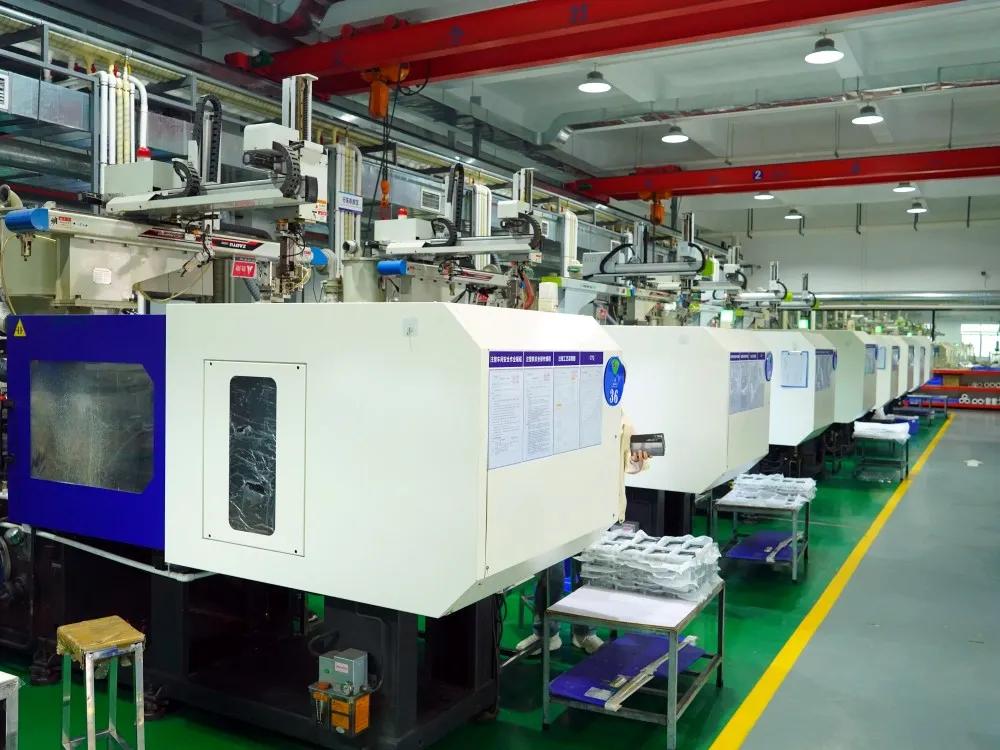
For example, manufacturers use this process to make consumer electronics housings, automotive electrical connectors, disposable medical products, and packaging parts. These products all have steady annual demand, fully finalized designs, and a strong focus on competitive per-unit pricing. High-volume production lines depend on fully automated systems, multi-cavity molds, robotic part handling, and real-time quality checks to deliver steady, uninterrupted output. Of course, upfront tooling and setup costs run high at first. But when you spread those costs across hundreds of thousands of parts, the per-part tooling expense falls sharply.
High-Volume vs. Low-Volume Injection Molding
At their core, both high-volume and low-volume injection molding follow the same basic steps: melt plastic resin, inject it into a mold cavity, let it cool, and eject the finished part. Even so, almost every supporting part of the process changes drastically when production volume goes up.
| Aspect | Low-Volume Injection Molding | High-Volume Injection Molding |
|---|---|---|
| Mold material | Aluminum or soft steel alloys | Hardened tool steel built to last millions of production cycles |
| Cavity setup | Single cavity, occasionally dual-cavity | 8, 16, 32 cavities or more for maximum output |
| Typical cycle speed | Longer cycles from simplified tooling and limited optimization | Optimized cycle times via multi-cavity layouts and efficient cooling |
| Cost structure | Low upfront tooling, higher per-unit cost | High upfront tooling cost, near-negligible per-part expense at scale |
| Quality checks | Periodic batch sampling | Continuous in-line inspection with real-time monitoring |
| Design flexibility | Minor tweaks between runs are acceptable | Design must be fully locked and DFM-optimized before tooling |
| Labor setup | Dedicated operator per molding press | Single operator supervising multiple production cells |
| Material efficiency | Regular runner scrap generation | Minimized runner waste for better material usage |
Tooling and Cost Dynamics
In detail, low-volume molds focus on fast turnaround and low upfront cost. Manufacturers build them for short production runs, not for the extended lifespan that mass manufacturing demands. By contrast, high-volume production molds are precision tools machined from hardened steel. They include built-in cooling channels, balanced multi-cavity layouts, and hot runner systems.
The upfront cost gap can reach 10x or more. Still, the per-part tooling cost swings heavily in favor of production-grade molds once you pass a few thousand units. In fact, the entire cost structure changes as volume grows. For low-volume runs, mold costs usually make up the largest share of each part’s price. At high volumes, you spread tooling costs out to fractions of a cent per unit. Instead, raw resin prices, cycle speed, and scrap rates become the main cost drivers.
Quality and Design Flexibility
When it comes to quality, high-volume production shifts control from end-of-batch sampling to continuous in-process checks. Checking 10 sample parts from a 500-piece run gives you enough coverage. But the same sample size from a 100,000-piece run would miss most potential defects. Instead, automated vision systems, part weight checks, and cavity pressure sensors catch defects as they happen. You don’t have to wait until the end of a full shift to find problems.
Meanwhile, design flexibility shrinks significantly at production scale. A part that sticks a little in a prototype mold is easy to remove by hand with little disruption. But that same sticking issue in a 16-cavity automated mold will shut down the entire production cell. For this reason, high-volume production works best when you lock in part designs and optimize them for manufacturability before you start building the mold.
How to choose between the two: Low-volume injection molding works best for prototype testing, bridge tooling while you build production molds, and niche products with low annual demand. On the other hand, high-volume injection molding makes financial sense when annual demand tops 10,000 units, the product design is stable, and you want competitive per-part pricing at scale.

Key Engineering Features of Production-Grade Injection Molds
To start, a production-grade mold looks almost nothing like a prototype tool. The significant cost gap comes from four core engineering design decisions.
Cavity Count and Runner Systems
Multi-cavity mold design. First, instead of making one part per cycle, a production-grade mold may have 8, 16, or 32 separate cavities. As an example, a 16-cavity mold with a 12-second cycle can make thousands of finished parts every hour. The main engineering challenge here is flow balance. Every cavity must fill at the exact same rate and with consistent material properties. Otherwise, size differences between cavities will create unacceptably high scrap rates at scale.
Hot runner system technology. Second, cold runner molds leave solid plastic runner material on every production shot. Workers either grind this material for regrind use or discard it as waste. Hot runner systems keep plastic molten inside the manifold, and they deliver melted material directly to each cavity. As a result, they drastically improve material efficiency by cutting out most solid runner waste compared to traditional cold runner setups. For a 20-gram part made across one million molding cycles, cutting runner waste saves a huge amount of material cost over the full production run.
Cooling Design and Preventive Maintenance
Advanced cooling system design. Third, cooling takes up the biggest share of total molding cycle time — often 50% or more of the full cycle. Simple drilled cooling channels work fine for prototype molds. For production molds, many manufacturers use conformal cooling channels that follow the exact shape of the part to pull out heat more efficiently, though traditional straight cooling layouts are still common. Even cutting cycle time by just 3–4 seconds per cycle adds up to hundreds of saved machine hours across a full production run.
Structured preventive maintenance. Finally, a prototype mold may run thousands of shots between service checks. But a production mold runs on a strict scheduled maintenance plan:
- Regular cavity cleaning and lubrication at fixed cycle intervals
- Surface inspections for wear, pitting, or scoring damage
- Dimensional checks of ejector pins and guide pins
- Flow testing of cooling channel circuits
Catching a worn ejector pin before it scratches a cavity surface protects both your mold investment and your production schedule.
Critical Design Principles for High-Volume Molding Success
Importantly, design choices you make in the CAD phase multiply in impact across every production cycle. A detail that works fine in a prototype run can turn into a major production bottleneck when you scale up.
| Design Element | Why It Matters at Scale | General Guideline |
|---|---|---|
| Wall thickness | Cutting excess wall thickness shortens cooling time and boosts cycle efficiency | Use reinforcing ribs for stiffness instead of thickening walls |
| Draft angles | Even a half-second sticking event disrupts automated ejection and robotic handling | 1.5°–3° draft on all vertical surfaces is standard practice |
| Gate placement | Defines fill pattern, internal stress points, and final surface finish | Valve gates eliminate sprue waste; edge gates are simpler but leave a small mark |
| Gate sizing | Must match resin viscosity for consistent cavity filling | Smaller gates for fast-flowing materials; larger gates for thick resins |
| DFM timing | CAD changes cost almost nothing; steel fixes cost time and money | Run full DFM analysis before you start building the mold |
Wall Thickness and Draft Angles
When it comes to cycle time, wall thickness is the most powerful design lever in high-volume production. Every extra millimeter of wall thickness adds to required cooling time. When you need more structural strength, reinforcing ribs add stiffness without the extra cooling time that thick solid walls create.
Draft angles do more than just help parts release from the mold. In an automated production cell, part ejection has to be clean and fully predictable. If a robotic gripper misses a part because it stuck during ejection, it breaks the entire production cycle. For this reason, generous draft angles keep production flow steady and predictable.
Gate Design and DFM Optimization
Gate placement affects every downstream production result: material fill pattern, weld line position, surface quality, and post-processing trimming needs. A badly placed gate can create a cosmetic mark that no one notices in small prototype batches. But it becomes unacceptable in full-scale production.
You must complete DFM reviews before you start building the mold — not after. Once you machine the steel, moving a gate or adjusting a wall section means welding, re-machining, or even rebuilding the entire mold. Thankfully, early flow analysis spots fill imbalance, sink marks, and ejection issues while fixes are still cheap and fast to make.
Maintaining Uniform Quality Across Large Production Runs
The millionth part should match the first part in every production run. To make this happen, high-volume quality control must live inside the production process — not just sit as a final check at the end of the line.
Real-Time Monitoring and In-Line Inspection
Real-time process monitoring. First, sensors track injection pressure, cavity pressure, melt temperature, and cooling rate nonstop throughout production. The system flags even a 3°C shift in melt temperature right away, before parts go out of spec. In turn, this turns quality control from a post-production filter into a live, closed-loop system.
In-line automated inspection. Second, manual visual checks don’t work for high production volumes. Automated vision systems check every single part for surface flaws, size accuracy, and consistent weight. The system separates rejected parts right away, and the data feeds back into real-time process tweaks.
End-to-End Traceability
You can trace every finished part back to its raw material lot, specific mold cavity, production machine, work shift, and exact production time. If a quality issue shows up later — like a batch of enclosures cracking during assembly — traceability narrows your investigation from “which production run” to “which exact cavity on which exact day.” Notably, this level of traceability is required for medical, automotive, and aerospace parts that have strict documentation rules.
Understanding Cost Structures in High-Volume Injection Molding
Total production cost at scale means more than just the quoted per-part price. As production volume goes up, costs shift across different categories.
| Cost Category | Low-Volume Production (1,000 parts) | High-Volume Production (500,000 parts) |
|---|---|---|
| Per-part tooling cost | Higher per-unit cost due to limited volume | Minimal per-part cost as tooling spreads across large volumes |
| Raw material cost | Standard market resin pricing | Bulk discounted pricing + hot runner savings of 10–20% |
| Labor cost | Two operators per molding press | One operator supervising multiple production cells |
| Scrap cost impact | 2% scrap = 20 defective parts | 2% scrap = 10,000 defective parts |
Breakdown of Production Costs
Tooling cost spread is the biggest variable factor in per-part pricing. A mold that seems expensive at the quoting stage turns into a tiny per-unit cost once production volumes ramp up. For this reason, committing to a production-grade mold only makes financial sense when you can reliably forecast demand and the part design is fully stable.
Material costs improve in two key ways when you scale up high-volume production:
- Buying resin in bulk lowers the per-kilogram material price
- Hot runner systems cut out cold runner waste, pushing material yield above 98%
Meanwhile, labor costs drop as automation spreads across the production floor. Robotic part removal, automated inspection, and conveyor packaging let one operator oversee multiple molding machines. In a fully automated cell, per-part labor costs can be just a small fraction of what they are in a low-volume setup.
Scrap rates also have a huge financial impact at scale. Cutting scrap from 2% to 1% on a one-million-part order saves 10,000 finished parts — worth tens of thousands of dollars depending on material cost and part complexity. Often, investments in process control and in-line inspection pay for themselves entirely through lower scrap rates alone.
How to Select the Right High-Volume Injection Molding Partner
Not every injection molding provider can handle high-volume production well. Below are the key factors to check before you commit to a production partner.
- Production-grade tooling expertise
First, ask whether the supplier builds molds in-house and how many production-grade molds they have delivered to date. A shop that only handles prototype work may lack the tooling engineering depth needed for high-cycle, high-volume production. - DFM analysis capabilities
Second, look for strong DFM analysis capabilities. A supplier that runs DFM analysis before giving a price catches potential issues early in the process. At PartsMastery, our quoting platform generates a free DFM report alongside every price quote — checking wall thickness, draft angles, undercuts, and material flow before you cut any steel. - Relevant industry certifications
Third, check for relevant industry certifications. For medical device parts, ISO 13485 certification is critical. For automotive parts, IATF 16949 certification is required. These are not just badge credentials — they confirm the supplier has documented processes for traceability, process control, and corrective action. - Scaling capacity
Fourth, evaluate scaling capacity. Can the supplier handle ups and downs in production volume? A direct manufacturing partner with in-house capacity plus a qualified partner network gives you flexibility without forcing you to switch suppliers when demand spikes. - Digital workflow efficiency
Finally, consider digital workflow efficiency. An instant quoting platform with built-in order tracking and online communication cuts down the back-and-forth delays that can add weeks to project timelines. This matters most during the shift from prototype to production, where speed to market often matters more than tiny per-unit cost cuts.
Conclusion
High-volume injection molding delivers the best results when you make critical decisions before production starts. Mold design, material strategy, and even the draft angles in your CAD model build up in impact across one million molding cycles. Getting all these details right takes manufacturing expertise and the right production partner.
Before you commit to a production mold, validate your part design with CNC-machined or 3D-printed prototype parts. These bridge steps confirm fit and function while you build the production tool, and they lower the risk of expensive steel changes later on.
If your part design is ready for full-scale production, upload your CAD file for a free DFM review and a custom high-volume production quote. Fixing design issues now costs a tiny fraction of what it would to fix them after you build the mold.
Frequently Asked Questions
At what production quantity does high-volume injection molding become cost-effective?
The break-even point varies based on part complexity, tooling cost, and annual demand. But generally, high-volume molding becomes the more economical option when production volumes reach tens of thousands of units or more.
What is the core difference between a prototype mold and a production mold?
A prototype mold prioritizes fast turnaround and low upfront cost. It usually has a single cavity, uses aluminum or soft steel, and has basic cooling systems. A production mold prioritizes long service life and maximum throughput. It has multi-cavity layouts, hardened steel construction, optimized cooling, and hot runner systems built to last for millions of cycles.
How much can automation reduce per-unit production costs?
Automation primarily lowers labor expenses. A high-volume production cell can cut staffing from two dedicated operators per shift to one operator overseeing multiple machines. Combined with lower scrap rates from automated inspection, automation significantly reduces labor needs, improves consistency, and brings down overall manufacturing costs.
What design issues create the most problems when scaling to high-volume production?
Insufficient draft angles cause part sticking that disrupts automated ejection systems. Uneven wall thickness leads to warpage and sink marks that get far worse at scale. Poor gate placement causes inconsistent filling across cavities. All three issues are far cheaper to fix in CAD software than they are to correct in finished mold steel.
How do manufacturers maintain consistent quality across one million parts?
They use continuous process monitoring — including cavity pressure sensors, precise temperature control, and cycle time tracking — paired with automated in-line inspection. This setup catches process drift early, instead of finding issues after thousands of defective parts are already made. Traceability systems also link every individual part to its production conditions for fast root cause analysis.
What steps should I complete before committing to a full high-volume production run?
First, confirm your part design is stable and fully validated. Then verify your chosen supplier has production-grade tooling experience, relevant industry certifications, and strong DFM capabilities. Finally, run a pilot batch with the production mold to validate cycle time, part quality, and production yield before you scale to full volume.