





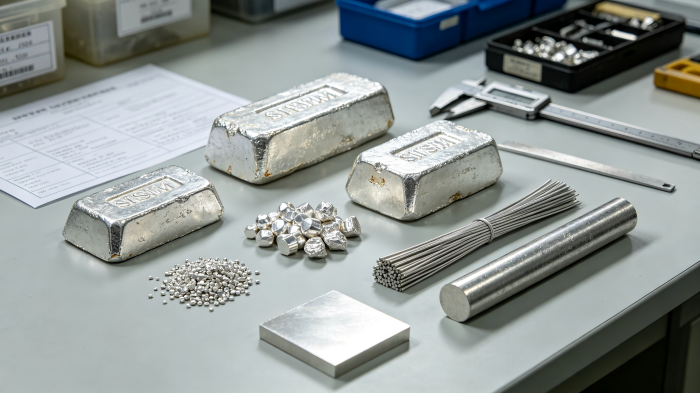
Tin ranks among the most widely deployed low-melting post-transition metals across global industries. It delivers exceptional corrosion resistance, solderability and alloy modification potential, so it fills irreplaceable roles in electronic soldering, protective plating, alloy manufacturing and float glass production.
This soft, silvery-white metal almost never serves as a standalone structural material. Instead, manufacturers integrate it into production chains primarily as plating or alloying elements, making it a foundational material for electronics manufacturing, precision machinery and new energy sectors.
This guide breaks down the elemental properties, core performance metrics, mainstream alloy systems and industrial use cases of tin metal. It also covers precision machining best practices to serve as a technical reference for engineering selection, material evaluation and manufacturing process design.
Table of Contents
- Basic Overview of Tin Metal
- Core Performance Parameters of Tin Metal
- Performance Comparison Between Tin and Common Metals
- Mainstream Tin Alloy Systems and Applications
- Key Industrial Applications of Tin Metal
- Advantages and Limitations of Tin Materials
- Precision Manufacturing Essentials for Tin
- Environmental Impact and Sustainability
- Frequently Asked Questions
1. Basic Overview of Tin Metal
1.1 Elemental Nature and Definition
Tin holds atomic number 50 on the periodic table and carries the chemical symbol Sn, taken from the Latin term stannum. It falls into the post-transition metal category. Pure tin has a soft, highly ductile texture and shows a silvery-white luster with a subtle bluish tint at room temperature.
To start, pure tin is an elemental metal, not an alloy. In everyday language, the word “tin” often describes tin-plated sheets, tin alloy goods and other tin-bearing materials. These materials differ greatly in performance and use cases from pure tin. Engineering teams must clearly separate them by purity, composition and product form during material selection.
Commercially refined tin typically reaches 99.85% to 99.99% purity for industrial use. Impurity levels directly shape its melting behavior, electrical conductivity and plating reliability. For high-stakes applications like electronics or medical components, manufacturers must provide full material composition certification.
1.2 Main Production Regions and Manufacturing Process
Most natural tin occurs as cassiterite, an ore made of tin dioxide. Primary mining regions sit across Asia, South America and Africa. Ore grade, refining capacity, recycling rates and downstream electronics demand all shape commercial tin supplies. These factors create moderate fluctuations in pricing and lead times.
Industrial tin production follows four core stages. First, operators enrich cassiterite ore through beneficiation. Next, they reduce tin oxide into crude tin via carbothermal reduction. Refining then removes unwanted impurities like iron, lead and arsenic. Finally, refiners cast pure tin into standard forms including ingots, bars, powders and anodes, or blend it directly into tin alloy raw materials.
2. Core Performance Parameters of Tin Metal
Tin delivers its industrial value through a unique set of properties: low melting point, strong corrosion resistance, excellent solderability and flexible alloying potential. At the same time, its low strength and creep tendency rule it out as a primary structural material.
2.1 Physical and Mechanical Properties
Pure tin has a density of roughly 7.31 g/cm³, a melting point of just 231.9°C and a boiling point near 2602°C. This makes it a classic low-melting fusible metal.
Its low melting point stands as one of its most valuable practical traits. For example, tin-based solders form reliable bonds well below the melting point of base materials, so they cause no thermal damage to delicate components.
Mechanically, pure tin sits on the soft end of the spectrum with low tensile strength but outstanding plasticity and ductility. Manufacturers can roll, stamp or form it into ultra-thin foils. Even so, pure tin can only handle limited loads and will deform or creep under high stress. For this reason, engineers usually choose tin alloys for structural component applications.
2.2 Chemical Properties and Corrosion Resistance
Tin maintains chemical stability at standard room temperature and pressure. A dense, passive tin oxide film forms naturally on its surface and blocks further attack from air and moisture. As a result, it holds up well against corrosion in atmospheric, freshwater and most mild chemical environments.
This property makes tin an excellent protective plating option for steel and copper parts. Classic tinplate — thin steel coated with tin — supports food-grade packaging by leveraging tin’s corrosion resistance.
Still, tin only offers finite corrosion protection. Strong acids, strong alkalis and certain industrial chemicals can break down the passive film and trigger corrosion failure. For harsh operating conditions, teams must run media compatibility tests before deployment.
2.3 Electrical Conductivity and Machinability
Tin offers moderate electrical conductivity. It cannot match high-performance conductors like copper or silver, but it works well enough for electronic connections and contact components.
Furthermore, tin plating delivers both oxidation resistance and better solderability. Manufacturers widely use it for surface treatment on electronic terminals and connectors.
For machinability, tin’s softness reduces required cutting forces, but pure tin creates notable processing challenges. It easily sticks to tools, deforms under clamping and produces tangled chips during cutting. These issues raise the difficulty of precision machining significantly.
By comparison, tin bronze and tin-based bearing alloys deliver far more stable cutting performance. They represent the mainstream choice for machining-focused applications.
2.4 Tin Whisker Risk in Electroplating Applications
Pure tin plating can spontaneously grow fine, hair-like metal single crystals called “tin whiskers” under certain stress conditions. These whiskers can stretch several millimeters long and bridge adjacent circuits in high-density electronic assemblies.
This creates short-circuit risks that pose a major concern for high-reliability sectors like aerospace, automotive electronics and industrial control.
The industry uses several standard mitigation strategies. Teams can swap pure tin for tin alloy plating, tune electroplating parameters, add annealing steps, apply barrier layers or design wider electrical clearances. For high-reliability products, engineers must define the plating’s tin whisker risk level and document corresponding control plans before production.
3. Performance Comparison Between Tin and Common Metals
Tin occupies a clear performance niche as a soft, low-melting, highly solderable material that complements common structural metals. The table below contrasts tin with copper, lead, aluminum and zinc across core metrics to support informed material selection.
| Metal Type | Core Features | Typical Applications | Key Difference from Tin |
|---|---|---|---|
| Copper | High electrical and thermal conductivity, moderate strength | Busbars, heat sinks, copper alloys | Much more conductive than tin; often used as a base material protected by tin plating |
| Lead | High density, soft texture, low melting point | Traditional solders, radiation shielding | Subject to toxicity regulations; tin is the core substitute in lead-free solder systems |
| Aluminum | Lightweight, high specific strength, easily oxidized | Structural housings, heat sinks, lightweight parts | Used as main structural material; tin mostly serves as functional surface plating |
| Zinc | Good corrosion resistance, excellent die-casting performance | Steel galvanizing, die castings, zinc alloys | Works mainly via sacrificial anode protection; tin plating leans toward functional protection |
4. Mainstream Tin Alloy Systems and Applications
Pure tin carries notable performance limitations, so industrial applications mostly use it in alloy form. Engineers blend tin with copper, antimony, bismuth, silver and other elements to boost hardness, strength, wear resistance and high-temperature stability. This alloying flexibility greatly expands tin’s usable application range.
4.1 Tin Bronze
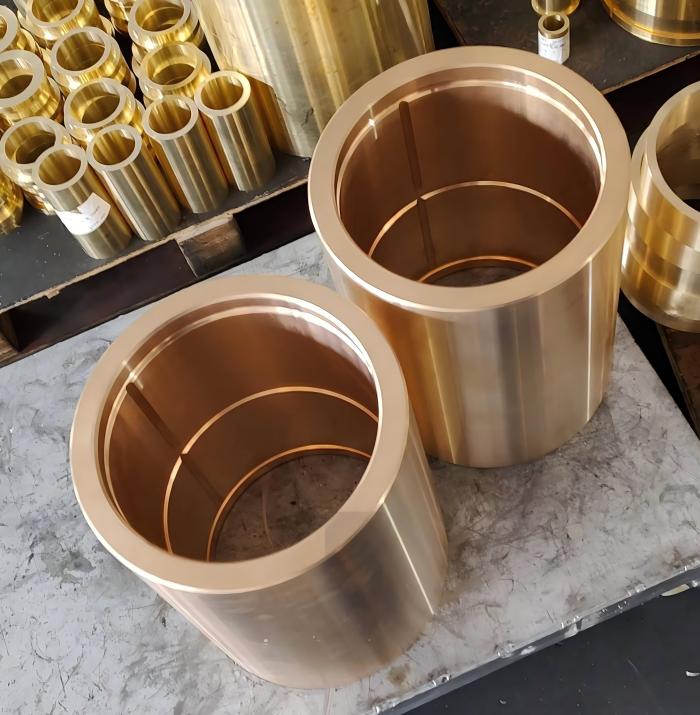
Tin bronze is a copper-based alloy that uses copper as its base and tin as its primary alloying element. It stands as the most widely used tin alloy family.
Adding tin delivers meaningful gains in copper’s hardness, wear resistance and corrosion resistance. It also preserves strong castability and machinability.
Manufacturers use tin bronze extensively to make bushings, bearings, gears, marine hardware and wear-resistant liners. It excels in heavy-load, low-speed and corrosive operating environments. This makes it a core wear-resistant material for precision machinery and marine engineering sectors.
4.2 Tin-Based Solder Alloys
Solder production accounts for the largest share of global tin consumption. Traditional tin-lead solders offer low melting points, strong wettability and proven reliability.
Today, however, environmental regulations limit lead use. Most modern systems use lead-free solder formulas built around tin, blended with silver, copper, bismuth or antimony to fine-tune melting behavior and mechanical strength.
Each solder composition matches specific soldering processes and reliability targets. When selecting solders for electronics manufacturing, teams must weigh multiple factors together. These include melting temperature range, joint strength, thermal fatigue resistance and compatibility with component surface finishes.
4.3 Pewter Alloys
Pewter centers on tin and includes small additions of antimony, copper and bismuth. It stands out for its high luster, smooth castability and low melting point.
Historically, craftspeople used it mainly for tableware, vessels and decorative goods. Today, lead-free pewter appears in art pieces, jewelry, precision castings and ornamental components.
Pewter offers only modest mechanical strength. It works best for low-stress parts where appearance and formability take priority. Designers should not specify it for load-bearing structural applications.
4.4 Tin-Based Bearing Alloys
Tin-based bearing alloys — or tin-based Babbitt metals — use tin as their base and blend in antimony, copper and other elements. This creates a microstructure with dispersed hard phases.
The material delivers a low friction coefficient, excellent conformability and strong anti-seizure properties. These traits make it a classic choice for sliding bearing systems.
These alloys remain relatively soft on their own. Manufacturers typically cast them as bearing linings on steel backing shells. They effectively reduce shaft wear and work well in medium-speed, medium-heavy load power machinery setups.
4.5 Special Low-Melting Tin Alloys
Material scientists combine tin with bismuth, cadmium, indium and other elements to create alloys that melt below 100°C. These specialized formulas serve niche use cases including thermal fuses, fire safety thermal triggers, precision casting wax patterns and temperature-activated control devices.
Engineers can precisely tune the melting point of these alloys by adjusting their chemical makeup. They fall into the custom specialty material category. To select the right formula, teams must define exact working temperature thresholds and mechanical load requirements upfront.
5. Key Industrial Applications of Tin Metal
Industries deploy tin to leverage its core functional properties, with use cases spanning electronics, packaging, automotive, glass and new energy sectors. The most prominent applications are outlined below.
5.1 Electronics & Soldering
Tin-based solder acts as the core joining material for electronics manufacturing. It supports consumer electronics, automotive electronics, industrial control, aerospace and more by creating both mechanical and electrical bonds between components and circuit boards. It remains an irreplaceable foundational material for the entire electronics industry.
5.2 Protective Coatings & Packaging
Tin plating delivers three key benefits: corrosion protection, improved solderability and enhanced electrical contact performance. Manufacturers apply it widely to steel, copper and electronic terminal parts. Food-grade tin-plated steel (tinplate) still stands as one of the primary solutions for food cans and beverage packaging.
5.3 Automotive & Mechanical Engineering
In the automotive sector, tin enables on-board electronic systems through solder formulations. It also boosts corrosion resistance for terminals and fasteners when applied as plating.
In mechanical form, tin bronze and bearing alloys create wear-resistant moving parts. Together, these uses cover electronics, fastening and mechanical friction pair applications.
5.4 Float Glass Manufacturing
The float glass process depends on the flat, stable surface of molten tin at high temperatures. Molten glass spreads and solidifies on top of the molten tin bath to produce perfectly flat glass sheets. This method serves as the standard production process for architectural, automotive and display glass products.
5.5 New Energy & Advanced Materials
Photovoltaic panels, energy storage batteries and power electronics all rely heavily on tin-based solders for reliable connections. Meanwhile, tin compounds like tin oxide play important roles in transparent conductive coatings, optical films and catalytic materials. This makes tin a supporting material for new energy and optoelectronic industries.
5.6 Chemical & Specialty Uses
Tin compounds work as catalysts, heat stabilizers and flame retardants in the chemical industry. They also find targeted applications in medical and optical fields. Different tin chemical forms vary widely in performance and safety profiles, so each use case requires separate, targeted evaluation.
6. Advantages and Limitations of Tin Materials
Tin’s material profile comes with very clear strengths and drawbacks. For engineering applications, teams must play to its strengths and avoid scenarios where its limitations would cause failure.
6.1 Core Advantages
- Strong corrosion resistance: forms a stable passive film at room temperature that effectively protects base metals in most mild operating environments
- Exceptional solderability: combines low melting point with excellent wettability to serve as the core material for electronic soldering
- High formability: offers outstanding plasticity for rolling, casting and plating, and adapts well to diverse manufacturing processes
- Flexible alloy modification: blends easily with multiple metals to targeted improve hardness, wear resistance, melting point and other key properties
- Food-safe surface: food-grade tin plating meets global packaging safety standards and supports direct contact with edible products
6.2 Application Limitations
- Low structural strength: pure tin stays soft and creep-prone, and cannot function alone as a load-bearing structural component
- Low temperature ceiling: a 231.9°C melting point limits high-temperature use; softening and failure occur readily at elevated heat
- Tin whisker risk: pure tin plating carries short-circuit hazards in high-density electronics and requires extra process controls
- Supply and cost volatility: concentrated mineral reserves and global supply chain shifts create less price stability than common structural metals
7. Precision Manufacturing Essentials for Tin
Precision manufacturing with tin and tin alloys spans machining, cutting and surface treatment steps. Process engineers must optimize parameters to account for the material’s soft texture and low melting point.
7.1 Feasibility of CNC Machining
Shops can run CNC machining on pure tin, but the material’s extreme softness creates common issues. These include tool sticking, workpiece deformation and inconsistent dimensional accuracy.
Successful setups require sharp tools, shallow cut depths, stable fixturing and low-temperature cutting strategies. These extra steps make pure tin machining relatively cost-inefficient.
For most industrial applications, shops perform precision machining on tin bronze, tin-based bearing alloys and similar materials. These alloys deliver far more stable cutting behavior. They can produce bushings, bearing shells, connectors and other parts with tight tolerances and premium surface finishes.
7.2 Applicability of Laser Cutting
Laser cutting works for thin tin stock, but the material’s low melting point and high reflectivity demand tight process control. Wrong parameters quickly lead to excessive melting, edge deformation and slag buildup.
For this reason, teams should always run preliminary process validation before full production.
For high-volume precision part production, teams should compare multiple fabrication methods. These include laser cutting, stamping, waterjet cutting and chemical etching. The final choice should factor in material thickness, tolerance needs and batch size to pick the most cost-effective option.
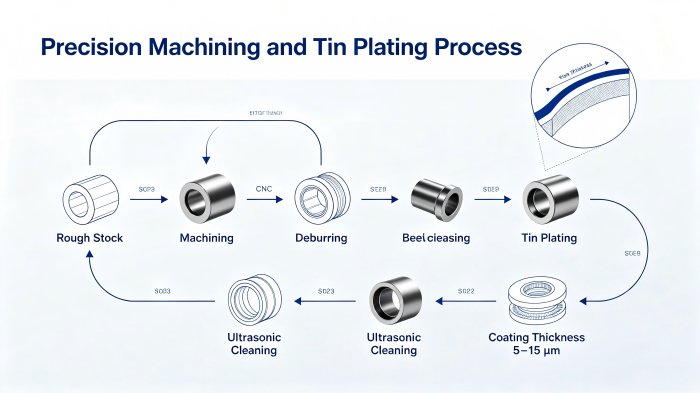
7.3 Tin Plating Process for Precision Parts
Tin plating ranks as a mainstream surface treatment for precision metal parts. It boosts solderability, corrosion resistance and electrical contact performance.
High-quality plating demands strict control over pretreatment, coating thickness, adhesion and porosity. Without this control, plating peeling and protection failure become common failure modes.
For tight-tolerance parts, designers must build in plating thickness margins at the design stage. This prevents dimensional over-tolerance once the plating is applied. For high-reliability use cases, teams must also add tin whisker risk assessment and control procedures.
8. Environmental Impact and Sustainability
Tin’s full life-cycle environmental impact requires evaluation across three core stages: mining, production and recycling. Across the industry, the trend shifts steadily toward responsible procurement and circular material use.
8.1 Mining and Production Footprint
Unregulated tin mining and smelting can damage land, water systems and local ecosystems around mining areas. Compliant producers reduce environmental loads through tailings treatment, wastewater recycling and controlled emissions.
Downstream manufacturers can lower their own environmental and compliance risks through supply chain traceability and certified material sourcing.
8.2 Recycling and Circular Economy
Tin supports high recyclability. Refiners can recover and reuse tin from waste solder, tin-plated steel, electronic scrap and industrial offcuts.
Recycled tin matches the elemental performance of primary tin with no meaningful loss of quality. Promoting sorted waste collection and closed-loop tin recycling reduces reliance on virgin resources and improves overall sustainability.
8.3 Responsible Industrial Use
Responsible industrial tin use follows several core principles. Teams should only specify tin where its properties deliver clear functional value. They should also optimize plating thickness to cut material waste and control use and emissions of tin-bearing chemicals. These steps reduce environmental impact across the entire value chain.
9. Frequently Asked Questions
What are the five main industrial uses of tin?
Tin’s five leading industrial applications fall into clear categories. These are tin-based solders for electronics, tin plating for steel corrosion protection, wear-resistant alloys like tin bronze, float glass manufacturing processes and tin-plated steel for food packaging.
Beyond these, tin also plays important roles in bearing alloys, optical coatings, new energy interconnections and chemical catalysts.
Why do we rarely hear about “tin products” nowadays?
Tin has not fallen out of use — pure tin consumer products have simply become less common, and most tin applications now sit deeper in the industrial supply chain.
For example, most household “tin foil” today is actually aluminum foil, and other materials have replaced pure tin tableware and vessels. Even so, tin consumption continues to grow steadily in core industrial sectors like electronic soldering, plating and alloy production. It remains an irreplaceable key material for modern manufacturing.
Is tin a high-performance metal?
Tin excels as a functional metal thanks to its corrosion resistance, solderability, low melting point and alloy modification capabilities. At the same time, it delivers low structural strength and poor high-temperature performance, so it does not work well as a load-bearing metal.
Any assessment of tin must tie to specific use cases. For functional plating, soldering and alloy tuning, tin delivers performance that no other material can easily match.
Are tin and aluminum the same material?
No, they are entirely separate chemical elements. Tin carries the symbol Sn and atomic number 50, with high density, soft texture and a low melting point.
Aluminum uses the symbol Al and atomic number 13; it is lightweight with high specific strength and serves as a mainstream structural metal. Most everyday “tin foil” is actually aluminum foil — the name is simply a holdover from historical terminology.
Conclusion
Tin stands as a classic “function-first” industrial metal. It does not lead in structural strength, but its corrosion resistance, solderability and strong alloying potential embed it deeply in core supply chains. These include electronics, automotive, glass and new energy industries.
From tiny electronic solder joints to full-scale float glass production lines, tin’s unique properties deliver irreplaceable value in their targeted applications.
For engineering material selection, teams must understand the performance gaps between pure tin and tin alloys. They should match material form and composition to specific operating conditions and account for processing requirements, risk controls and compliance rules. Following this approach helps teams unlock the full functional value of tin-based materials.
PartsMastery delivers precision CNC machining services for custom engineered components. If your project involves tin bronze, tin-based bearing alloys, tin-plated precision parts, functional prototypes or low-volume custom production, our engineering team can support you end to end. We offer full-cycle manufacturing solutions covering material evaluation, machining feasibility analysis, tolerance control and scaled production rollout.