






Mould Manufacturers

In the vast ecosystem of global manufacturing, mould manufacturers occupy a position of extraordinary significance. Every plastic component that surrounds us—from the dashboard of an automobile to the casing of a smartphone, from medical syringes to household appliance housings—owes its existence to a precision-crafted mould. Behind each seamless curve and perfectly replicated feature lies the meticulous work of skilled mould manufacturers, toolmakers, and engineers. As industries continue to demand higher precision, faster production cycles, and more complex geometries, the role of mould manufacturers has never been more critical.
The Scale of the Mould Manufacturing Industry
The global industrial mold market has demonstrated remarkable growth in recent years. According to industry data, the market was valued at approximately $59 billion in 2025 and is anticipated to reach $64.46 billion in 2026, with projections suggesting a compound annual growth rate (CAGR) of 9.25% that could drive the market to $130.81 billion by 2034. Other estimates indicate that the industrial mold market grew from $54.04 billion in 2025 to $57.41 billion in 2026, with strong growth expected to continue through 2030 at a CAGR of 7.1%. This expansion is driven by multiple factors, including the continued growth of plastic manufacturing, rising automotive production, and increasing demand for mass-produced components across virtually every industrial sector.
The manufacturing and production industries themselves are growing robustly. In 2023 alone, global industrial value-added increased by 2.4 percent, with manufacturing output rising by 2.8 percent year-over-year, creating sustained demand for industrial molds that serve as essential tools enabling cost-effective, precise, and scalable production.
Understanding Mould Types and Their Applications
Not all moulds are created equal. Mould manufacturers produce different types of tools corresponding to the specific manufacturing processes they support. The five primary moulding processes each demand distinct tooling characteristics.
Injection Molds are the most common and complex type. These precision-built tools operate by injecting molten plastic under high pressure into a two-part metal mold. The molds themselves are highly sophisticated and expensive to create, but they can produce millions of identical parts with extreme precision. Injection molding forms the backbone of mass production for solid components such as electronic enclosures, automotive interior parts, medical devices, and consumer goods ranging from LEGO bricks to power tool housings.
Blow Molds serve a fundamentally different purpose. Rather than producing solid parts, blow molding creates hollow objects. The process begins with a hollow tube of molten plastic called a parison, which is inflated inside a mold cavity using compressed air. This method is used almost exclusively for manufacturing thin-walled, hollow items such as water bottles, milk jugs, automotive fuel tanks, and industrial chemical drums.
Compression Molds operate on a simpler principle. A pre-measured amount of molding material is placed directly into a heated, open mold cavity. The mold is then closed, and pressure is applied to force the material to fill the cavity and cure. Compression molds are typically simpler and more robust than injection molds, making them excellent for producing high-strength thermoset plastic components such as electrical parts, automotive under-hood components, and durable composite dinnerware.
Rotational Molds offer unique capabilities for large, hollow forms. The process involves placing plastic powder into a hollow mold, which is then heated and slowly rotated on two axes. The melting plastic tumbles and coats the interior walls evenly. Rotational molds can be very large but are relatively low-cost compared to injection molds because they do not need to withstand high pressure. This method is ideal for creating large, seamless, stress-free hollow parts such as kayaks, large water tanks, playground equipment, and industrial containers.
Extrusion Molds differ fundamentally from all other types. Instead of producing discrete parts, extrusion creates continuous linear shapes. Molten plastic is forced through a shaped die, emerging as a long profile that is then cooled and cut to length. Extrusion is ideal for products with consistent cross-sections, including pipes, window frames, plastic decking, and drinking straws.
The Technical Craft of Mould Manufacturing
The process of manufacturing a high-quality mould is a journey that transforms a digital concept into a physical precision tool capable of running for millions of cycles. Skilled mould manufacturers follow a rigorous sequence of steps.
Design and Tool Planning begin long before any metal is cut. Tooling engineers develop detailed 3D CAD models of the mold, splitting the part geometry into core and cavity components. Critical decisions at this stage include determining parting lines, shutoffs, draft angles, gate locations, and the number of cavities the tool will contain. The cooling channel layout is designed for optimal thermal management, and any features requiring sliders or lifters are identified.
材料选择 profoundly influences mold performance and lifespan. For high-volume production applications, hardened tool steels are the industry standard. P20 steel serves as a general-purpose, pre-hardened material suitable for moderate production runs. H13 steel offers excellent wear resistance and thermal fatigue strength, making it ideal for demanding applications involving abrasive materials or high temperatures. For optical or cosmetic parts requiring mirror-like surface finishes, stainless tool steels such as S136 are commonly specified.
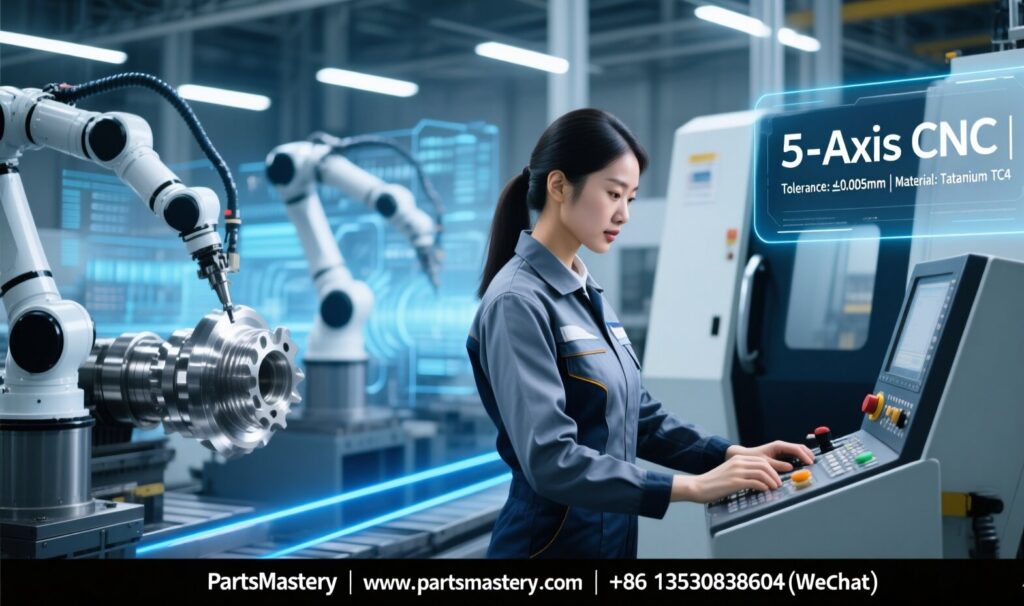
精密加工 brings the digital design into physical reality. This stage relies heavily on advanced CNC machining technologies. Five-axis CNC machining has revolutionized mould manufacturing by enabling the creation of complex geometries with exceptional precision. Unlike traditional three-axis machines, five-axis systems can move the cutting tool along five different axes simultaneously, allowing mould manufacturers to machine undercuts, complex curves, and fine details that were previously difficult or impossible to achieve. This capability reduces production time by eliminating multiple setups while improving surface finish.
Electrical Discharge Machining serves a complementary role. EDM uses electrical discharges to remove material from the workpiece, making it particularly valuable for machining hard materials and creating intricate shapes that CNC tools cannot reach—sharp internal corners, thin walls, deep ribs, fine logos, and complex internal features. One key advantage of EDM is its ability to machine materials that are difficult to cut using conventional methods, all without direct contact between the tool and workpiece, which reduces the risk of damage during machining.
Finishing, Assembly, and Validation complete the process. After machining, mould components are meticulously finished and polished. The surface texture of the mold directly translates to the final part, so finishing ranges from standard machine finishes to mirror-like optical polishes. The core, cavity, ejector pins, sliders, and cooling lines are then carefully assembled. The completed mold undergoes its first trial run, known as T1, where sample parts are measured and inspected against original design specifications. Based on trial results, the mold may be disassembled for adjustments—a process called tuning or spotting—before final approval for production.
Industry Trends Shaping Mould Manufacturing
Several major trends are reshaping the mould manufacturing landscape. The rapid expansion of electric vehicle production is significantly amplifying demand for specialized industrial molds. Each EV battery enclosure requires large-scale aluminum die-casting molds capable of withstanding high pressures and thermal cycles. Electric vehicles generally require more molded components for insulation, battery housings, and interior assemblies, accelerating investment in high-tonnage molding machines and multi-material mold designs.
The medical technology sector’s push toward minimally invasive devices and disposable diagnostics is fueling demand for micro-molding and ultra-precision industrial molds. Extremely tight tolerances are required in micro-molding applications, and the European Commission’s Medical Device Regulation mandates batch traceability, prompting mold makers to integrate RFID tags and cavity identification systems directly into tooling.
Sustainability considerations are increasingly influencing mould manufacturing. The industry is transitioning from hydraulic to all-electric injection molding machines, which offer superior energy efficiency and considerably lower carbon footprints. Closed-loop material recycling and energy-efficient mold cooling systems are gaining traction as manufacturers seek to minimize carbon emissions and resource consumption.
Smart manufacturing systems are driving demand for molds integrated with sensors and IoT-enabled monitoring capabilities. The adoption of smart, sensor-enabled molds is increasing, particularly in Europe. Digital twin simulations further accelerate mold validation by replicating production scenarios and optimizing tool design before physical fabrication, reducing trial iterations and time to market.
Selecting the Right Mould Manufacturer
For businesses seeking mould manufacturing partners, several factors warrant careful consideration. The complexity of modern molds has escalated with advancements in micro-machining and multi-cavity configurations, making technical capability a primary selection criterion. Mould manufacturers must demonstrate proficiency in advanced CAD/CAM systems, CNC programming, and mold flow analysis to deliver tools that perform reliably at scale.
Production volume expectations should guide material and design decisions. Aluminum molds are suitable for prototyping and low-volume production, typically under 10,000 parts, offering faster and more economical machining but limited longevity. Hardened tool steel molds represent a significant upfront investment but deliver exceptionally low per-part costs at scale, capable of producing millions of cycles before requiring maintenance.
The mould manufacturing industry stands as a testament to precision engineering and industrial capability. From the smallest medical component to the largest automotive panel, moulds enable the mass production that defines modern life. As technologies continue to advance and industries evolve, skilled mould manufacturers will remain essential partners in turning concepts into reality.
For more information about mould manufacturing solutions, please contact PartsMastery.
*📞 +86 13530838604 (WeChat)*