








What to Expect from a Professional Custom Injection Mold Maker
Every mass-produced plastic product begins as a concept, then a CAD file, and finally—a mold. But not all molds are created equal. When you partner with a skilled custom injection mold maker, you gain more than just a tool; you gain an engineering partner who optimizes your design for manufacturability, cycle speed, and long-term durability. At PartsMastery, we have spent years perfecting the art and science of custom tooling. This guide explains what separates a true custom mold specialist from a generic supplier.
Why “Custom” Matters More Than You Think
Off-the-shelf molds do not exist in injection molding. Every product—whether a medical device housing, an automotive clip, or a kitchen appliance knob—requires a unique cavity shape. A custom injection mold maker designs and machines that cavity from solid steel or aluminum based entirely on your 3D model.
However, a truly custom approach goes far beyond copying your geometry. It involves:
-
Draft angle analysis: Ensuring parts release cleanly.
-
Gate location optimization: Placing the entry point where it minimizes visible marks.
-
Cooling channel design: Tailoring water lines to the specific hot spots of your part.
-
Ejection system layout: Positioning pins to push without damaging features.
Without these custom engineering touches, even a geometrically perfect mold will produce defective parts.
The Custom Mold Workflow: From CAD to First Shot
A professional custom injection mold maker follows a structured, transparent process. Here is what you should expect:
Step 1: Part Design Review (DFM)
Your 3D file (STEP, IGES, or X_T) undergoes a Design for Manufacturability analysis. The mold maker checks for uniform wall thickness, sharp corners (stress risers), undercuts, and draft angles. A DFM report is then issued with recommended changes.
Step 2: Mold Flow Simulation
Before any steel is cut, the mold is virtually tested. Simulation software predicts how molten plastic will fill the cavity. It identifies weld lines, air traps, and pressure drop areas. A quality custom injection mold maker will not proceed without this step.
Step 3: Steel Selection & Cutting
Based on your production volume, the appropriate steel grade is chosen (e.g., P20 for moderate volumes, H13 for high-volume, S136 for optical parts). CNC machining centers then rough-cut and finish-cut the mold base, cavities, and cores.
Step 4: Heat Treatment & Surface Finishing
Hardened steels undergo vacuum heat treatment to achieve target hardness (typically 48-52 HRC). The cavities are then polished to the specified finish—from a standard #2 stone finish to a mirror-like SPI A-1 diamond polish.
Step 5: Fitting & Assembly
Ejector pins, return pins, guide pillars, and bushings are fitted. If the mold includes a hot runner system, the manifolds and valve gates are installed and leak-tested.
Step 6: Sampling (Trial Shot)
The completed mold is mounted on an injection molding machine. Sample parts are produced, measured, and compared to the original CAD. Adjustments are made if dimensions fall outside tolerance.
Step 7: CMM Inspection & Shipment
A final Coordinate Measuring Machine (CMM) report confirms every critical dimension. The mold is then cleaned, rust-protected, and crated for shipping.
The Steel Decision: What Volume Dictates
One of the first questions a custom injection mold maker will ask is: “What is your expected annual volume?” The answer determines the steel grade:
-
Prototype / Low Volume (under 5,000 parts): Aluminum or pre-hardened P20. Lower cost, faster machining, but limited lifespan.
-
Medium Volume (50,000 to 500,000 parts): Pre-hardened P20 or 718 steel. Good balance of cost and durability.
-
High Volume (500,000 to 2 million+ parts): Hardened H13, S136, or 420 stainless. These withstand millions of cycles without wear.
-
Extreme Volume (5 million+ cycles): Hardened steel with wear-resistant coatings (TiN, CrN, or DLC).
An honest custom injection mold maker will never sell you hardened steel if aluminum will suffice. Conversely, they will refuse to build a low-cost mold that would fail under your actual production demands.
Tolerances: How Precise Can Custom Molds Be?
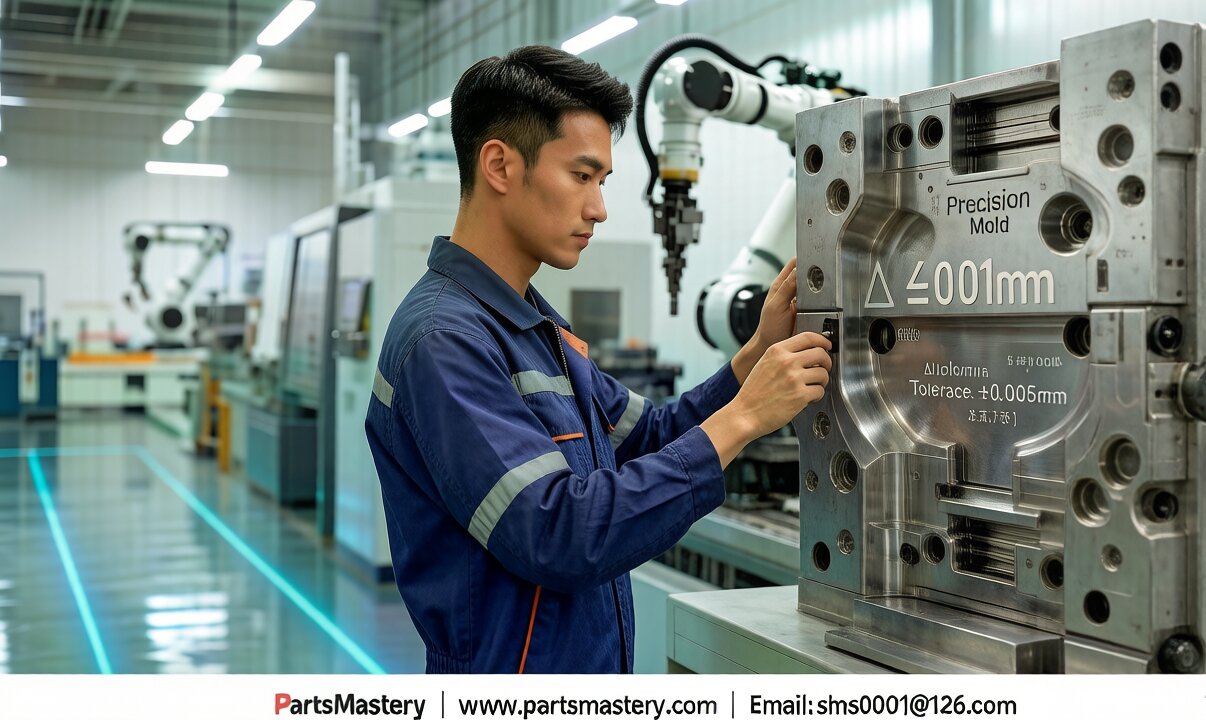
Precision is the hallmark of a skilled custom injection mold maker. Standard machining tolerances are ±0.05mm. High-precision work achieves ±0.01mm to ±0.005mm. For context, a human hair is roughly 0.07mm thick.
What requires such tight tolerances?
-
Medical device components (syringe barrels, inhalers).
-
Gear and moving mechanical parts.
-
Connector housings for electronics.
-
Lens and optical components.
If your project demands sub-0.01mm accuracy, confirm that the mold maker uses CMM verification and has experience with micro-molding or high-precision tooling. At PartsMastery, we regularly hold tolerances of ±0.008mm on critical features.
Hot Runners vs. Cold Runners in Custom Tooling
Every custom mold must incorporate a runner system—the channels that guide plastic from the nozzle to the cavities. Your custom injection mold maker will help you choose between two architectures:
Cold Runner:
-
Simpler and less expensive to machine.
-
Generates waste (sprue and runner) that must be reground or discarded.
-
Suitable for low volumes or heat-sensitive materials (PVC, some bioplastics).
Hot Runner:
-
Uses heated nozzles and manifolds to keep plastic molten.
-
Produces zero runner waste, saving 15-30% on material costs.
-
Faster cycle times due to reduced cooling requirements.
-
Higher upfront investment (adds $3,000 to $15,000+ depending on cavity count).
For production runs exceeding 100,000 parts per year, a hot runner system typically pays for itself within six months. A good custom injection mold maker will calculate your break-even point before recommending either option.
Undercuts and Side Actions: Complex Features Made Simple
Many plastic parts include undercuts—features like side holes, clips, or threads that cannot be molded with a straight pull of the mold halves. A skilled custom injection mold maker solves this with:
-
Side cores (sliders): Mechanical inserts that move perpendicular to the mold opening.
-
Lifters: Angled pins that release internal undercuts.
-
Unscrewing mechanisms: Geared or hydraulic systems that rotate threaded cores out of molded caps or closures.
Each of these adds complexity and cost, but they are essential for functional parts. At PartsMastery, we specialize in complex tooling with up to 12 independent sliders or unscrewing racks.
Surface Finish Options for Custom Molds
The finish of your molded part is determined by the finish inside the steel cavity. A professional custom injection mold maker offers a range of SPI (Society of the Plastics Industry) finishes:
-
SPI A-1 (Mirror): Diamond-polished for optical lenses, clear covers, and high-gloss ABS.
-
SPI B-1 (Fine satin): Stone-finished for textured consumer electronics.
-
SPI C-1 (Medium satin): Paper-finished for general-purpose housings.
-
SPI D-1 (Coarse matte): Dry-blasted for hidden structural parts.
-
Chemical etching: Custom leather, wood grain, or geometric patterns (requires specialized EDM or acid etching).
If you need a specific texture (e.g., VDI 3400 or Mold-Tech standards), confirm that the mold maker has the necessary electrodes or etching partners.
Why Maintenance Kits Matter
A custom injection mold is an asset that should last for years. Responsible custom injection mold maker provides a maintenance kit with every tool. This kit typically includes:
-
Spare ejector pins (2-4 of each size).
-
Spare core pins and sleeves.
-
Extra guide bushings and return pins.
-
O-rings and seals for hot runner systems.
-
A detailed lubrication and cleaning schedule.
Without these spares, a single broken ejector pin can shut down your production line for days while you wait for replacements.
The PartsMastery Difference
As a dedicated custom injection mold maker, PartsMastery combines advanced machining infrastructure with responsive, transparent service. Our facility includes:
-
5-axis CNC machining for complex 3D contours.
-
EDM sinkers and wire EDM for sharp internal corners.
-
8 injection molding machines (90 to 1,300 tons) for in-house sampling.
-
CMM and optical measurement for 100% critical dimension verification.
-
ISO 9001:2025 certified quality system.
We build molds for automotive, medical, consumer goods, electronics, and industrial applications. Whether you need a single cavity prototype mold or a 32-cavity high-production hot runner system, we deliver on time and on spec.
Ready to Build Your Custom Mold?
Do not settle for generic tooling that compromises your product quality. Partner with a custom injection mold maker who treats your project as if it were their own.
Contact PartsMastery Today:
-
Phone / WeChat: +86 13530838604
-
Brand: PartsMastery
-
Website: www.partsmastery.com
Send us your 3D file for a free DFM analysis and Mold Flow simulation. Let us turn your concept into a production-ready reality.